
Navigating the real-time fluctuations of the foreign exchange (FX) market can feel like staring at an encrypted code of volatile charts and dense technical data. Yet, the core principles governing these shifts are remarkably logical. The exchange rate between two currencies is far more than a simple price tag—it acts as a dynamic economic counterweight, continuously balancing global capital flows with a country’s underlying economic vitality.
For decades, exchange rates around 1,100 KRW per USD felt like the established baseline. Recently, however, markets witnessed unprecedented moves, with the South Korean Won soaring past 1,400 KRW and touching a historic peak of 1,552 KRW on July 1, 2026.
This spike leaves American and foreign investors asking a fundamental question: If South Korea is a wealthy, advanced industrial power, why is its currency so weak—and what does this mean for U.S. capital deployed in Korean assets?
Here is a breakdown of the structural shifts behind the Korean Won, the forces driving high exchange rate regimes, and strategic ways U.S. investors can position their portfolios.
1. Key Financial Terminology
- USD/KRW Exchange Rate: The conversion ratio between the U.S. Dollar and the South Korean Won. An increase in the USD/KRW rate means the Won is depreciating against the Dollar (a weaker Won), while a decrease signifies Won appreciation (a stronger Won).
- Strong Dollar / King Dollar: A macroeconomic environment where the U.S. Dollar appreciates significantly against major world currencies, fueled by high Federal Reserve interest rates and robust relative U.S. economic growth.
- Floating Exchange Rate System: A framework where currency values are determined entirely by market supply and demand without direct government price-fixing. South Korea fully adopted this regime following the 1997 Asian Financial Crisis.
- Foreign Direct Investment (FDI): Long-term investments made by domestic or cross-border companies to establish local operations, build facilities, or acquire business stakes. A primary modern example is the massive buildup of U.S.-based manufacturing plants by major Korean conglomerates.
- FX Hedging: Financial strategies used to reduce exposure to currency fluctuations, effectively locking in exchange rates to protect investment returns from unexpected FX shifts.
2. Historical Paradigm Shifts in Korea’s FX Structure
South Korea’s foreign exchange market has transitioned through three distinct historical phases. Understanding these structural changes explains why the “normal” baseline for the Won has moved permanently higher.
Historical Evolution of the USD/KRW Framework
| Category | Past Era (Pre-1990s ~ Pre-IMF Crisis) | Recent Structure (2020s ~ 2026) |
| Exchange Rate System | Government-Managed / Market-Average Exchange Rate System (700–800 KRW range) | Free-Floating Exchange Rate System (1,300–1,400 KRW range New Normal) |
| Dollar Inflows & Outflows | Dollars earned through exports accumulated in domestic banks. | Trade surplus Dollars are recycled abroad via domestic retail investors (“Seohak Ant”) & corporate FDI. |
| External Asset Structure | Net Debtor Nation with high external debt (Highly vulnerable to FX crises). | Net External Creditor Nation (Overseas assets exceed foreign debt). |
Anatomy of the 1,550 KRW Spike and Subsequent Stabilization
The extreme volatility seen in mid-2026—where the Won briefly spiked to 1,552 KRW before stabilizing near 1,410 KRW—was driven by market mechanics and temporary liquidity imbalances rather than a collapse in Korea’s core economic fundamentals.
HTML
FX Market Volatility Flow: 2026 Case Study
1. The Surge (Up to 1,552 KRW): Synchronized spikes in U.S. and Japanese bond yields ➜ Geopolitical risks in the Middle East ➜ Foreign institutional equity sell-offs in Seoul ➜ Exporters hoarding Dollars (“Dollar Holding”) in anticipation of higher rates ➜ Extreme market overshooting.
2. The Normalization (Down to ~1,410 KRW): Joint verbal intervention by U.S., Korean, and Japanese FX authorities ➜ Coordinated liquidity stabilization measures ➜ Federal Reserve rate easing expectations ➜ Resumed corporate Dollar conversions ➜ Receding panic premiums.
3. Core Drivers of the Modern Exchange Rate Environment
| Component | English Term | Key Description & Characteristics |
| Dominance of U.S. Capital | U.S. Capital Monopoly | Absorption of global capital into U.S. markets led by AI and Big Tech. |
| Structural Capital Outflows | Outflow of Domestic Capital | U.S. stock purchases by domestic retail investors (“Seohak Ant”) and corporate investment in new U.S. manufacturing plants. |
| Purchasing Power Parity Gap | Purchasing Power Gap | Reflects the cumulative inflation differential between South Korea and the U.S. accumulated over the past several decades. |
| FX Liquidity Defense | Strong Net Foreign Assets | Shields against sovereign default risk through ample foreign exchange reserves and net creditor status. |
4. International Context: Is a Weak Currency in a Strong Economy Normal?
American investors often assume that a trade surplus and strong industrial exports naturally lead to a stronger local currency. However, in an era dominated by U.S. financial market dominance, the correlation between export strength and currency value has decoupled. This trend is visible across major global export hubs:
Global Decoupling Examples
- Japan (The Ultra-Weak Yen Phenomenon):
- Context: Japan remains the world’s top net foreign asset holder, boasting massive overseas wealth and strong manufacturing performance. Yet, the Japanese Yen (JPY) experienced multi-decade lows against the Dollar.
- Cause: A massive capital drain driven by domestic Japanese retail and institutional investors moving capital into higher-yielding U.S. Treasuries and equities, alongside stark interest rate differentials.
- Germany & The Eurozone (Strong Manufacturing, Soft Currency):
- Context: Germany stands as Europe’s premier industrial and trade powerhouse, yet the Euro regularly struggles to maintain sustained strength against the U.S. Dollar.
- Cause: Slower domestic GDP growth across the European continent relative to the U.S., alongside institutional capital fleeing lower yields in Europe to seek out performance in Wall Street tech majors.
- China (Record Trade Surpluses, Persistent Yuan Pressure):
- Context: China generates the largest manufacturing trade surpluses globally, yet the Chinese Yuan (CNY) faces ongoing structural depreciation pressures.
- Cause: Cooling domestic economic real estate sectors, outbound Foreign Direct Investment, and domestic corporate preference for holding U.S. Dollar assets rather than repatriating revenues.
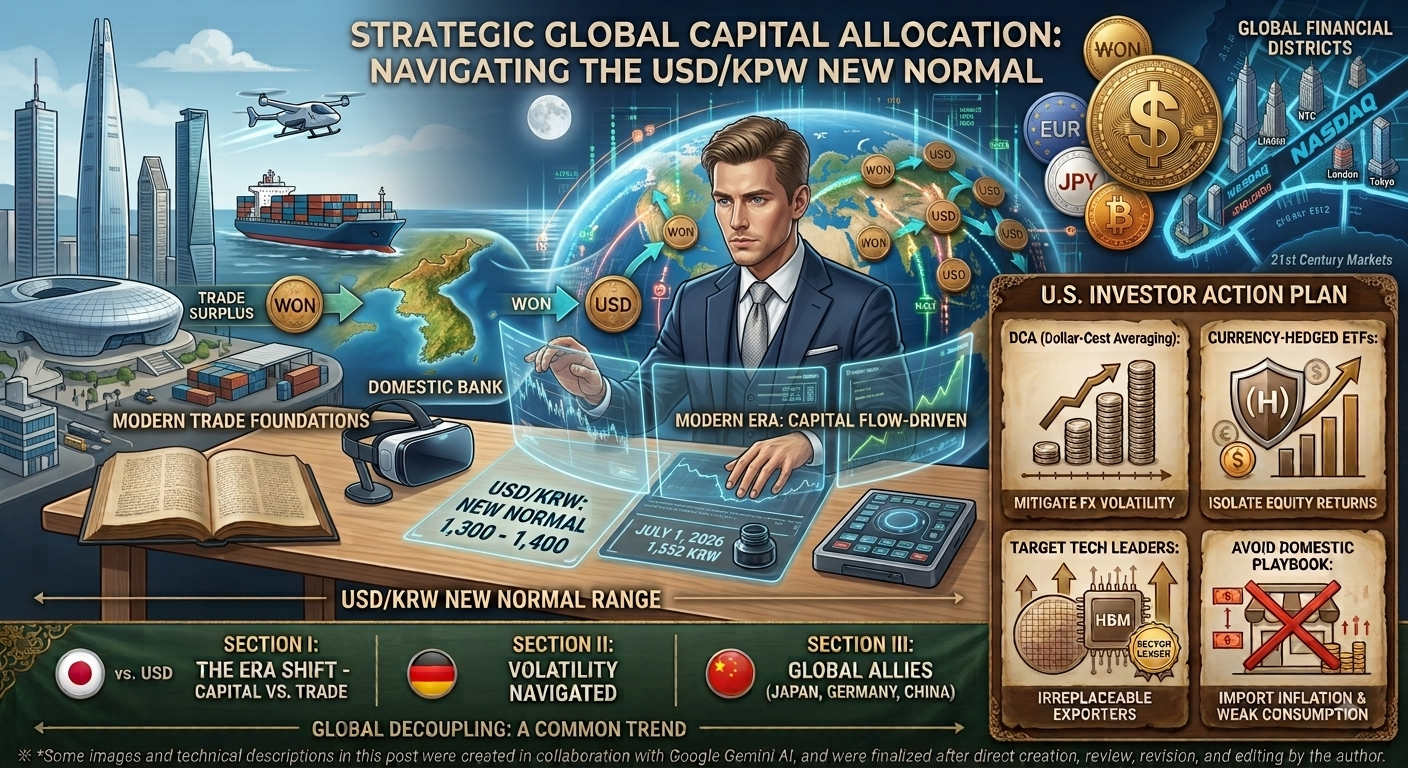
Key Takeaway for U.S. Investors: The global economy has shifted from the Era of Merchandise Trade to the Era of Capital Flows. No matter how many automobiles or memory chips a nation exports, if global capital seeks the liquidity, security, and return profiles of U.S. capital markets, export-oriented nations will see their currencies trade at a relative discount.
5. Why Has the Structural Level of the Won Shifted Higher?
South Korea is an advanced industrial nation with global leadership in semiconductors, EV batteries, shipbuilding, and defense manufacturing. Despite these strengths, three structural shifts keep the baseline USD/KRW rate in the 1,300–1,400 range:
- Capital Flows Dominate Trade Balances: In earlier decades, export earnings accumulated directly in domestic Korean banks, creating natural demand for the Won. Today, trade proceeds are quickly reinvested overseas by domestic institutions, retail investors, and corporate factory buildouts in the U.S.
- Transition to Floating Rates and U.S. Financial Primacy: Pre-1997 exchange rates in the 700–800 range were sustained by heavy government market management. Under a modern floating rate system, the baseline reflects real-time global demand—where U.S. financial assets exert an unprecedented pull on global capital.
- Decoupling Sovereign Risk from Import Inflation: Historically, a sharp rise in the USD/KRW rate signaled an impending sovereign default. Today, South Korea is a net creditor nation, meaning high FX rates do not threaten national solvency. Instead, currency weakness transmits primarily as imported inflation and higher input costs for domestic consumers.
6. Strategic Framework for U.S. Investors in Korean Assets
A high USD/KRW rate creates a multi-layered landscape for foreign capital. While currency weakness can compress dollar-denominated returns in the short term, it also creates attractive entry valuations for globally competitive South Korean equities.
Impact of High USD/KRW on Foreign Allocations
Weaker local currency expands top-line revenue and operating margins when converting foreign sales back into Won.
Unhedged USD-denominated positions face currency drag if the Won depreciates further after investment entry.
World-class Korean tech, defense, and industrial leaders trade at historically discounted multiples in U.S. Dollar terms.
Actionable Guidelines for U.S. and Global Investors
- Deploy Dollar-Cost Averaging (DCA): When allocating capital to South Korean equities or local market ETFs (such as MSCI South Korea index vehicles) during periods of heightened FX volatility, avoid lump-sum entries. Stagger capital deployments across monthly tranches to reduce FX timing risk.
- Utilize Currency-Hedged Structures: If you anticipate continued U.S. Dollar dominance or wish to isolate pure corporate equity performance without local currency exposure, consider currency-hedged ETFs (e.g., ETFs traded on U.S. exchanges with currency-hedge mechanisms built-in).
- Target Irreplaceable Global Exporters: Seek out South Korean enterprises possessing deep moat technologies—such as high-bandwidth memory (HBM) chipmakers, advanced naval shipbuilders, defense contractors, and specialized EV battery suppliers. These sectors maintain pricing power and benefit from margin expansion during elevated USD/KRW cycles, drawing institutional foreign buying regardless of broader FX headwinds.
- Avoid Purely Domestic Revenue Playbook: Steer clear of local Korean companies heavily reliant on imported raw materials or purely domestic consumer demand, as high exchange rates increase their input costs while eroding local purchasing power.
Conclusion: Key Takeaways
- A Structural Level Shift, Not a Financial Crisis: Elevated USD/KRW exchange rates in the 1,300–1,400 range represent a long-term structural recalibration driven by outbound capital flows, corporate direct investments in North America, and broad U.S. Dollar strength—not a sovereign credit risk.
- Double-Edged Macro Environment: While a weaker Won creates imported inflation locally, it acts as an earnings cushion for South Korea’s premier export powerhouses, enhancing their international competitiveness.
- Strategic Execution for Foreign Allocators: U.S. investors should navigate the Won’s volatility by utilizing phased capital entries, leveraging currency-hedged investment tools, and selectively targeting global technology and industrial leaders with structural pricing power.
※ This post is provided strictly for informational purposes and does not constitute a recommendation or solicitation to buy or sell any specific financial instruments or securities. The analysis and opinions expressed herein are based on information available at the time of writing, but no guarantee is made regarding their accuracy, completeness, or timeliness. All investment decisions and risk exposures are solely the responsibility of the individual investor.
※ Some images and technical descriptions in this post were created in collaboration with Google Gemini AI, and were finalized after direct creation, review, revision, and editing by the author.