
Every individual investor eventually faces a critical juncture in the market: “My stock dropped significantly below my purchase price. How should I respond?”
When faced with unrealized losses, many investors resort to a strategy known as Averaging Down. When executed with precision, averaging down can dramatically lower your average cost basis and accelerate your path back to profitability. However, when mismanaged, it transforms into financial poison that can utterly ruin your portfolio.
This guide explores the foundational mechanics of averaging down, the conflicting market philosophies behind it, and the mandatory conditions required to execute it safely.
1. Defining Averaging Down: Mechanics & Key Differences
Averaging Down refers to the practice of purchasing additional shares of an asset as its price declines below your initial entry point. This process continuously lowers the overall average cost per share across your entire position.
While averaging down sounds similar to Dollar-Cost Averaging (DCA), their underlying motivations are fundamentally different:
- Dollar-Cost Averaging (DCA): A disciplined, pre-planned strategy where you invest a fixed amount at regular intervals, regardless of market volatility or directional movements.
- Averaging Down: A reactive, post-hoc maneuver implemented specifically in response to a declining market position.
2. Investment Philosophy: Value Opportunity vs. Psychological Trap
Two opposing camps in financial markets view averaging down through radically different lenses:
3. Mathematical Realities & Capital Exhaustion
Understanding mathematical asymmetry is essential before committing capital to a losing trade.
When an asset falls -50%, it requires a +100% rally just to restore the initial principal. Averaging down significantly reduces this required break-even threshold. However, it comes with exponential capital exhaustion:
- Tranche 1: You invest $10,000. The position drops -50%.
- Tranche 2: You must invest an additional $10,000 just to lower your cost basis to the midpoint.
- Tranche 3: If the stock plunges another -50%, you need $20,000 more just to adjust the average cost effectively.
Without strict cash management, retail accounts quickly run dry, leaving investors completely defenseless at the actual market bottom.
4. Averaging Down vs. Stop-Loss Discipline
Averaging down and stop-loss limits represent two mutually exclusive risk management approaches.
The moment you choose to average down without a pre-calculated plan, your original stop-loss parameter is invalidated. Unplanned averaging down is often emotional revenge trading disguised as strategy.
Stop-Loss Execution
- Accepts incorrect timing thesis
- Locks in immediate loss
- Preserves capital for new trades
- Prevents emotional impulse trades
Averaging Down Execution
- Doubles down on initial thesis
- Increases total risk exposure
- Deploys fresh cash into losing trade
- Lowers break-even threshold
5. Five Strict Criteria for Safe Execution
To safely execute an averaging down strategy without wrecking your portfolio, confirm all five conditions beforehand:
- Substantial Cash Reserves: Maintain at least 2x to 3x your initial entry amount in cash reserved specifically for tranches.
- Fundamental Analysis: Verify that the price fall stems from macro panic or short-term noise, not underlying corporate decline.
- Long Horizon Capital: Use patient capital that can sit untouched for 2 to 3 years, avoiding margin or leverage.
- Emotional Separation: Base additional purchases on objective valuation metrics rather than desperate attempts to breakeven.
- Clear Exit Scenarios: Determine in advance whether you will sell the full position at breakeven or trim down upon recovery.
6. Asset Eligibility: Where to Apply and Where to Avoid
| ✅ Suitable Assets | ❌ High-Risk / Do Not Touch |
|---|---|
|
Mega-Cap Market Leaders: Well-capitalized category leaders (e.g., Apple, Microsoft) built to survive economic cycles. Broad Index ETFs: Diversified broad-market funds (e.g., S&P 500 ETFs) with zero individual insolvency risk. Cash-Flow Compounders: Companies with clean balance sheets and strong free cash flows. |
Unproven Speculative Stocks: High-valuation stocks lacking earnings, vulnerable to severe dilution. Unprofitable Biotech: Binary-outcome plays facing clinical failures or regulatory rejections. Leveraged 2X/3X ETFs: Products subject to daily resets and volatility decay that destroy value over time. |
7. Market Regime Considerations
Macroeconomic trends often outweigh individual company metrics.
| Market Environment | Suitability | Strategic Rationale |
|---|---|---|
| Bull Market Pullbacks | High | Dips during structural bull markets offer fast cost-basis recoveries. |
| Secular Bear Markets | Low / Danger | Protracted downturns can linger for years, draining capital into endless lower lows. |
| Range-Bound Markets | Moderate | Buying near range support levels can yield steady returns once the price rotates back to range resistance. |
Pro Tip: Avoid buying into sharp price collapses. Wait for downward momentum to decelerate, allowing price action to stabilize and form consolidation patterns alongside volume before deploying your next tranche.
Conclusion: Key Takeaways
- Treat Averaging Down as a Blueprint, Not an Emergency Escape: Unplanned additional purchases are emotional reactions designed to dodge realized losses. Establish your buy targets and reserve allocations before making your initial entry.
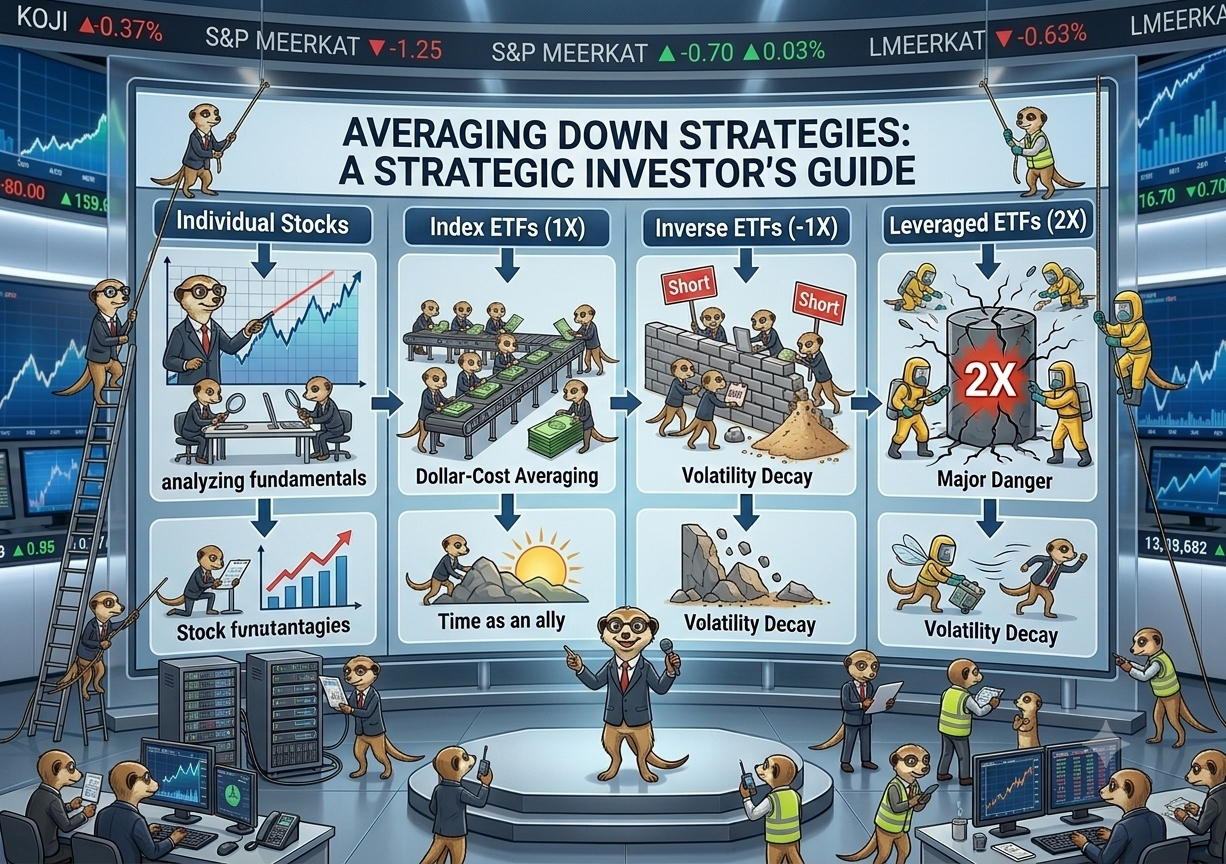
- Filter Asset Quality Aggressively: Limit averaging down to ultra-resilient mega-cap market leaders or broad index ETFs. Never attempt to average down on speculative high-beta stocks or leveraged products.
- Avoid Catching Falling Knives: Let price momentum cool off. Initiate additional buys only after a stock stops making lower lows and shows signs of base-building.
- Protect Cash Reserves: Your additional capital allocations must outsizedly outweigh initial positions to meaningfully move your average cost. Maintain a strict cash cushion to protect against extended market drawdowns.
※ This post is provided strictly for informational purposes and does not constitute a recommendation or solicitation to buy or sell any specific financial instruments or securities. The analysis and opinions expressed herein are based on information available at the time of writing, but no guarantee is made regarding their accuracy, completeness, or timeliness. All investment decisions and risk exposures are solely the responsibility of the individual investor.
※ Some images and technical descriptions in this post were created in collaboration with Google Gemini AI, and were finalized after direct creation, review, revision, and editing by the author.