
In 2017, Google published a short, historic paper titled “Attention Is All You Need” that changed the trajectory of computing forever. The Transformer architecture introduced in that paper became the beating heart behind the AI models millions use daily, including ChatGPT, Claude, and Gemini.
However, cracks are beginning to appear in what once seemed like an unbeatable foundation. As AI systems consume increasingly vast volumes of data, researchers have run into a fundamental barrier: exponential slowdowns and astronomical computational costs. Today, the global AI research community is closely following a new generation of challenger architectures. Emerging models like Mamba are stepping up to challenge the dominant position of the Transformer. This breakdown explores the technical shift from Transformers to next-generation AI architectures and what it means for the industry.
1. History and Evolution: How the AI Crown Has Shifted
To understand where artificial intelligence is headed, we must look at how its core designs have evolved over time:
- The Sequential Era (RNNs): Early natural language processing relied on Recurrent Neural Networks (RNNs). Think of an RNN as a diligent clerk reading a long document line by line, word by word. Because it processed information strictly in sequence, it struggled to remember details from earlier paragraphs and proved exceptionally slow when analyzing long texts.
- The Transformer Revolution (2017–Present): Google revolutionized the field by introducing the Transformer. Instead of processing text sequentially, Transformers evaluate an entire document simultaneously using an “Attention” mechanism. This allowed models to capture deep context and paved the way for modern Large Language Models (LLMs).
- The Next-Gen Challenger Era: While Transformers excel at contextual understanding, their processing speed declines rapidly as document length grows. This limitation has opened the door for a new wave of efficient, next-generation architectures designed to overcome computational bottlenecks.
2. Real-World Analogies: Understanding the Architectures
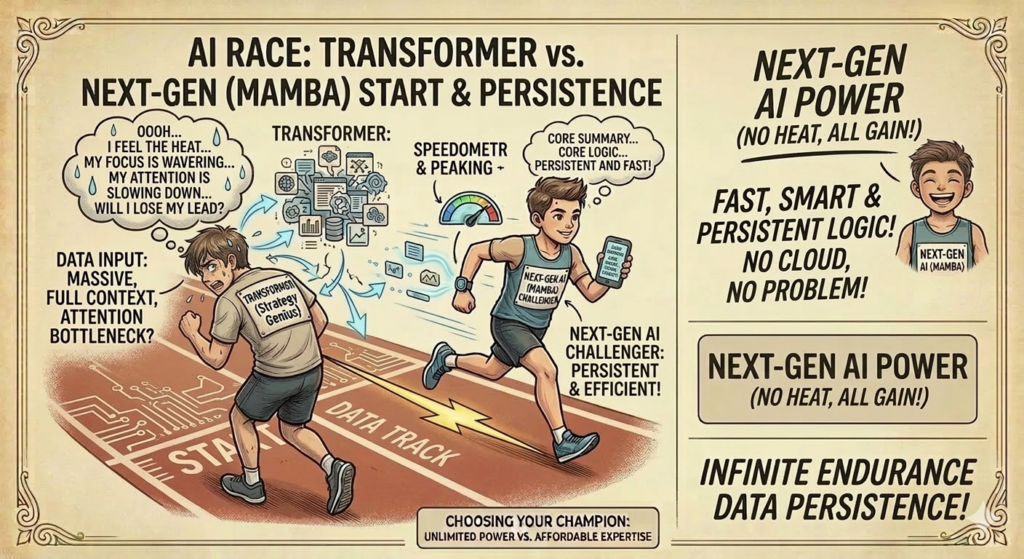
Transformer = The Genius Master Strategist
The Transformer serves as the core foundation for modern LLMs because of its unmatched ability to analyze complete sentences and complex contexts instantly.
- Learning Style: Imagine taking a high-resolution photograph of an entire textbook page at once. The Transformer scans every word simultaneously and draws explicit relational arrows between all terms using its self-attention mechanism.
- Real-World Scenario: In the sentence “The movie I watched yesterday was incredible, especially the lead actor’s performance…”, the model instantly connects “performance” back to “movie” across multiple intervening words.
- The Catch: While its contextual awareness is extraordinary, as input documents grow longer, the required calculations multiply drastically, leading to high processing memory demands and hardware overheating.
Next-Gen AI (Mamba & SSMs) = The Super-Memory Scholar
Next-generation architectures were built specifically to resolve the memory bottlenecks inherent in Transformers.
- Learning Style: Instead of photographing every page, this model continuously absorbs information like a master strategist while selectively distilling core insights into a compact digital notebook.
- Real-World Scenario: Whether processing a single article or a multi-volume library, it remains responsive because it compresses key context on the fly rather than keeping every raw word connection open at once.
- Key Advantage: It operates with vastly higher processing throughput and infinite endurance, handling massive text streams swiftly without draining hardware resources.
3. Why Are Next-Gen Models Challenging the Transformer?
The Achilles’ Heel of Transformers: The “Quadratic Curse”
Transformers process context by calculating the mathematical relationship between every single token and every other token in a sequence. If you double the length of an input document (n), the required computational work and memory usage do not merely double—they scale quadratically (n^2).
The Transformer’s Achilles’ Heel:
The Quadratic Curse
The core mechanism that makes Transformer models so effective at understanding context is their ability to calculate the mathematical relationship between every single token and every other token in a sequence. This “Attention” is exhaustive and powerful.
However, this all-to-all calculation comes with a severe, hidden cost. As the input grows, the model’s computational demands don’t just grow; they explode.
“If you double the length of an input document ($n$), the required computational work and memory usage do not merely double—they scale quadratically ($n^2$).”
The Explosive Nature of $N^2$ Complexity
This efficiency bottleneck is formally expressed by the model’s computational complexity, a concept from computer science that describes how resource needs grow with input size:
This means the time and memory needed are proportional to the square of the input tokens ($n$). In plain language, this is the “Quadratic Curse.”
Visualizing the Curse: $y = n^2$
Use the slider to increase the Input Size ($n$). Watch how the Computational Work ($n^2$) grows uncontrollably.
Real-World Impacts
This quadratic scaling creates an insurmountable barrier when dealing with modern, large-scale data tasks:
- Long-Context Failure: When processing entire books, massive codebases, or long video feeds, calculating every pairwise connection causes memory requirements to explode, often leading to “Out of Memory” errors even on powerful hardware.
The Economic Burden
Beyond technical limitations, this inefficiency translates directly into significant economic and infrastructural costs:
- Inflated Energy Bills: The massive computational load drives up data center electricity consumption dramatically.
- Expensive Hardware Dependency: Enterprises are forced to deploy costly clusters of high-end GPUs just to maintain basic inference capabilities.
The Challenger Strategy: Linear Scaling
Next-generation architectures break free from this quadratic bottleneck by redesigning the underlying math to achieve linear complexity ($\mathcal{O}(n)$):
This approach transforms the landscape. Instead of resource needs exploding, they now grow in direct proportion to input size. The table below provides a dramatic comparison:
Benefits for Edge Devices
Because computational overhead scales directly in proportion to input size, these new models can run efficiently on smaller edge devices, such as smartphones and laptops, without relying constantly on cloud servers.
4. Next-Gen Superpowers: Escaping the Bounds of Context Memory
The transition from purely scaling model size (LLMs) to re-engineering core brain structures represents a major architectural evolution toward efficient, agentic AI systems.
Key Architectural Players
- Mamba (State Space Model / SSM): Mamba continuously filters incoming data, selectively compressing relevant context into a hidden “state.” Because its computational footprint grows linearly ($\mathcal{O}(n)$), it processes ultra-long context streams up to five times faster than standard Transformers.
- RWKV (Receptance Weighted Key Value): RWKV combines the parallelized training efficiency of Transformers with the lightweight execution speeds of RNNs. It can be trained efficiently on GPUs while running inference smoothly on low-power consumer hardware.
- Hybrid Models (Transformer-Mamba Mixes): Hybrid designs allocate complex contextual reasoning tasks to Transformer layers while delegating long-sequence processing to Mamba layers. This combined approach offers a compelling balance of accuracy and raw speed.
5. Architectural Comparison
6. Who Is Leading the Next-Gen AI Wave?
- AI Researchers & Open-Source Communities: Teams pioneering models like Mamba, RWKV, and Jamba are pushing non-Transformer designs into mainstream research.
- Hardware & Semiconductor Giants: Chip manufacturers are optimizing next-generation hardware architectures—such as NVIDIA’s Rubin platform—to accelerate non-Transformer operations at the silicon level.
- Smartphone & Edge Device Makers: Consumer electronics hardware developers are adopting lightweight State Space Models to power responsive, privacy-focused on-device AI applications without reliance on external cloud servers.
Conclusion: Key Takeaways
- Quadratic Scaling Bottleneck: The Transformer’s self-attention mechanism requires quadratic computational work ($\mathcal{O}(n^2)$), making long-context processing expensive and resource-intensive.
- The Linear Solution: Emerging architectures like Mamba and RWKV leverage linear scaling ($\mathcal{O}(n)$) to dramatically reduce processing overhead while maintaining constant memory footprints.
- Economic Incentives: Cutting inference costs by up to 90% gives enterprises a strong financial incentive to adopt hybrid and non-Transformer architectures.
- The Rise of Hybrid Systems: The future of AI hardware will likely rely on hybrid architectures that combine the deep reasoning powers of Transformers with the speed and memory efficiency of State Space Models.
AI Disclosure: Images and foundational research for this article were created in collaboration with Google Gemini AI. The final content was translated, rewritten, reviewed, and published by the author.