
When a meticulously engineered performance management system like the Balanced Scorecard (BSC) fails, executives rarely blame the metrics themselves. Instead, they blame market volatility or poor execution. However, the most destructive root cause of performance management failure in modern enterprises is the systemic oversight of human psychology.
Even the most sophisticated corporate strategy tracking framework will drift off course if the employees being evaluated—and the leadership team conducting those evaluations—fall into deep-seated cognitive traps. When psychological distortions take over, metrics stop being windows into organizational health and instead become walls that blind leadership. To protect your organization from the dangerous paradox where metrics actively sabotage performance, we must deeply analyze the psychological biases occurring within the BSC framework and establish structural safeguards to neutralize them.
1. The Psychological Traps and Cognitive Biases Corrupting Your KPIs
Introducing a performance management system into any corporate culture inevitably triggers primal defense mechanisms among staff. This friction breeds specific, highly destructive cognitive biases that twist data and derail strategic intent.
Surrogation (Mistaking the Metric for the Strategy)
Surrogation is the psychological phenomenon where employees subconsciously replace the grand strategic goal with the narrow, proxy metric designed to measure it. In the minds of your team, maximizing the KPI score becomes the strategy itself, completely eclipsing the actual corporate objective.
Consider a firm attempting to deepen long-term client relationships. To track this, leadership introduces a metric monitoring daily call volumes, operating under the assumption that more communication equals stronger ties. Employees quickly adapt to the metric rather than the goal: they rush through conversations and abruptly hang up on complicated clients simply to hit their daily call targets. The numeric goal is achieved, but the actual corporate strategy is fundamentally destroyed.
Motivated Reasoning (Cherry-Picking Data to Fit Narratives)
Motivated reasoning occurs when individuals or business units establish a preferred, self-serving conclusion first, and then selectively process data to validate that outcome. Rather than letting unbiased metrics drive decision-making, managers filter operational reality through their own preconceptions. If a favorite project is failing, a leader suffering from motivated reasoning will ignore glaring red flags in negative lag indicators and obsessively highlight minor, ambiguous lead indicators to convince executives that victory is just around the corner.
Common Measure Bias (The Erasure of Divisional Uniqueness)
When evaluators or corporate HR teams compare multiple business units, they experience a strong cognitive tendency to disregard “unique measures”—metrics tailored specifically to a single department’s specialized function—in favor of “common measures” that apply universally across the entire enterprise.
For instance, an executive assessing both a mature sales division and a long-term research and development (R&D) unit will frequently over-index on universal metrics like immediate quarterly cost efficiency or standard head-count productivity. Because the R&D team’s unique, long-horizon innovation indexes are harder to cross-reference on a standardized corporate spreadsheet, their true strategic contribution is completely erased during performance reviews.
Tunnel Vision (The Blind Maximization of Personal Metrics)
Tunnel vision narrows an employee’s focus down to a point where they only care about checking off their assigned KPI boxes, regardless of the damage done to peripheral corporate operations. A classic example occurs when customer support teams are scored heavily on satisfaction ratings. To keep their scores artificially high, agents may intentionally manipulate ticketing queues, dodging or delaying the intake of complex, frustrated clients with difficult problems. The department’s dashboard glows green, but the enterprise’s true operational quality deteriorates.
Sandbagging (The Defensive Lowering of Expectations)
When a corporate culture treats performance metrics as punitive tools, employees immediately shift into a defensive posture known as sandbagging. This is the deliberate practice of proposing conservative, easily achievable targets during annual planning cycles, even when a team is fully capable of pursuing aggressive, exponential growth. Sandbagging strangles corporate innovation in the crib, converting a tool meant for strategic acceleration into an anchor of corporate mediocrity.
The Recency and Halo Effects (The Flaws of Subjective Observation)
Human memory is fundamentally flawed. In annual or semi-annual performance reviews, evaluators are routinely derailed by the Recency Effect, where an employee’s performance in the final three weeks of the fiscal year completely overshadows eleven months of steady operational data. This distortion is frequently compounded by the Halo Effect, where a supervisor assumes a department is succeeding across all four perspectives of the BSC simply because they hit a home run on a single, highly visible project.
2. The Operational Fallout: How Bias Cripples Corporate Performance
When these psychological distortions go unchecked within a performance management system, an enterprise incurs massive, invisible costs that can trigger severe operational and financial crises.
Strategic Decoupling
In an environment dominated by surrogation, a total disconnection emerges between the executive suite’s vision and the front-line reality. While top management gives speeches about customer-centric long-term value, employees remain entirely consumed by daily transactional tallies. Because corporate funding follows the metrics, capital is systematically wasted on short-sighted behaviors, rendering the CEO’s grand strategy a hollow slogan.
Erosion of Data Integrity and the Creation of Strategic Blind Spots
Once employees realize that KPIs are used primarily for discipline, they stop reporting reality and start engineering compliance. Through tunnel vision and sandbagging, the data entering the BSC platform becomes systematically manicured. Corporate dashboards present a flawless, fabricated illusion of health, leaving senior executives completely blind to mounting systemic threats until it is far too late to course-correct.
Amplified Silo Effects and Destructive Interdepartmental Conflict
When common measure bias devalues unique departmental contributions, and the BSC lacks explicit cross-functional collaboration metrics, corporate silos solidify into fortresses. Individual business units adopt a mercenary mindset: as long as their isolated local KPIs are secure, they are entirely indifferent if a neighboring department collapses. This local optimization comes at the direct expense of global, enterprise-wide optimization.
Brain Drain and the Downward Spiral of Morale
High-performing, strategic thinkers who quietly execute long-term initiatives or maintain critical unique departmental functions are routinely penalized when evaluators rely on raw common metrics or fall prey to the recency effect. When top-tier talent sees political operators who merely manipulate numbers get rewarded, organizational trust shatters. The true innovators exit the firm, leaving behind a residual culture of compliance officers who excel at gaming the system but fail at creating actual value.
Capital Misallocation and Sunk Cost Fallacies
When executive leadership suffers from motivated reasoning, they selectively interpret corporate data to justify maintaining underperforming business lines. By ignoring objective, negative financial performance indicators and over-indexing on minor, positive operational metrics, firms fail to execute timely exits. This keeps capital trapped in failing ventures, starves high-growth initiatives of necessary funding, and directly threatens corporate liquidity.
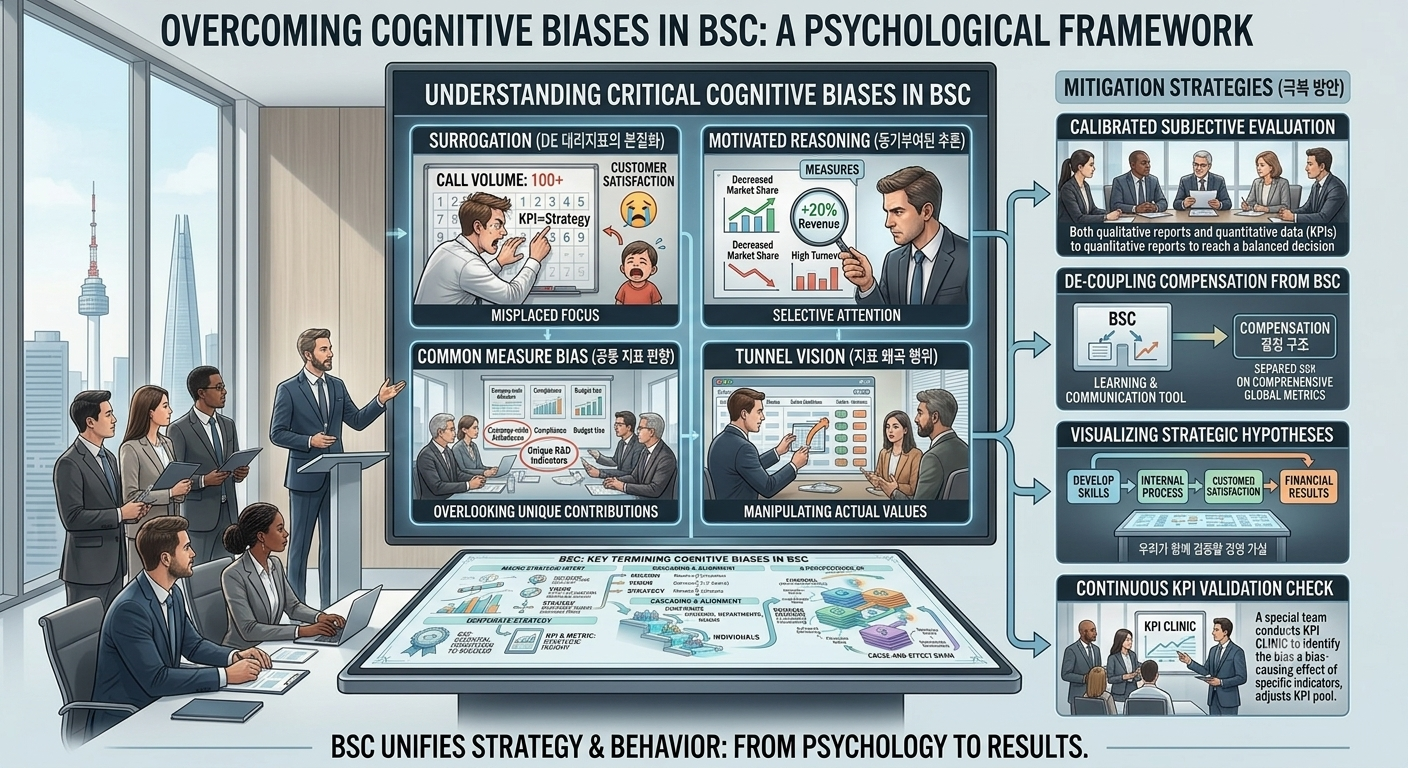
3. Structural Solutions: How to De-Bias Your Performance System
De-biasing a performance management framework requires moving beyond mere metric adjustments; it demands establishing robust institutional and cultural safeguards.
| Strategic Remedy | Targeted Cognitive Bias |
|---|---|
| Calibration Committees | Common Measure Bias, Recency Effect, Halo Effect |
| Balanced Incentive Decoupling | Surrogation, Sandbagging, Tunnel Vision |
| Strategy Map Visualization | Motivated Reasoning |
| Continuous Metric Auditing | Data Manipulation, Corporate Gaming |
Implement Calibrated Subjective Evaluations
To neutralize common measure bias and surrogation, organizations must abandon absolute reliance on raw quantitative metrics. Firms must institutionalize formal Calibration Committees and multi-rater review panels. These committees review the qualitative context behind the numbers, ensuring unique departmental innovations and long-term strategic contributions are weighed fairly against standardized corporate metrics.
De-Couple Compensation from Direct Metric Ratios
Tying compensation directly to individual KPI scores on a strict 1-to-1 ratio is a guaranteed way to incentivize sandbagging and tunnel vision. Instead, the BSC should be treated primarily as a strategic learning and alignment tool. Financial bonuses should be determined through a blended model that balances company-wide fiscal health, qualitative peer collaboration reviews, and overall initiative completion rates, removing the incentive to manipulate individual metrics.
Visualize Strategic Hypotheses Through Strategy Maps
To dismantle motivated reasoning, corporate leadership must continuously communicate the cause-and-effect relationships embedded within the organization’s Strategy Map. Metrics must never be handed down as isolated commands. Instead, leadership must frame them as collective business hypotheses, clearly showing how an early-stage learning indicator directly drives an internal process improvement, which eventually unlocks long-term financial success.
Launch a Continuous Metric Validation Program
To prevent data manipulation and system gaming, enterprises must establish an annual auditing process for their KPIs. By implementing a regular review system, organizations can identify which metrics are triggering unintended, protective behaviors or toxic rivalries between divisions. If a metric is found to be driving short-sighted behavior, it must be immediately refined or removed from the performance pool.
Conclusion: Key Takeaways
The ultimate success of a Balanced Scorecard does not depend on the complexity of its software or the sheer volume of data points it collects. It depends on whether leadership accounts for human psychology.
- Metrics are not strategies: A metric is merely a proxy for an objective. When tracking a number becomes more important than achieving the mission, the system is failing.
- De-escalate the stakes: Reduce the direct, mechanical link between isolated KPI metrics and financial bonuses to shut down sandbagging and data manipulation.
- Context over raw data: Utilize structured calibration processes to ensure unique divisional achievements are not erased by generic corporate metrics.
- Maintain a dynamic framework: Treat the BSC as an evolving set of strategic hypotheses that must be audited and adjusted regularly to prevent corporate blind spots.
AI Disclosure: The conceptual insights and analytical frameworks presented in this publication were developed through a collaborative partnership with Google Gemini AI. The final content was meticulously reviewed, localized for North American corporate contexts, and edited by the blog administrator.