
When evaluating corporate performance, many executives mistakenly treat net income as the definitive indicator of business stability. They operate under the dangerous assumption that if an income statement reflects a robust net profit, the company is fundamentally secure. However, a business can easily report substantial paper profits while simultaneously hurtling toward a liquidity crisis. This fatal operational mismatch between revenue recognition and physical capital availability frequently results in profitable insolvency, a devastating event where a company goes bankrupt despite being highly profitable on paper.
To steer an enterprise safely, senior leadership must rely heavily on the cash flow statement. This financial tracking system serves as an enterprise’s true circulatory health report, exposing exactly how much liquid capital is moving through the organization. Unlike the income statement, which can be heavily altered by non-cash accounting entries, cash tracking strips away all assumptions to present financial reality. To help leaders institutionalize rigorous capital discipline, this guide establishes the definitive hierarchy of core cash tracking elements, distinguishes operating cash from accounting profit, analyzes the structural limits of historical data, and details the specific financial warning signs a CEO must actively monitor.
1. Defining the Core Lexicon and the Three-Tiered Cash Architecture
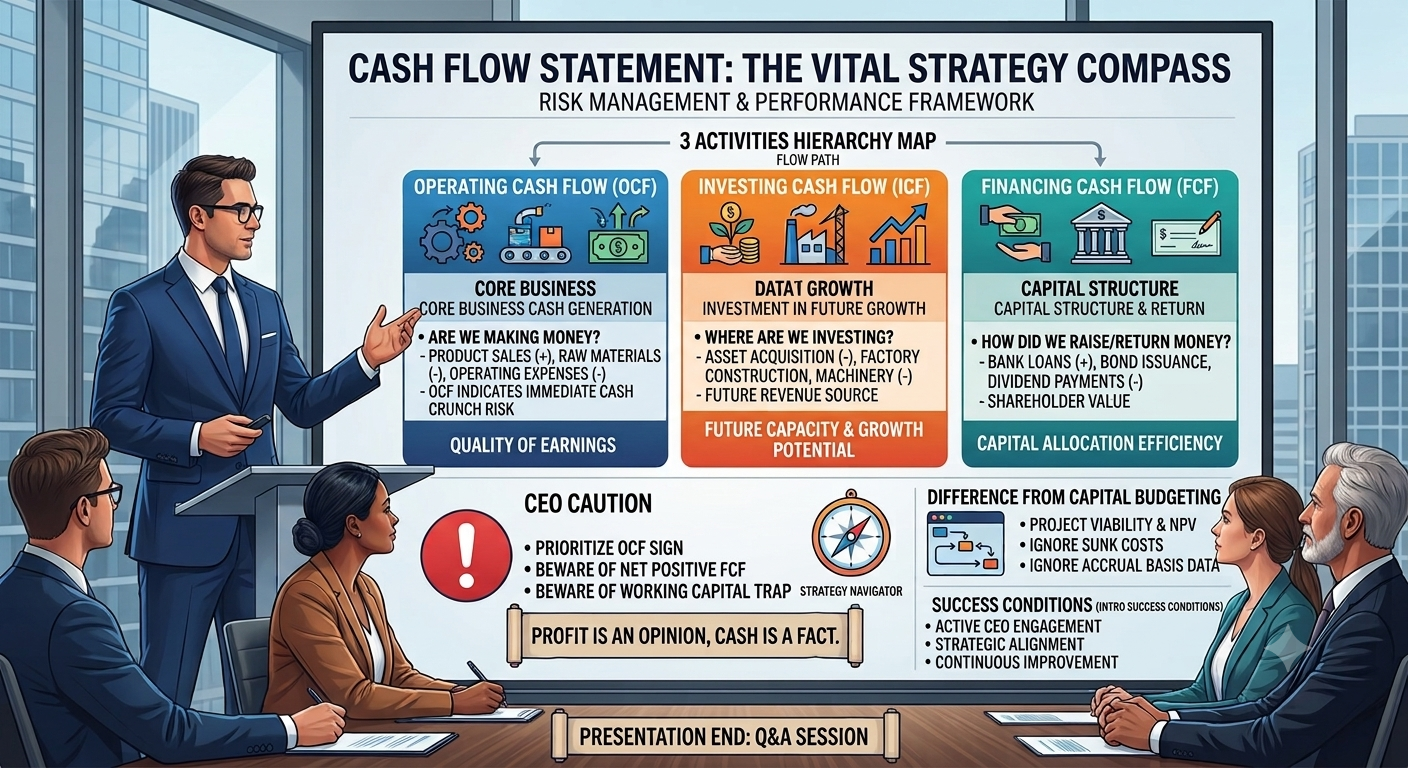
Implementing effective corporate capital governance requires absolute clarity regarding the three main pillars of cash movement. The statement of cash flows bypasses traditional accrual accounting anomalies to organize every dollar entering or exiting the corporate accounts into a strict, three-part structural framework.
Operating Cash Flow
This structural layer tracks all net cash generated directly from the primary operational baseline and core business activities of the company. It answers the fundamental question: “Can our core product or service actively generate enough physical cash to sustain the business?” Operating cash flow represents the ultimate health metric for an enterprise. It captures the true economic vitality of day-to-day transaction processing, including receiving cash from customers, paying manufacturing input costs, and settling frontline supplier accounts.
Investing Cash Flow
This dimension records the cash inflows and outflows tied to the acquisition and disposal of long-term corporate assets and strategic investments. It explicitly answers the question: “How much capital are we committing to our future expansion?” This area logs transactions involving long-term financial assets, capital expenditures, corporate real estate purchases, and equipment upgrades. In a healthy, growth-oriented enterprise, this category is naturally negative, indicating that the firm is actively reinvesting its profits into long-term infrastructure.
Financing Cash Flow
This component acts as the governance ledger for external capital acquisition, debt settlement, and equity distributions. It explicitly answers the question: “How are we financing our capital structure, and how are we rewarding our investors?” This segment includes issuing corporate debt, drawing down bank lines of credit, executing stock buybacks, initiating equity raises, paying down principal debt, and distributing cash dividends to equity holders.
Beginning and Ending Cash Balance
The definitive reference points that bookend a given accounting cycle. The Beginning Cash Balance is the verified volume of immediately deployable, liquid reserves held in corporate bank accounts at the start of the quarter or fiscal year. After adding the cumulative net contributions from operating, investing, and financing activities, the statement concludes with the Ending Cash Balance. This final figure must match the liquid balance sheet accounts exactly, serving as the ultimate verification of financial data integrity.
2. Navigating the Structural Advantages and Technical Limitations of Cash Tracking
While a cash flow statement provides unparalleled operational transparency, an executive must understand both its analytical benefits and its inherent structural boundaries to use it effectively as a strategic tool.
Structural Advantages
- Early Protection Against Insolvency: Because cash tracking documents the physical movement of money rather than arbitrary billing records, it exposes early-stage liquidity risks long before they register on a standard income statement.
- Immunity to Accounting Manipulations: Net profit figures can be legally altered or managed through subjective changes in depreciation schedules, revenue recognition policies, or inventory appraisal methods. Cash tracking is exceptionally difficult to manipulate, providing a reliable baseline of a firm’s true performance.
- Clear Visibility into Capital Capacity: It instantly shows whether an enterprise is funding its capital expenditures out of organically generated operational revenue or if it is relying on external debt lines to stay afloat.
Technical Limitations
- The Delay of Retrospective Data: The statement of cash flows is inherently a historical document published after the close of an accounting cycle. This historical nature introduces a distinct reporting delay, meaning it cannot provide real-time notification of a sudden liquidity crisis.
- The Distorted Valuation of Early-Stage Innovators: Early-stage technology enterprises or high-growth firms frequently dedicate massive amounts of capital to long-horizon research and development or large facility build-outs. This aggressive investment results in a deeply negative cash flow from investing activities, which can make the firm appear financially unstable to undisciplined analysts, masking its true long-term value.
3. Net Income versus Operating Cash Flow: The Accrual-Cash Disconnect
The operational disconnect between accounting profit and actual cash availability stems directly from the underlying conflict between accrual accounting rules and cash reality.
| Evaluation Dimension | Income Statement: Net Income | Cash Flow Statement: Operating Cash Flow |
| Accounting Recognition Principle | Accrual Basis Accounting: Transactions are recorded when economic value is created, regardless of cash timing. | Cash Basis Accounting: Transactions are registered exclusively when money physically changes hands. |
| Operational Impact Example | An enterprise sells $100,000 worth of products on standard credit terms. The income statement immediately logs a $100,000 revenue increase. | The same $100,000 credit sale registers as $0 in cash flow, because the customer has not yet settled the outstanding invoice. |
| Handling of Non-Cash Expenses | Subtracts non-cash entries like depreciation to lower net taxable accounting income. | Adds non-cash entries like depreciation back to the total, since no physical cash left the bank account. |
4. Operational Accounting versus Internal Capital Budgeting
Executives must avoid confusing the historical cash flow statement prepared for external regulators with the forward-looking cash flow projections used in internal Capital Budgeting.
Financial reporting cash flow provides a retrospective look at the entire organization’s performance across a past period, designed primarily for external investors, auditors, and lenders. Conversely, capital budgeting cash flow is a predictive tool used to assess the viability of major upcoming corporate investments, such as building a new factory or launching a brand-new product line.
When conducting a capital budgeting evaluation, financial analysts look exclusively at Incremental Cash Flows—the new, additional inflows and outflows generated directly by the project. This process deliberately ignores all Sunk Costs, such as past market research or legacy facility expenses that cannot be recovered, because they have no bearing on future cash efficiency. Furthermore, capital budgeting applies strict present-value discounting, using metrics like Net Present Value (NPV) and Internal Rate of Return (IRR) to adjust future project cash projections for the time value of money, a process completely absent from a standard historical cash flow statement.
5. The Executive Dashboard: Critical Financial Warning Signs for the CEO
To manage an enterprise effectively, a CEO must look past superficial top-line revenue metrics and closely monitor the underlying trends on the cash flow sheet.
- Prioritize a Positive Operating Cash Flow Sign: If an enterprise is reporting millions in net income but consistently shows a negative operating cash flow, the business is in serious trouble. This mismatch indicates that the firm is either struggling to collect payments from its clients or overproducing inventory that is rotting away in warehouses.
- Investigate Positive Financing Cash Flow Trends: A positive sign in financing activities is not a cause for celebration. It explicitly means the company is bringing in cash by taking on bank debt or diluting equity holdings. If a firm relies on debt financing because its core operations cannot generate cash, it is operating on borrowed time.
- Avoid the Working Capital Trap: Rapid sales growth can inadvertently trigger a liquidity crisis if an executive mismanages working capital. If a company must pay its raw material suppliers within 30 days but allows its corporate buyers 90 days to settle their invoices, a massive sales spike will rapidly deplete available cash reserves, potentially triggering a sudden operational collapse.
Conclusion: Key Takeaways
- Cash Trumps Accounting Opinion: Net income is a subjective accounting calculation influenced by non-cash estimates. Cash flow is an indisputable operational fact that dictates whether an enterprise can survive.
- Audit the Operating Cash Flow Vector: Treat your operating cash flow sign as the definitive indicator of business sustainability. If it is negative while paper profits are rising, pause expansion plans immediately to audit your collections performance.
- Isolate Incremental Project Realities: When making capital budgeting decisions for major future investments, evaluate only incremental cash flows and future benefits, completely ignoring unrecoverable sunk costs.
- Maintain Total Alignment: Use your statement of cash flows alongside your balance sheet to monitor changes in working capital, ensuring that rapid revenue growth is matched by actual cash collection.
AI Disclosure: The financial frameworks, accounting comparisons, and corporate governance insights detailed in this publication were developed through a collaborative partnership with Google Gemini AI. The final manuscript was reviewed, customized for North American corporate accounting standards, and approved by the blog administrator.