
Developing a long-term corporate vision and formulating precise organizational goals are essential parts of business leadership. However, an organization’s ultimate success depends on its ability to translate those high-level strategies into concrete actions on the front lines. While the Balanced Scorecard framework provides a multi-dimensional structure for corporate evaluation, moving it from a theoretical model to an active operational asset requires highly careful planning, strict organizational alignment, and direct sponsorship from senior executives.
Simply listing key metrics in an evaluation template will not change organizational behavior. To build lasting accountability and maintain strategic velocity, corporate leaders must understand the practical step-by-step implementation process, clarify the relationships between metrics, actively avoid deployment pitfalls, and implement proven executive tactics.
1. The Structured Balanced Scorecard Implementation Process
Successfully turning an abstract mission statement into day-to-day employee behavior requires following a logical, step-by-step deployment sequence.
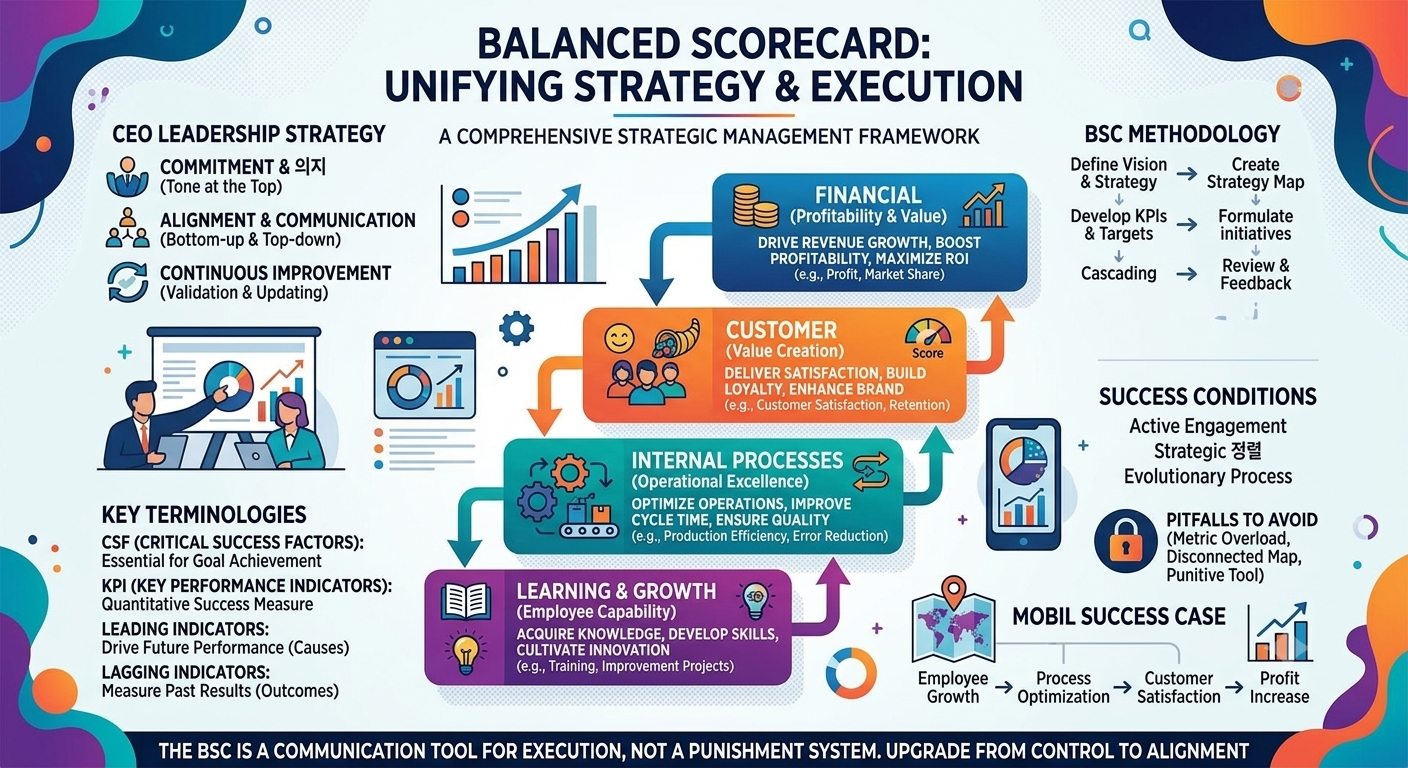
- Define Vision and Strategy: Senior executives must clearly define the company’s long-term destination. This involves explicitly establishing the multi-year business strategy, choosing target market positions, and isolating the primary corporate milestones the organization intends to reach.
- Create Strategy Map: Leadership organizes specific strategic goals into the four traditional operational pillars: Learning and Growth, Internal Business Process, Customer, and Financial. During this stage, planners map explicit cause-and-effect paths to illustrate how these goals depend on one another.
- Develop KPIs and Targets: Once strategic goals are placed on the map, teams set up objective performance metrics to track progress. Every metric must have specific, challenging targets that define what successful performance looks like for that business cycle.
- Formulate Strategic Initiatives: To close the gap between current operational performance and upcoming target goals, executives must establish practical action plans. This step includes defining corporate projects, setting clear timelines, and allocating necessary budgets.
- Cascade Across the Organization: The high-level corporate scorecard is systematically broken down and distributed throughout the corporate hierarchy. This process ensures that regional divisions, business departments, and individual teams are fully aligned with the central roadmap.
- Review and Feedback Loops: Management must deploy data tracking systems to review performance results at regular intervals. This continuous monitoring ensures that if market conditions change or initial assumptions prove wrong, leadership can adjust targets or reallocate resources in real time.
2. Navigating the Metric Framework and Operational Interplay
Building an effective scorecard architecture requires understanding the precise, underlying relationships between its core operational parts.
- Critical Success Factors (CSF): These are the vital operational pillars and core strategic areas where an enterprise must perform flawlessly to achieve its high-level business goals.
- Key Performance Indicators (KPI): These are the highly specific, quantifiable metrics used to measure exactly how effectively the organization is delivering on its defined critical success factors.
- Leading Indicators: These are forward-looking metrics that track the underlying operational drivers and core actions that generate future business results, such as employee training hours completed or internal process automation updates.
- Lagging Indicators: These are backward-looking metrics that document historical outcomes after an accounting cycle has closed, such as quarterly net profit margins or annual customer satisfaction rates.
The true value of this framework lies in how these elements interact. Abstract corporate visions are translated directly into tangible strategic objectives. These objectives dictate the necessary CSFs, which are then explicitly monitored via tailored KPIs. Within this structure, leading metrics serve as early indicators that predict and drive the performance of lagging metrics, keeping the entire organization aligned.
3. Systemic Implementation Pitfalls: Structural Malfunctions to Prevent
Many corporate attempts to adopt a scorecard framework stall due to predictable, systemic design errors that can turn a strategic execution asset into an administrative burden.
- Metric Overload and Superficial Categorization: A frequent mistake occurs when companies take hundreds of pre-existing, isolated operational metrics and simply drop them into the four standard scorecard buckets. This creates a cluttered list of conflicting data points rather than a focused, strategic tracking tool. Without direct links to long-term strategy, the scorecard becomes nothing more than a complex administrative report card.
- Fragmented Strategy Mapping: When departments create their internal performance trackers without ensuring a clear, logical progression from foundational employee learning to top-tier financial outcomes, the entire framework breaks down. When these cause-and-effect connections are broken, teams naturally focus on localized, self-serving targets that fail to drive overall corporate success.
- Punitive Evaluation Controls: If management transforms the scorecard into a strict corporate weapon used primarily to cut compensation or police employee behavior, it will trigger immediate organizational resistance. Workers will naturally protect themselves by setting easily achievable goals, working to manipulate performance data, and avoiding any strategic initiatives that carry operational risk.
- Static Operational Frameworks: Markets move quickly, and an organization’s performance tracking must keep pace. If an executive leadership team keeps using rigid metrics established at the beginning of the fiscal year after a major market disruption has occurred, a serious disconnect will form between daily operational realities and formal performance reviews.
4. Architectural Case Studies: Analyzing Failure and Success
The core trade-offs of scorecard deployment become clear when comparing real-world organizational case studies.
| Case Study Category | Core Operational Actions | Ultimate Strategic Outcome |
| Corporate Failure: Global High-Tech Manufacturer (Company A) | Allowed divisions to distribute 200 legacy metrics into the scorecard without overall alignment; used the dashboard primarily as a punitive tool to cut annual bonuses. | Widespread internal resistance, defensive target-setting, fragmented department collaboration, and data manipulation that completely undermined the system. |
| Corporate Success: Global Refining Division (Mobil Oil) | Built an explicit four-tier causal map linking training to process optimization, dealer loyalty, and financial returns; held monthly strategic reviews led directly by the CEO. | Transformed division performance from the bottom of the industry to number one in profitability within 24 months, setting an industry benchmark. |
Lessons from the Field
Company A’s experience shows how an implementation can break down when leadership fails to establish genuine cultural alignment. By allowing business units to repackage their legacy metrics without connecting them to a long-term strategy, the scorecard became a complicated administrative exercise. When the tool was used destructively to control teams and cut compensation, it broke employee trust and led to defensive behaviors that undermined corporate data integrity.
In contrast, Mobil Oil’s turnaround shows the power of structured strategy mapping. They focused on a tight chain of actionable indicators: advanced training reduced refinery downtime, which improved dealer satisfaction, which ultimately increased returns on investment. This clear connection allowed employees to see exactly how their daily work drove the company’s financial success, turning the scorecard into an effective communication and growth platform.
5. Executive Insights for Strategic Governance
The contrast between these successful and failed implementations shows that the performance of a scorecard system depends entirely on management philosophy.
- Prioritize Alignment Over Punitive Control: Use the scorecard as a collaborative tool to align the organization, not as a system for policing staff or cutting compensation. When employees see how their daily work supports the company’s long-term vision, they are much more likely to collaborate across departments and focus on genuine corporate growth.
- Enforce Clear Cause-and-Effect Logic: Avoid cluttering your dashboards with disjointed, low-level metrics. Ensure that every indicator on your strategy map is part of a clear causal chain, demonstrating exactly how investments in employee capabilities improve internal processes, enhance customer satisfaction, and drive final financial returns.
Conclusion: Key Takeaways
- Secure Absolute Executive Sponsorship: Scorecard initiatives must be driven directly from the top. The CEO and executive team must actively lead strategy reviews and use scorecard data to guide all major resource allocation decisions.
- Connect Leading Drivers with Lagging Outcomes: Build balanced tracking dashboards that pair lagging financial metrics with forward-looking operational drivers, giving management early visibility into future performance risks.
- Maintain Flexible KPI Architectures: Review your performance metrics regularly to ensure they stay aligned with changing market dynamics, economic shifts, and evolving corporate strategies.
- Communicate the Strategy Map Transparently: Share your high-level strategy map across all tiers of the organization, giving every employee a clear understanding of how their individual responsibilities drive the company’s long-term success.
* This article was created in collaboration with Google Gemini AI. The author independently created, reviewed, and edited the content to ensure professional quality.