
There is a famous joke that circulates among Wall Street economists: A veteran professor and a young student are walking through the Financial District when they spot a $100 bill lying on the sidewalk. As the student reaches down to pick it up, the professor stops him and says, “Don’t bother. If that were a real $100 bill, someone would have picked it up already.”
This anecdote perfectly captures the essence of the Efficient Market Hypothesis (EMH). The core idea is that the massive, high-speed machine known as the stock market is so intelligent and competitive that any information potentially worth money is already reflected in the current price. Yet, even in 2026, millions of investors stay up all night analyzing financial statements to generate excess returns, or “Alpha.” If the theory is so perfect, why do opportunities still exist in the real world?
1. The Birth of EMH: “Genius Mathematicians and the Chicago Rebellion”
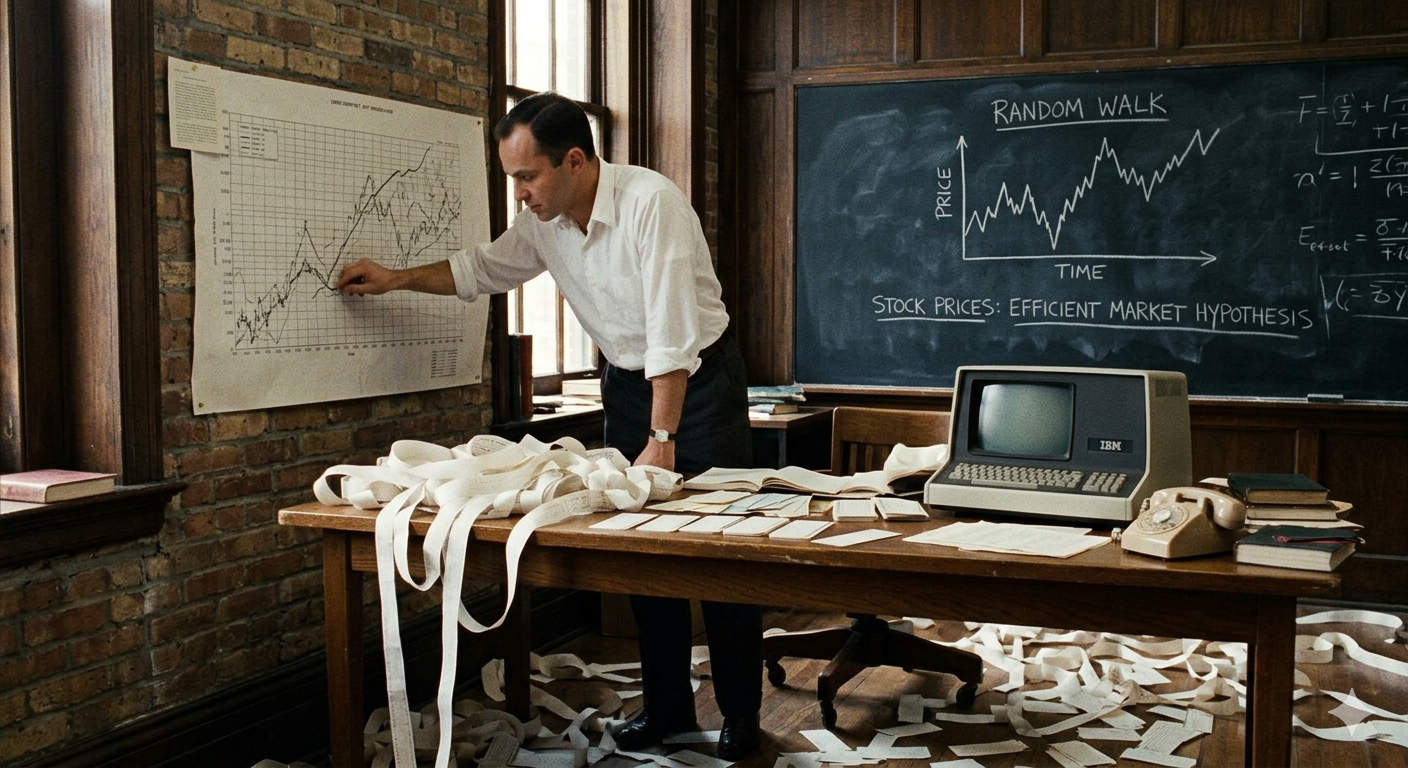
How did this bold attempt to confine the chaotic stock market into a mathematical formula begin? It started at the University of Chicago in the 1960s with a young scholar named Eugene Fama. Before Fama, the investment world was largely driven by guesswork and “gut feelings.” He decided to apply the cold, hard yardsticks of “data” and “statistics” to the market. After analyzing tens of thousands of stock price data points, he reached a conclusion that sent shockwaves through the financial industry:
“Stock prices move like the steps of a drunkard (Random Walk). It is impossible to predict where they will go tomorrow based on where they were yesterday!”
Why this theory became a financial ‘rockstar’ in North America:
- Order Amidst Uncertainty: It explained the complex market with a single word: “Efficiency.” Academic circles were enamored by the idea that markets are self-correcting machines that reflect truth through prices.
- A Weapon for Institutional Capital: This theory became the bedrock for John Bogle, the founder of Vanguard. It led to the birth of the Index Fund, based on the logic that “Since you can’t beat the market, you should simply own the market at the lowest possible cost.”
- The Advent of High-Frequency Trading: As computers began processing vast amounts of data in real-time, EMH moved beyond a mere hypothesis to become the “orthodoxy” of modern financial engineering.
2. The Mechanics: Why Prices Move Randomly
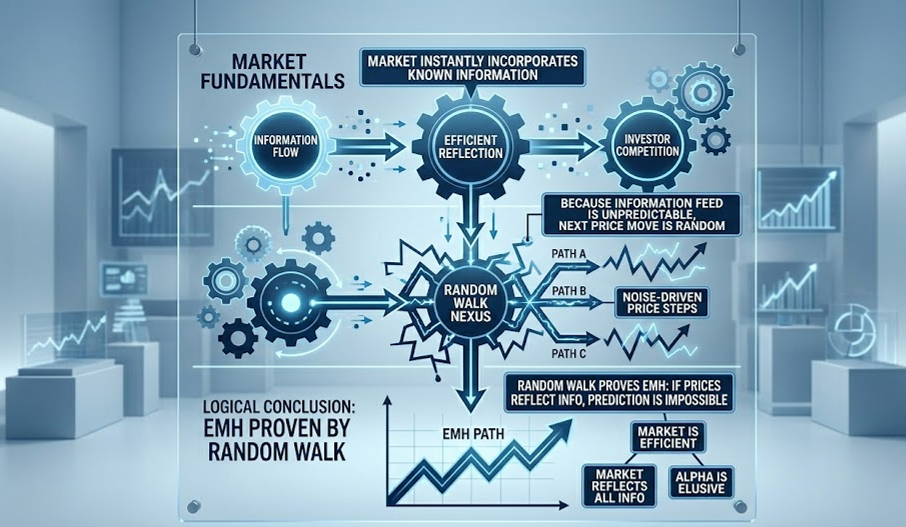
To understand why the “Random Walk” theory is the root and evidence of an efficient market, we must look at how information travels. In highly developed markets like the NYSE or TSX, efficiency is driven by three primary factors:
1) Immediate Information Incorporation
In a digital age, new information is reflected in stock prices at the speed of light. If a breakthrough technology or a surprise earnings beat is announced, the price adjusts almost instantly. By the time a retail investor reads the headline on their phone, the “profit” from that news has already been “consumed” by the current market price.
2) Dependence on ‘New Information’
If all known information is already baked into the price, the only thing that can move the stock tomorrow is “new information that doesn’t exist yet.” By definition, true news is a surprise. Since surprises are unpredictable, price movements appear random—much like a drunk person not knowing where their next step will land.
3) Conclusion: “The Past Does Not Inform the Future”
Fama’s research proved there is zero statistical correlation between yesterday’s price trends and today’s. The market essentially has no memory. Think of it like a coin toss: the result of the last flip has no influence on the next one. EMH is the engine that creates this unpredictability, and the Random Walk is the footprint it leaves behind.
3. Behavioral Finance: “The Market Isn’t Always Rational”
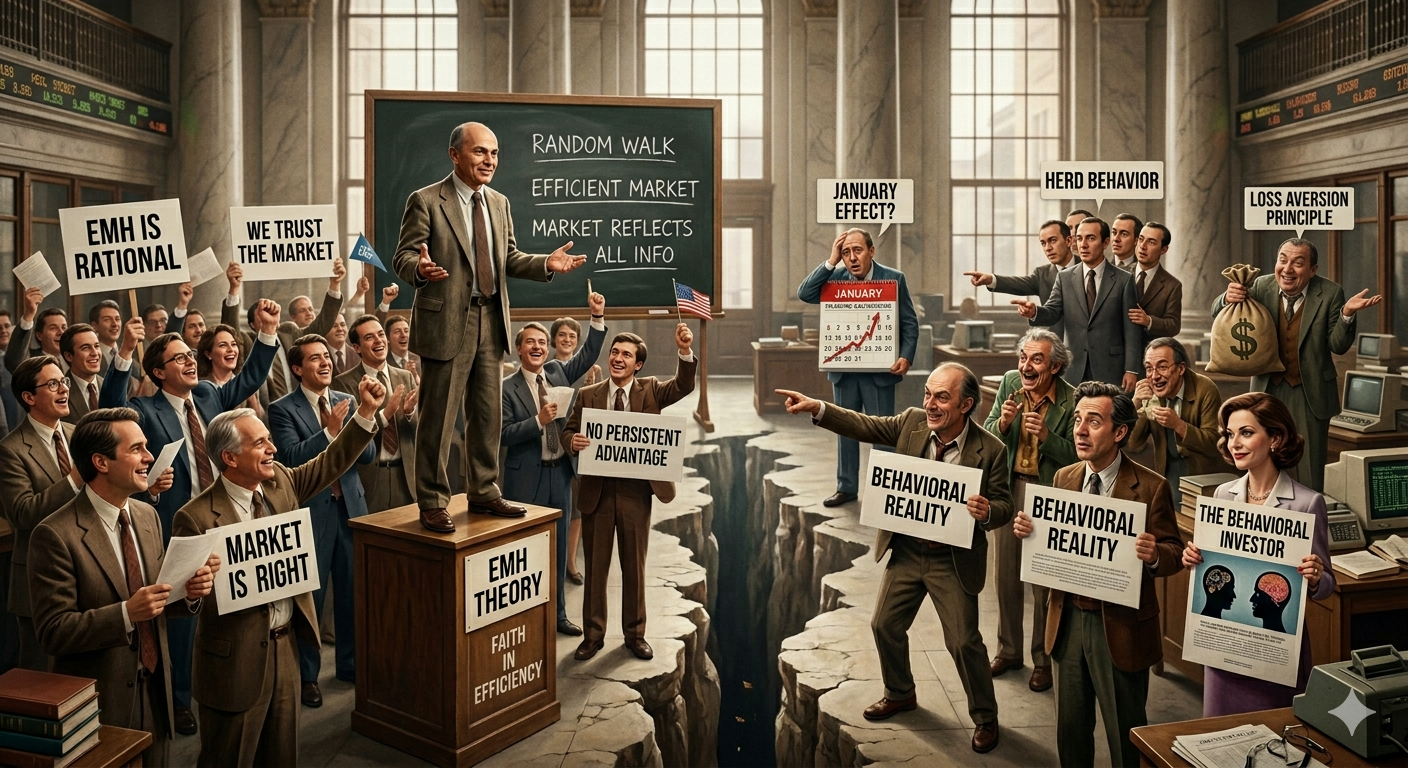
While EMH is beautiful on paper, behavioral economists argue that the market is driven by the “human heart,” which is often far from efficient. In the real world, we see clear evidence that the market isn’t a perfect machine:
1) Irrational Decision-Making
EMH assumes humans are cold, calculating machines. In reality, investors suffer from Loss Aversion (feeling the pain of a loss twice as much as the joy of a gain) and Confirmation Bias (only seeking news that supports what they already want to believe).
2) Herd Behavior & Overreaction
Investing is often a social activity. When one person runs, everyone runs. This creates a “Huddling Phenomenon” where people over-react with optimism to good news (creating bubbles) or over-react with fear to bad news (leading to panic selling). The market often reflects the crowd’s emotions rather than the company’s fundamentals.
3) Limits of Arbitrage
EMH suggests that when prices are wrong, “smart money” will immediately fix them. However, in reality, smart investors often face capital shortages or psychological pressure that prevents them from acting. As the famous saying goes, “The market can remain irrational longer than you can remain solvent.”
4. The Great Paradox: Why We Must Still Analyze
If you strictly believe in EMH, you might think market analysis is a waste of time. However, to survive as a professional investor, you must analyze more intensely. This is known as the Grossman-Stiglitz Paradox.
- The Paradox: The only reason the market stays efficient is that there are millions of “greedy” investors trying to prove it’s inefficient and find excess returns. If everyone stopped analyzing, price discovery would fail.
- Price vs. Value: While the market price might be “efficient” in terms of public info, it doesn’t mean it’s the “right” price for your specific life goals.
- Adaptive Markets: Analysis helps you see if an asset matches your specific retirement goals, risk tolerance, and North American tax strategies.
5. Success Strategies: What Should You Do?
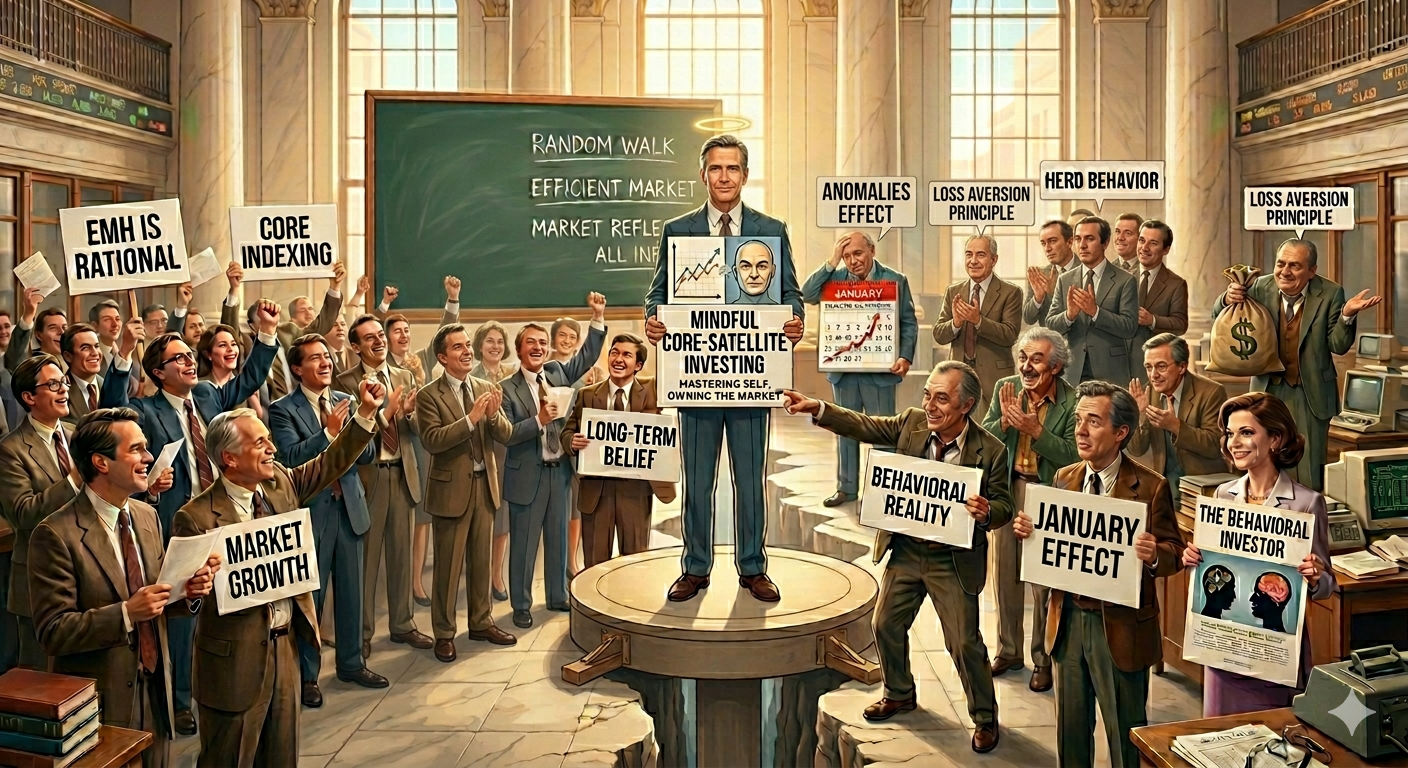
1) Accept Market Efficiency (Passive Strategy)
Don’t try to outsmart thousands of algorithms every day. Keep 70-80% of your portfolio in stable, low-cost ETFs like those tracking the S&P 500 or Nasdaq 100. Let the market’s long-term growth do the heavy lifting for you.
2) Hunt for Inefficiencies (Active Strategy)
Look for gaps when the public is panicking or overly greedy. Focus on sectors you understand deeply—perhaps mid-cap tech or local real estate—where information might lag or human emotion is causing a temporary price distortion.
3) Systemic Control (Psychological Defense)
Use automated Dollar-Cost Averaging and regular Rebalancing. This forces you to buy low and sell high without your emotions getting in the way. It turns your investment strategy into a disciplined system rather than a series of emotional reactions.
6. Summary Table: Market Theory vs. Behavioral Reality
| Category | The EMH Standard (Theory) | The Behavioral Opportunity (Reality) |
| Market Crash | Prices reflecting new risks accurately. | A buying opportunity created by fear. |
| Hot Tech Stocks | News is priced in; do not chase. | Momentum created by herd behavior. |
| Your Role | A navigator riding the market’s waves. | A hunter finding public errors and biases. |
| Greatest Enemy | Market Volatility (Systemic Risk). | Your own emotions (Greed and Fear). |
| Success Goal | Capturing Market Returns (Beta). | Achieving Alpha (Excess Returns). |
Conclusion: Key Takeaways
The debate between Market Efficiency and Behavioral Finance isn’t about choosing a side; it’s about finding a strategic balance.
- Trust the System for the Long Term: Acknowledge that you cannot predict the “Random Walk” of daily prices. Let the core of your wealth grow within efficient, low-cost index funds.
- Master Your Psychology: Recognize that market “inefficiencies” are usually just “human emotions” in disguise. When the crowd panics in the North American markets, stay rational and look for value.
- Never Stop Analyzing: Your analysis is what keeps the market healthy. It provides you with the “armor” to protect your assets during times of high volatility and ensures your portfolio aligns with your ultimate retirement dreams.
AI Disclosure: Created in collaboration with Google Gemini. All core content was authored, reviewed, and edited by the author.