
Buying high-quality blue-chip stocks and holding them for the long term has been the “golden rule” of investing throughout history. However, in the modern era, the environment for practicing this rule has become significantly more complex and sophisticated. In the past, the challenge was finding good companies in a desert of information. Today, we live in an “information flood” where it is increasingly difficult to discern true value from the noise.
As we build this blog to re-examine these timeless investment principles, we will explore two dominant, yet conflicting, perspectives: how incredibly smart the market is (Efficient Market Hypothesis) and why human beings repeatedly make the same mistakes (Behavioral Finance). Some believe the market is a perfect, supercomputer-like machine, while others argue it is a chaotic reflection of human error.
As of 2026, we stand at the crossroads of a “digital market,” where information is priced in at the speed of light, and a “psychological arena,” where greed and fear still run rampant. We live in an age where we must choose: do we look for a mathematical “correct answer,” or do we read the hearts of others to find our opportunity?
1. Understanding Through a Real-World Analogy
Our perspective on the stock market is remarkably similar to how we approach the “Used Car Market.” It comes down to a fundamental belief: Do you trust that the current price perfectly reflects the car’s accident history and performance? Or do you believe that if you inspect it closely enough, you can find a hidden gem that the seller underpriced?
Decoding the Terms:
- Efficient Market Hypothesis (EMH):
- Efficient: This means information does not leak; it is instantly merged into the price.
- Market: The arena where stocks are traded.
- Hypothesis: A theoretical explanation built by scholars.
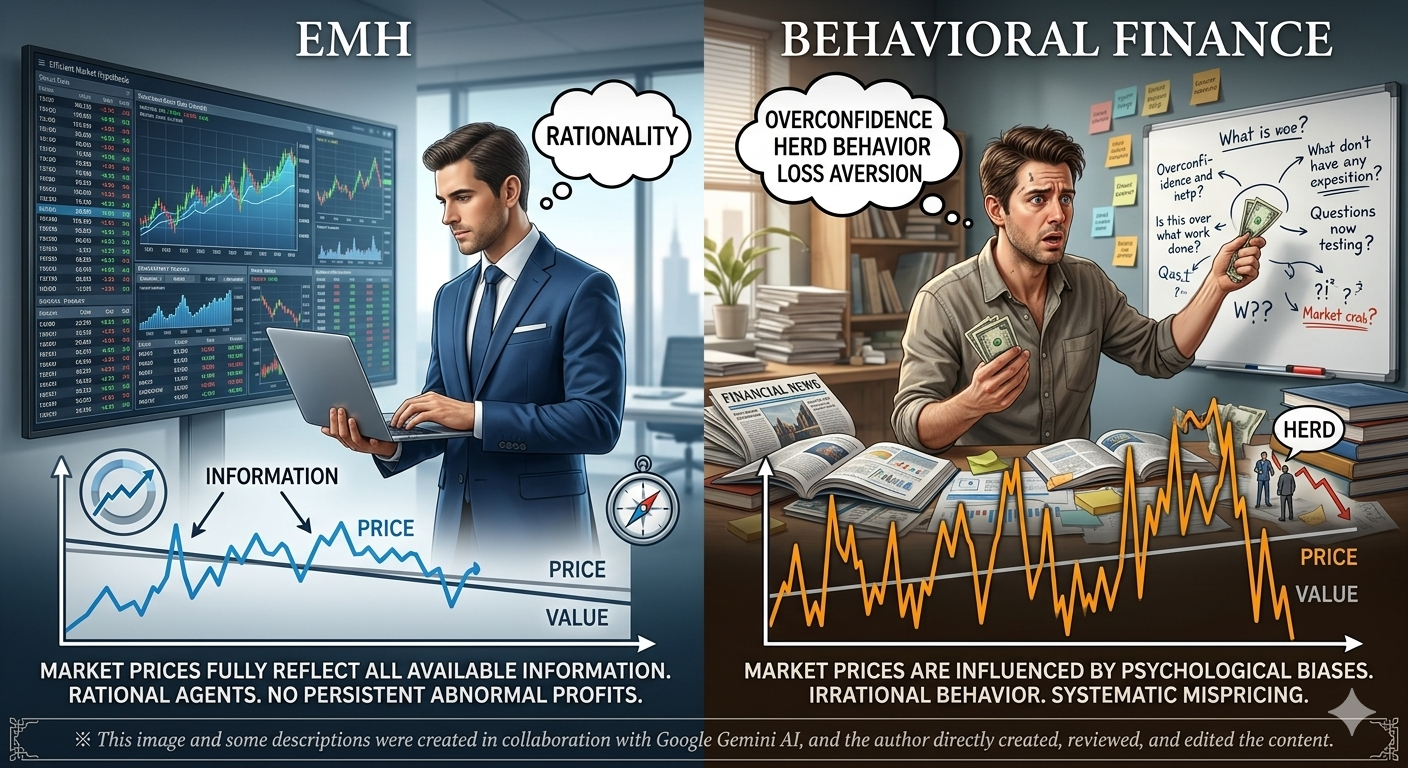
- The Core Message: “The market is so smart that all information is already baked into the price.” This view suggests it is nearly impossible for an individual to consistently outperform the market average through effort alone. (e.g., Index Funds, S&P 500 ETFs)
- Behavioral Finance:
- Behavioral: Studying the actual actions and psychology of people.
- Finance: The study of money management and asset flow.
- The Core Message: “The market is moved by people; therefore, prices are often decided incorrectly due to human emotions and biases.” This view suggests that by exploiting the mistakes of others, one can find opportunities for significant wealth. (e.g., Value Investing, Contrarian Trading)
2. Efficient Market Hypothesis (EMH): “How Fast Does Information Travel?”
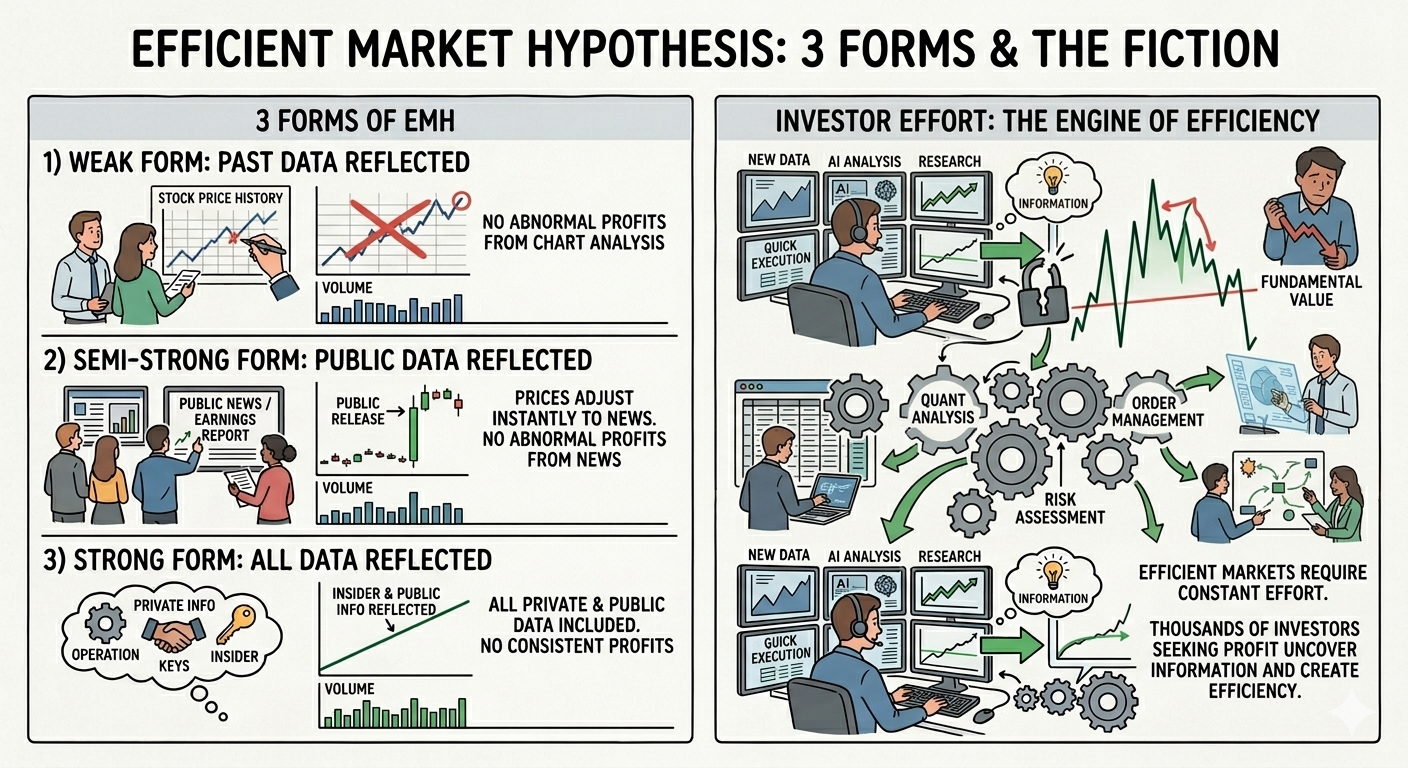
Scholars categorize market efficiency into three stages. Let’s use the popularity of a local “Famous Burger Joint” to explain how this works in the North American market.
- Weak Form Efficiency: “Trying to predict today’s wait time solely by looking at how long the line was yesterday.” This suggests that past price records (charts) are already reflected in the price, meaning technical analysis alone won’t make you rich.
- Semi-Strong Form Efficiency: “The moment a positive review hits social media or the news, the place is instantly packed.” This means all ‘publicly available information’—like earnings reports or news—is immediately reflected in the stock price. Large-cap giants like NVIDIA (NVDA) or Apple (AAPL) typically operate in this space.
- Strong Form Efficiency: “Even the secret recipes or internal business plans known only to the owner are already reflected in the price.” This is a theoretical state of perfection where even insider information is already accounted for in the market value.
3. Behavioral Finance: “Is Our Brain Unfit for Investing?”
Behavioral finance scientifically explains why we consistently make “strange” investment choices. It turns out, our evolutionary wiring often works against us in the stock market.
- Loss Aversion: Scientifically, humans feel the pain of losing $1,000 twice as intensely as the joy of gaining $1,000. This is why many investors refuse to sell a “losing” stock, holding on to it until the loss becomes catastrophic, simply because they cannot stomach the psychological pain of realizing the loss.
- Confirmation Bias: If you have purchased Amazon (AMZN) stock, you tend to only look for news that says the company is doing great while ignoring warnings about regulation or slowing growth. Your instinct is to collect evidence that proves “I made the right choice,” rather than looking at the cold facts.
4. Real-World Strategies: Passive vs. Active
These two theories translate into very different practical strategies depending on which “camp” an investor falls into.
- Index Tracking (EMH Preference): Examples include the Vanguard S&P 500 ETF (VOO) or Invesco QQQ. Those who believe the market is efficient don’t waste time picking individual stocks; they bet on the growth of the entire market.
- Psychology & Value-Based (Behavioral Preference): Examples include focusing on high-growth or high-volatility names like NVIDIA, Tesla, or Broadcom (AVGO). These investors believe that the public’s euphoria or excessive fear creates “bubbles” or “undervalued” situations that offer active opportunities.
5. My Investment Strategy: Harmonizing the Cold Head and Warm Heart
Think of the relationship between EMH and Behavioral Finance as the relationship between a GPS Navigation System and a Driver’s Intuition. One believes the optimal route is pre-calculated and fixed, while the other believes a shortcut can be found depending on the traffic (human behavior).
Catchphrase: “The market is efficient in the head, but it still fluctuates wildly in the heart.”
How should a modern investor harmonize these two? Let’s look at the winning strategies from both sides.
1) The EMH Advice: “Don’t Try to Beat the Market”
EMH argues that no matter how much you study, it is impossible to consistently get information faster than millions of other investors and high-frequency algorithms. Therefore, the smartest strategy is to become the market.
- Execution: Consistently put a fixed amount into ETFs tracking the S&P 500 or Nasdaq 100 every month (Dollar-Cost Averaging).
- The Benefit: You are freed from the agony of analysis and the anxiety of “what if the price drops after I buy?” Over the long term, simply taking the market average usually puts you in the top 10% of all investors.
2) The Behavioral Finance Advice: “Use Human Error as Your Opportunity”
This view questions the perfection of the market. Because humans throw away stocks at ridiculously low prices when panicked and line up to buy at absurdly high prices when greedy, “gaps” are created.
- Execution: Reduce your exposure when the market is excessively euphoric (bubbles) and “courageously” buy when everyone else is pessimistic and prices fall below intrinsic value.
- The Benefit: By moving contrary to the crowd, you can expect “Alpha”—excess returns that exceed the market average.
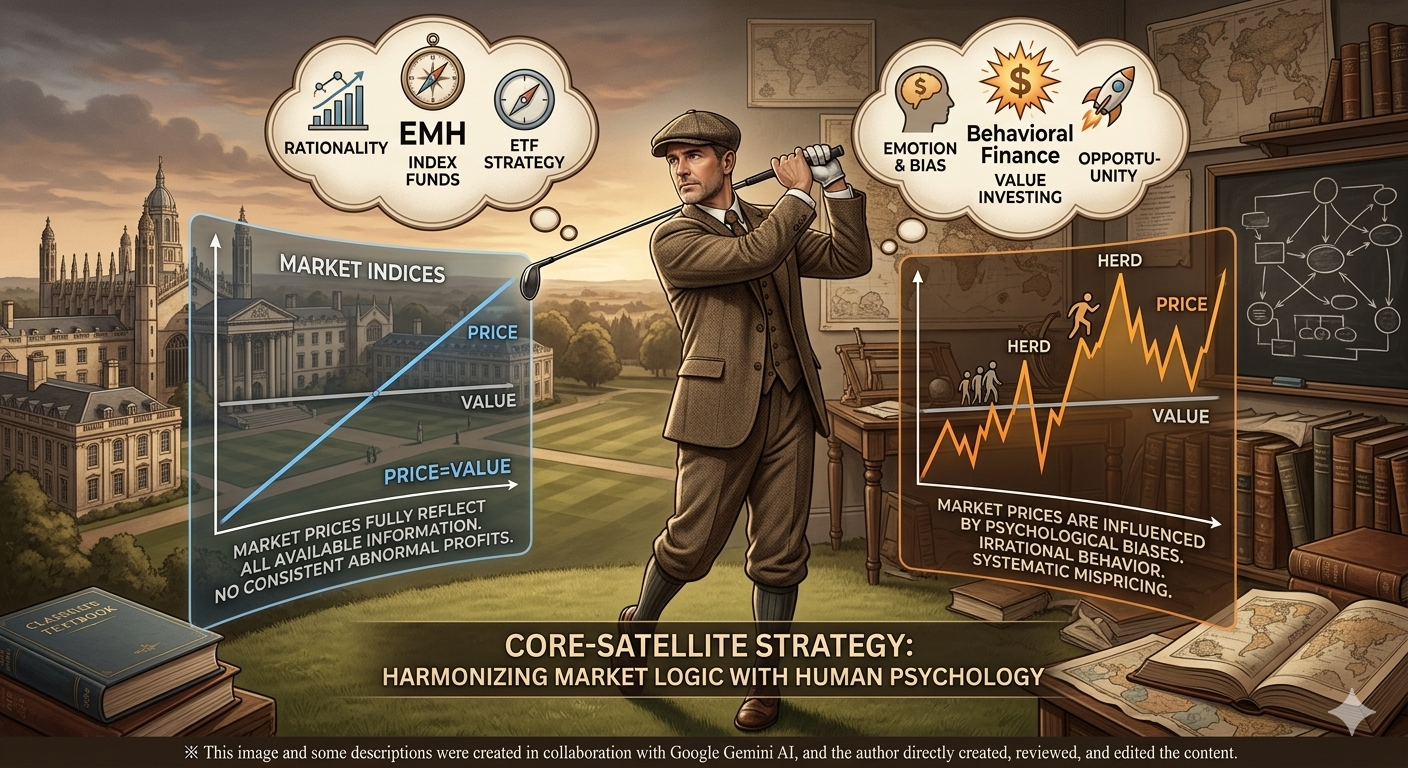
3) The Ultimate Harmony: The ‘Core-Satellite’ Strategy
You don’t have to choose just one. A wise investor combines both to create an optimized portfolio.
- The Core (70-80%): Following EMH advice, keep the majority of your assets in Broad Market ETFs. This serves as the sturdy root of your wealth.
- The Satellite (20-30%): From a behavioral finance perspective, invest in individual stocks you know well (e.g., NVDA, AAPL) or promising sectors. This allows you to hunt for extra returns while enjoying the process of active investing.
6. Summary: A Side-by-Side Comparison
| Category | Efficient Market Hypothesis (EMH) | Behavioral Finance |
| Core Belief | Market prices are always “right.” | Market prices are sometimes “wrong.” |
| Primary Tool | Index Funds, Broad Market ETFs | Individual Stocks, Value Investing |
| The Draw | Low fees and long-term stability | Profit from market distortions/errors |
| Major Risk | Will drop with the overall market | Potential for your own psychological bias |
Conclusion: Key Takeaways
Investing is the act of riding the waves of opportunity created by “human irrationality” while standing on the firm ground of “market efficiency.” When you understand the logic of the market with your head and read the psychology of the crowd with your heart, your portfolio becomes truly resilient.
- Build Your Foundation: Use the efficiency of the market to your advantage with low-cost index funds.
- Stay Vigilant: Recognize that your own brain is wired for biases like Loss Aversion.
- Balance is Key: Use the Core-Satellite approach to protect your future while capturing today’s unique opportunities.
AI Disclosure: Created in collaboration with Google Gemini. All core content was authored, reviewed, and edited by the author.