
Many CEOs are intimately familiar with the depreciation of tangible assets—factories, machinery, and IT hardware. However, when faced with “invisible assets” like patents, brand value, software, and goodwill, many still scratch their heads. “How do I recognize something with no physical substance on my books, and how can I use it as a shield to reduce taxes?”
In today’s column, we will break down the essence of intangible assets, the strict rules of value recognition, and the intense differences between accounting and tax treatments, complete with a global comparison involving the United States and Canada.
1. The CEO’s Primer: 4 Essential Intangible Asset Terms
Before diving into the strategy, we must establish a common framework of terms designed for handling invisible value.
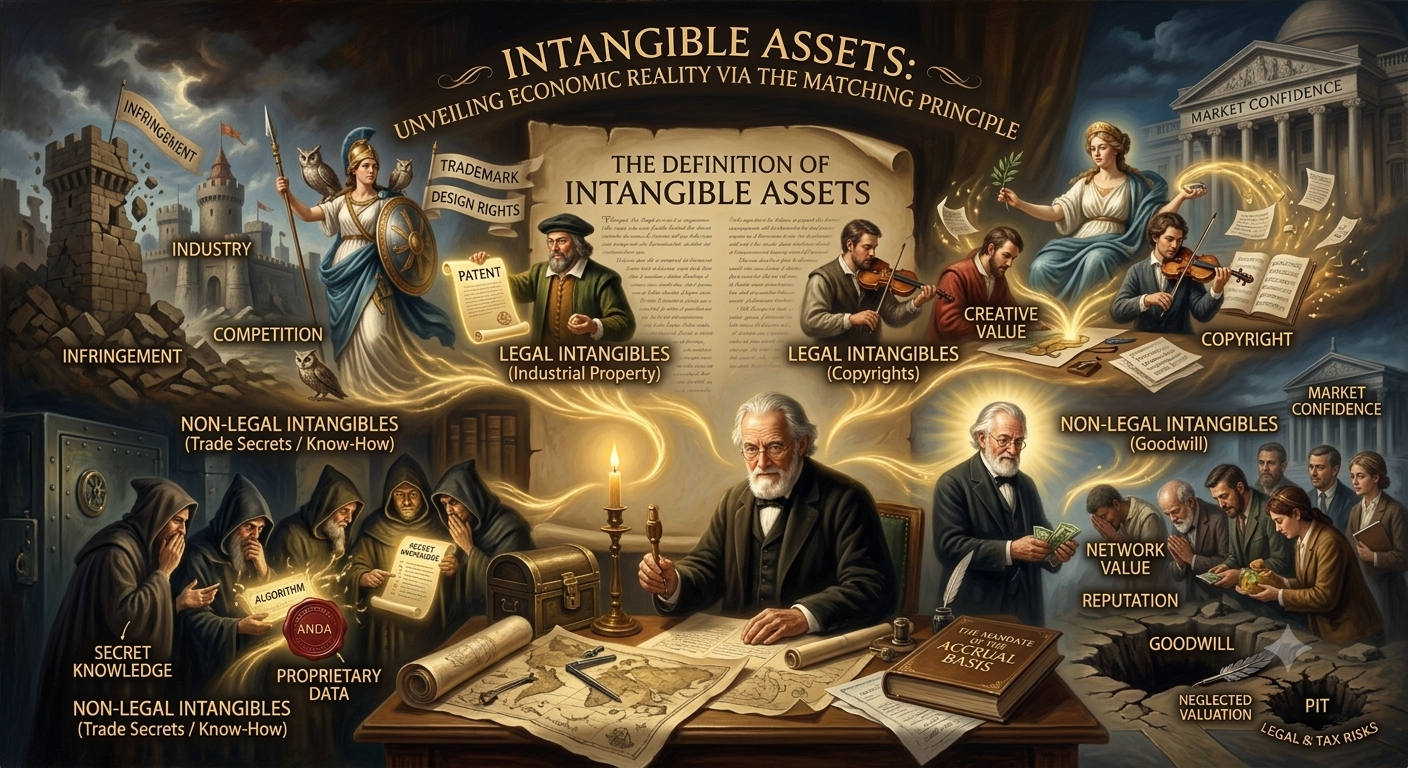
- Intangible Assets: Identifiable non-monetary assets without physical substance, controlled by the entity, from which future economic benefits are expected to flow.
- Identifiability: The core criterion for recognition. An asset is identifiable if it can be separated from the entity and sold, transferred, licensed, or rented, or if it arises from contractual or other legal rights. If it is not identifiable, it cannot be recorded as a specific intangible asset on the balance sheet.
- Capitalization: The accounting process of recording a cost as an asset on the balance sheet (to be expensed over time) rather than as an immediate expense on the income statement.
- Amortization: While the reduction in value of tangible assets is called “Depreciation,” the systematic allocation of the cost of an intangible asset over its useful life is distinguished as “Amortization.”
2. Valuation Realities: How Intangibles Are Created and Recognized
CEOs often make a common mistake: “Our team spent months developing this incredible technology; let’s put it on the books as a $1 million intangible asset right now!”
Unfortunately, accounting standards will flatly reject this. There is a cold, hard distinction between how accounting treats assets you build versus assets you buy.
① Internally Generated Assets vs. Acquired Assets
- Internally Generated Assets: Under conservative accounting principles, internally generated brands, mastheads, and customer lists cannot be recognized as assets. It is too difficult to measure their cost reliably and separate them from the cost of developing the business as a whole.
- Exception (R&D capitalization): Only costs incurred during the strict “Development Phase” of an R&D process—once commercial feasibility is proven—can be capitalized as “Development Costs” (an intangible asset).
- Acquired Assets: Patents, software licenses, or trademarks purchased from a third party are recognized immediately. Their value is clearly proven by the transaction price (the cost paid).
② The Research vs. Development Dichotomy
When a company spends money creating new technology, accounting splits the spending into two strictly defined phases:
| Phase | Activities | Accounting Treatment | Rationale |
| 1. Research | Original and planned investigation undertaken with the prospect of gaining new scientific or technical knowledge. | Expensed Immediately (Research Expense) | Future success is too uncertain to recognize an asset. |
| 2. Development | Application of research findings to a plan or design for the production of new or substantially improved materials, devices, products, or processes prior to commercial production. | Capitalized as Asset (Development Costs) | Success is probable. Capitalization starts only when strict criteria (technical feasibility, intent to sell/use, probable future economic benefit) are met. |
| 3. Launch | Patent registration and commercial product launch. | Amortization Commences | The asset is ready for use and begins generating revenue. |
3. Executive Summary: Key Terminology Comparison (KR vs. US)
To navigate global business, you must understand the nuances of the terminology.
| US/English Term | Practical Meaning & Nuance |
| Intangible Assets | Assets without physical substance but with control and future benefit. |
| Amortization | Systematically expensing the cost of an intangible asset over its useful life. |
| Goodwill | The premium paid over the fair value of net identifiable assets during a business acquisition. Not amortized under US GAAP/IFRS (subject to impairment test). |
| Research Expense / R&D Expense | Costs incurred before commercial feasibility is established; expensed immediately. |
| Capitalized Development Costs | Costs incurred after feasibility is proven; recorded as an asset. |
| Capitalization | Recording an expenditure as an asset rather than an expense. |
| Impairment Loss | A drastic, permanent drop in asset value, recognized immediately as a loss on the P&L. |
| Tax Shield | The reduction in taxable income created by non-cash expenses like amortization. |
4. Amortization Strategies: The Transient vs. The Eternal
Intangible assets are classified by their “useful life.” How you treat them depends entirely on this classification.
① Intangibles with Finite Useful Lives
These assets have a defined period of legal protection or economic utility (e.g., patents, software, contractual licenses).
- Method: Typically amortized using the Straight-Line Method, assuming zero residual value over the lesser of its legal or economic life.
- Tax Effect: Amortization expense acts as a legitimate “Tax Shield,” reducing taxable income annually without immediate cash outflow.
② Intangibles with Indefinite Useful Lives
These are assets where there is no foreseeable limit to the period over which the asset is expected to generate net cash inflows (e.g., Goodwill, certain established brand trademarks).
- Method: These are NOT amortized. Instead, they must undergo a mandatory “Impairment Test” at least annually. If the fair value of the asset drops below its carrying value on the books, an immediate “Impairment Loss” is recognized as an expense.
5. Risk vs. Reward: Are Intangibles “Real” Assets?
For CEOs and investors, intangible assets are a double-edged sword.
- The Source of Wealth (Reward): In the modern Knowledge Economy, a company’s true competitive advantage lies not in its factory buildings (tangible) but in its proprietary technology, brand dominance, and software (intangible). The majority of market value for global Big Tech firms is derived from their Intellectual Property (IP).
- The Risk of Accounting “Fluff”: Intangible asset recognition involves significant subjective judgment by management. Aggressive CEOs might capitalize costs that should be expensed (e.g., staying in the “Development” phase too long for a failing project) to protect recorded profits. This is a common form of financial window-dressing. If the technology fails, that “asset” on the books is merely 서류상의 거품 (paper fluff) that will eventually evaporate via a massive impairment.
6. Global Tax Jurisdictions: South Korea vs. North America (US/Canada)
The gap between Accounting (Book) and Tax treatments is much wider for intangibles than tangibles. Failing to understand these differences when operating globally creates significant tax risks.
① South Korea: Strict Guidelines and “Retention” (유보) Management
- The Development Cost Controversy: The Korean National Tax Service (NTS) strictly monitors R&D capitalization. If a tax audit determines development costs were capitalized without meeting all strict criteria, the capitalization will be denied, the income statement adjusted, and the tax difference managed via a specific equity adjustment called “Retention” (유보).
- Goodwill: Under Korean tax law, goodwill acquired during a merger is amortized equally over 5 years (Straight-Line) for tax deduction purposes.
② US (IRS) & Canada (CRA): Simplified Standardization
Unlike Korea, where tax authorities haggle over the “actual useful life” of a specific asset, North American tax systems utilize standardized, black-and-white rules.
- US Tax Code Section 197 (Amortization of Goodwill and Intangibles): The IRS does not care what your accounting books say about useful life. Under Section 197, almost all acquired intangible assets, including Goodwill, patents, and trademarks, must be amortized over a standardized 15 years (180 months) using the straight-line method for tax purposes.
- Canada Tax Code Class 14.1: Similarly, Canada merges goodwill and other eligible capital property into a single tax depreciation group (CCA Class 14.1), amortized at a standardized rate of 5% annually on a Declining Balance Method.
7. CEO’s Final Takeaway
- Strategically decide whether to capitalize or expense R&D costs. If you need to show strong net income to attract investment immediately, strictly meet capitalization criteria and move costs to “Development Costs” (Asset). Conversely, if you face a high immediate corporate tax burden and need to preserve cash flow, treat costs conservatively as “Research Expenses” to utilize the tax shield now.
- Calculate the tax effects of Goodwill in global M&A. Korea amortizes goodwill for tax over 5 years; the US requires 15 years. This difference drastically changes future Cash Flow projections. This must be factored into the deal structure valuation during cross-border acquisitions.
- Beware of “Fluff” on your balance sheet. During audits or valuation exercises, worthless development costs or trademarks can evaporate in an instant, turning into an Impairment Loss that creates a surprise net loss. Periodically, ruthlessly self-assess whether your intangible assets are truly generating revenue rights.
※ This post was created in collaboration with Google Gemini AI. The author created, reviewed, and edited the content to ensure accuracy and strategic business context.