
For many corporate executives, depreciation is often dismissed as a routine accounting entry—a line item managed quietly by the finance department or external tax advisors to write down fixed assets over time.
However, when viewed through a strategic lens, depreciation is far more than a passive compliance requirement. In corporate finance, it serves as a powerful strategic lever to manage earnings quality, protect operational cash flow, optimize capital allocation, and align executive incentives.
Here are five deep strategic insights on how C-suite leaders and finance teams can leverage depreciation within the context of U.S. GAAP, the IRS tax framework, and modern business realities.
1. Earnings Management and Quality of Earnings (QoE)
At its core, depreciation operates as a mechanism for earnings smoothing, helping companies align capital expenditures with the revenues those assets generate over time.
- Preventing P&L Distortions: Under the matching principle, absorbing a $10M automated assembly line in a single fiscal year would artificially collapse current-period net income, creating an illusion of windfall profits in subsequent years. Depreciation distributes this cost across the asset’s useful life to reflect true economic performance.
- Management Discretion and Audit Risks: Determining an asset’s useful life and choosing a depreciation method (e.g., straight-line vs. declining balance) involves significant executive judgment.
- Executives under pressure to meet quarterly earnings targets or maintain credit ratings may be tempted to artificially extend an asset’s useful life to reduce annual depreciation expense and boost reported EPS.
- However, aggressive accounting assumptions degrade a company’s Quality of Earnings (QoE). During M&A due diligence or SEC scrutiny, these distortions often trigger massive impairment losses, damaging corporate reputation and shareholder value.
2. Cash Flow Optimization & The IRS Tax Shield Strategy
While depreciation reduces net income on the Income Statement, it is a non-cash expense. No physical cash leaves the corporate bank account when depreciation is recognized.
- Protecting Operating Cash Flow (OCF): Because cash outflows occur when the capital asset is initially purchased, depreciation is added back to Net Income on the Statement of Cash Flows (Indirect Method) to determine true cash generated from operations.
- Leveraging the Tax Shield: Depreciation creates a legitimate, non-cash tax deduction that reduces taxable income, directly preserving liquidity.
$$\text{Tax Shield Savings} = \text{Depreciation Expense} \times \text{Corporate Tax Rate}$$
- Maximizing U.S. Tax Incentives (Section 168(k) & Section 179): To accelerate cash accumulation during growth phases, CFOs should aggressively navigate IRS provisions like Bonus Depreciation and Section 179 expensing. Front-loading depreciation allows companies to defer federal and state tax liabilities, effectively creating an interest-free loan from the government to fund ongoing working capital or reinvestment.
3. Capital Budgeting (CAPEX) & Managing Fixed-Cost Leverage
When evaluating major Capital Expenditures (CAPEX), integrating depreciation schedules into capital allocation models is critical to project success.
- DCF, NPV, and IRR Integration: Discounted Cash Flow (DCF) models—used to determine Net Present Value (NPV) and Internal Rate of Return (IRR)—rely on cash flows, not accounting profits. The timing and scale of depreciation-driven tax shields significantly alter projected cash flows, directly impacting investment decisions.
- Operating Leverage & Break-Even Point (BEP): Capital-intensive investments lock in high fixed depreciation costs for years. This increases the company’s operating leverage. During economic downturns or revenue contractions, these fixed costs raise the company’s Break-Even Point (BEP), exacerbating margin compression.
- Preventing Capital Lock-In in High-Tech Sectors: In fast-moving industries (e.g., semiconductors, AI infrastructure, software/cloud hardware), asset useful lives must be benchmarked against technological obsolescence, not physical durability. Keeping useful lives long creates a capital lock-in effect—executives hesitate to upgrade to next-gen technology because writing off obsolete assets would trigger massive write-downs on the balance sheet.
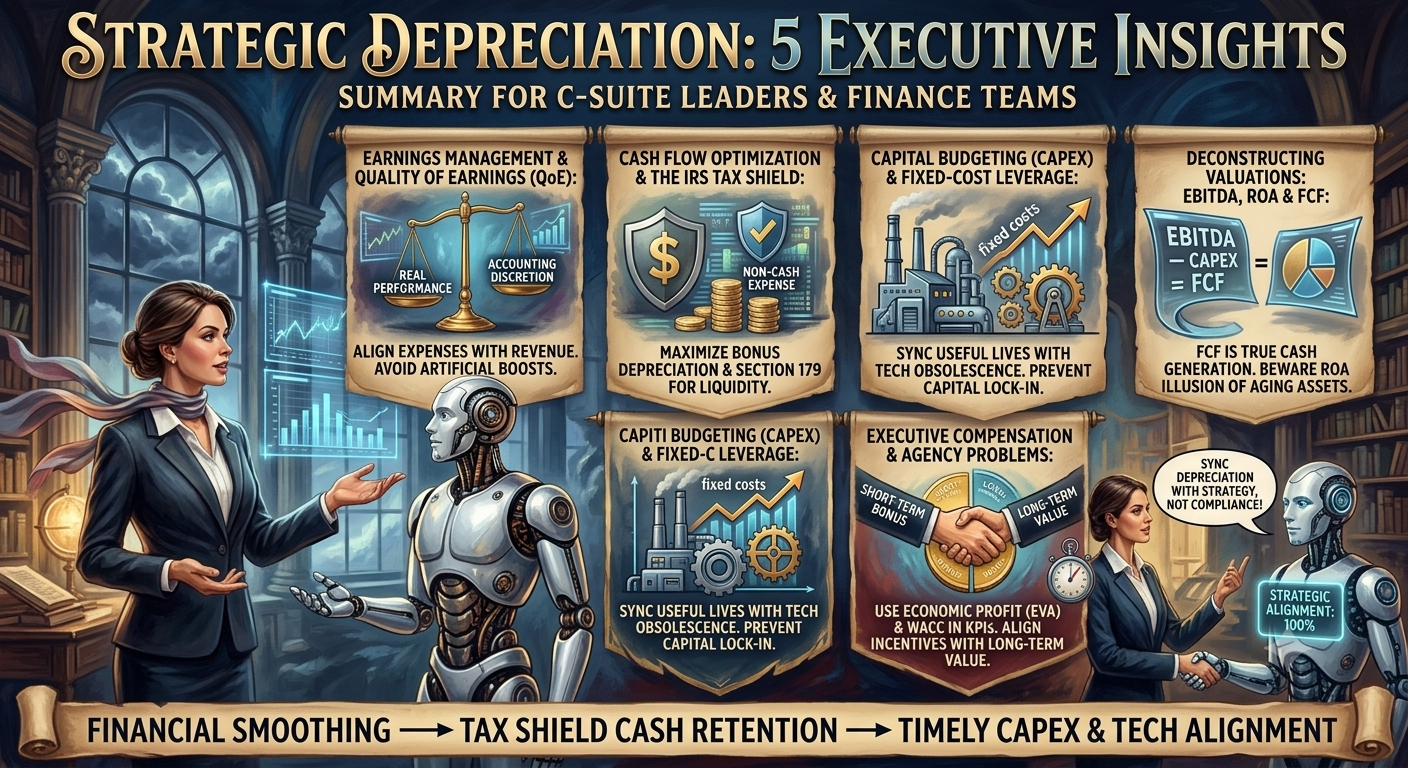
4. Deconstructing Valuations: EBITDA, ROA, and FCF
Wall Street and private equity firms frequently rely on depreciation-adjusted metrics to evaluate corporate value, but these metrics carry hidden traps.
- The Pitfalls of EBITDA Over-Reliance: EV/EBITDA is widely used in M&A to compare operating performance across companies with different capital structures and tax regimes. However, relying solely on EBITDA ignores ongoing capital reinvestment needs. A business with high EBITDA but massive annual CAPEX demands may generate weak Free Cash Flow (FCF). Executives must evaluate EBITDA minus CAPEX to understand true cash generation.
- The ROA Illusion: As assets age and accumulate depreciation, their Net Book Value (the denominator in Return on Assets) shrinks. Consequently, a division with aging, fully depreciated equipment may report an artificially high ROA despite declining operational efficiency and imminent failure risks.
5. Executive Compensation & Agency Problems
Depreciation policy intersects directly with corporate governance, executive performance metrics (KPIs), and incentive structures.
- Mitigating Short-Termism (Executive Myopia): Professional managers with short tenure horizons may defer necessary CAPEX projects or over-extend asset useful lives to suppress depreciation costs. This artificially inflates short-term operating income and ROE, securing performance bonuses while leaving the company with an aging, uncompetitive asset base.
- Designing Better KPIs (EVA Frameworks): To align executive incentives with long-term shareholder value, boards should look beyond basic operating income. Implementing Economic Value Added (EVA) or factoring in the Weighted Average Cost of Capital (WACC) ensures that management is held accountable for the full lifecycle cost and capital charge of the assets under their control.
💡 Executive Takeaways
- Align Tax Depreciation with Liquidity Needs: Work with tax strategy teams to maximize IRS accelerated depreciation provisions (Bonus Depreciation / Sec. 179) during heavy investment cycles to preserve internal liquidity.
- Focus on Free Cash Flow (FCF) Over EBITDA: Do not let high EBITDA metrics mask heavy ongoing maintenance CAPEX. Track FCF to ensure long-term solvency and reinvestment capability.
- Guard Against Accounting Distortions in Compensation: Structure executive KPIs using economic profit metrics (like EVA) to prevent managers from delaying necessary capital upgrades to artificially boost short-term net income.