
When business leaders purchase tangible assets—such as factories, commercial real estate, heavy machinery, corporate fleets, or IT infrastructure—a common question arises: “Since cash went out the door, does this register as an immediate loss on this month’s income statement?”
Standard accounting rules strictly reject this assumption. Expensing a million-dollar equipment purchase all at once would artificially crush a company’s current profitability. Conversely, failing to track the wear and tear of a revenue-generating asset over time would mislead investors and leadership alike.
This guide explores the essence of tangible asset depreciation, clarifies how it differs from market valuation, breaks down primary calculation methods, examines its impact on cash flow and profitability, and addresses complex scenarios like fully depreciated assets and impairment losses.
1. The Core Essence: Expense Allocation, Not Market Valuation
A common misconception among business owners is that depreciation tracks the real-time resale value or used-market price of an asset.
💡 The Accounting Definition of Depreciation
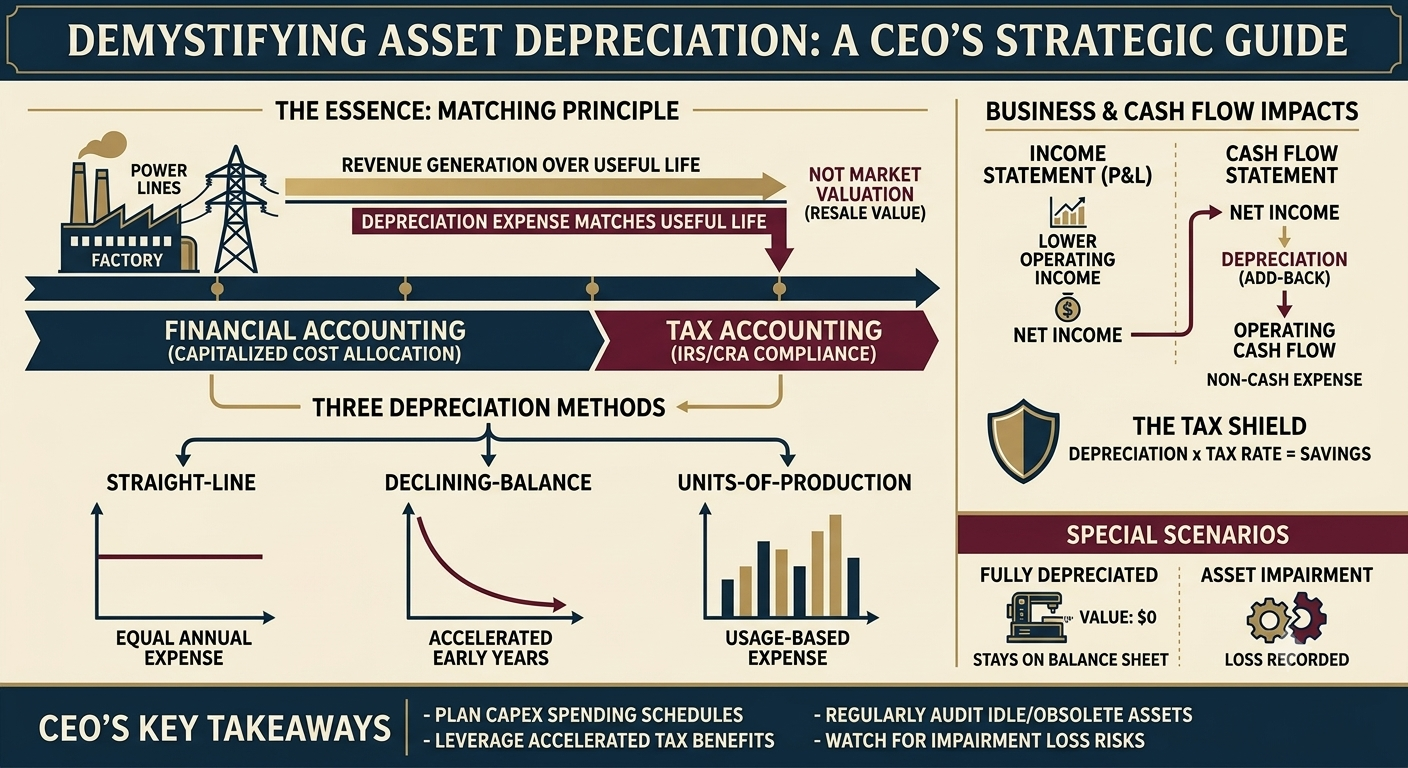
Depreciation is the systematic allocation of an asset’s historical cost (minus its estimated salvage value) over its useful life—the period during which the business expects to generate economic benefits from it.
- The Matching Principle: If a $1,000,000 piece of manufacturing equipment generates revenue over five years, accounting principles mandate spreading that $1,000,000 cost across those same five years. This aligns expenses directly with the revenues they help generate.
- Depreciation vs. Market Valuation: Market valuation measures what an asset could sell for on the open market today (fair market value). Depreciation simply distributes historical costs over time. Consequently, an asset’s net book value (carrying value) on a balance sheet rarely reflects its real-world secondhand market price.
2. Three Primary Methods for Calculating Depreciation
Selecting the right depreciation model depends heavily on how an asset delivers economic value over time.
| Calculation Framework | Formula | Typical Application |
|---|---|---|
| Straight-Line Method | Annual Expense=Useful LifeCost−Salvage Value | Commercial buildings, office furniture, basic fixtures |
| Declining-Balance Method | Annual Expense=Book Value×Depreciation Rate | Tech hardware, vehicles, machinery subject to rapid obsolescence |
| Units-of-Production Method | Annual Expense=(Cost−Salvage Value)×Total Estimated UnitsUnits Produced | Specialized manufacturing equipment, mining gear, aircraft engines |
① Straight-Line Method
Expenses an equal amount each year. It is best suited for assets that yield consistent utility throughout their operational lifespan.
② Declining-Balance Method
Accelerates expense recognition, writing off a larger portion of the asset’s value in its early years. This approach reflects assets that lose efficiency or face technological obsolescence quickly.
③ Units-of-Production Method
Ties depreciation directly to operational usage rather than the passage of time. If a machine runs heavily one quarter and sits idle the next, the recorded expense fluctuates accordingly.
3. Financial and Operational Impacts on the Business
Impact on the Income Statement (P&L)
Depreciation enters the income statement as either Cost of Goods Sold (COGS) for factory equipment or Operating Expenses (OPEX) for headquarters facilities and executive fleets. Higher depreciation reduces operating income and net income.
Impact on Cash Flow: A Non-Cash Expense
Depreciation is a paper expense. The actual cash outflow occurred entirely when the asset was originally purchased. Because no cash leaves the bank account when recording annual depreciation, financial analysts add depreciation back to net income when calculating Cash Flow from Operating Activities.
The Tax Shield Effect
While depreciation requires no immediate cash outlay, tax authorities allow it as a deductible expense. This lowers taxable income and reduces corporate tax liabilities, creating a tangible tax shield:
Tax Shield Savings=Depreciation Expense×Corporate Tax Rate
4. Navigating Complex Real-World Scenarios
Fully Depreciated Assets Still in Operation
When an asset reaches the end of its useful lifespan and its carrying value drops to a nominal amount (often a nominal $1 sum), annual depreciation stops. However, if the asset remains operational on the factory floor, it stays on the balance sheet.
If the company eventually sells this fully depreciated asset to a third party, the entire proceeds (minus any nominal book value) are recognized as a Gain on Disposal of Assets, boosting non-operating income for that fiscal period.
Unexpected Loss in Value: Depreciation vs. Asset Impairment
If equipment is damaged in an accident or rendered obsolete overnight by a sudden technological breakthrough, standard depreciation schedules no longer suffice.
Under accounting standards, the company must execute an Impairment Test. If the recoverable amount drops permanently below the carrying value, the business must write down the asset immediately and record an Impairment Loss on the income statement during that fiscal year.
5. Financial Accounting vs. Tax Accounting: Key Differences
Corporate leaders must manage two sets of expectations: financial reporting standards (GAAP/IFRS) and tax compliance rules (such as IRS guidelines in the United States).
| Dimension | Financial Accounting (GAAP / IFRS) | Tax Accounting (IRS / CRA) |
|---|---|---|
| Primary Goal | Presents an accurate view of financial health to stakeholders | Ensures standardized, equitable tax collection |
| Useful Life | Estimated by management based on economic utility | Governed by statutory recovery periods (e.g., MACRS in the US) |
| Expense Limits | Based on reasonable economic principles | Subject to statutory caps and specific tax deduction limits |
| Execution | Mandatory accounting entry every reporting period | Managed via tax adjustments, bonus depreciation, or Section 179 |
Tax accounting in North America often provides accelerated mechanisms—such as the Modified Accelerated Cost Recovery System (MACRS) or Section 179 expensing in the US—allowing businesses to write off capital investments faster than traditional GAAP methods permit.
Conclusion: Key Takeaways
- Incorporate Depreciation into CAPEX Planning: Capital expenditures increase fixed costs on future income statements. Evaluate how added depreciation impacts your break-even point before approving major equipment purchases.
- Leverage Tax Provisions Strategically: Work with tax professionals to utilize accelerated depreciation models, Section 179 deductions, or bonus depreciation to preserve working capital during high-growth investment phases.
- Audit Idle and Obsolete Assets Regularly: Holding non-productive or technologically obsolete assets on your books generates unnecessary ongoing expenses and heightens the risk of sudden impairment write-downs during financial audits.
AI Disclosure: This content was developed in collaboration with Google AI tools, followed by rigorous human review, translation adaptation, and editorial oversight to ensure technical accuracy and regional compliance.