
Imagine an indispensable business partner approaches you asking to borrow $10 million. They offer a compelling proposal: “I’ll pay you $50,000 every month as interest (a subscription fee), and I’ll return the full principal in three years. If you need cash urgently in the meantime, feel free to sell this paper to someone else.”
This arrangement represents the foundation of modern corporate finance: The Bond.
Bonds serve as both a powerful mechanism for corporations to raise large-scale capital and an effective vehicle for deploying excess corporate reserves. However, as accounting teams prepare period-end financial statements, bonds frequently become a source of complexity. Failing to properly account for discounting, premium amortization, and interest rate fluctuations can severely distort an organization’s financial reporting.
This guide provides a comprehensive overview of bond valuation, the mechanics of effective interest rate accounting under IFRS 9, and the strategic implications every executive must master.
1. Core Terminology & Fundamental Concepts
To navigate bond markets and corporate reporting effectively, executives must be familiar with key terminology:
- Bond: A formal debt instrument issued by governments, public entities, or corporations to raise long-term capital from investors.
- Face Value / Par Value: The nominal amount stated on the bond certificate, which the issuer agrees to repay at maturity.
- Coupon Rate: The contractual annual interest rate that the issuer promises to pay the bondholder periodically.
- Market Interest Rate (Yield to Maturity): The prevailing market rate of return required by investors for similar risk profiles. This is the primary driver of a bond’s current market value.
- Amortized Cost: The carrying value of a bond on the balance sheet, adjusted over time using the effective interest method to account for initial discounts or premiums.
2. Visualizing Bond Structure & Classification
Bonds function as “subscription-based promissory notes.” They guarantee periodic cash inflows (coupons) and principal repayment at maturity, while remaining fully tradeable in secondary markets.
By Issuer Type
- Government & Municipal Bonds: Backed by sovereign credit; minimal default risk.
- Corporate Bonds: Issued by enterprises; yields include a credit spread reflecting business risk.
By Structure & Features
- Coupon Bonds: Regular periodic interest payments with principal paid at maturity.
- Zero-Coupon Bonds: Issued at a deep discount; pays no interim interest.
- Convertible Bonds (CB/BW): Embedded options allowing conversion into equity.
3. Core Mechanics: Bond Valuation & The Seesaw Rule
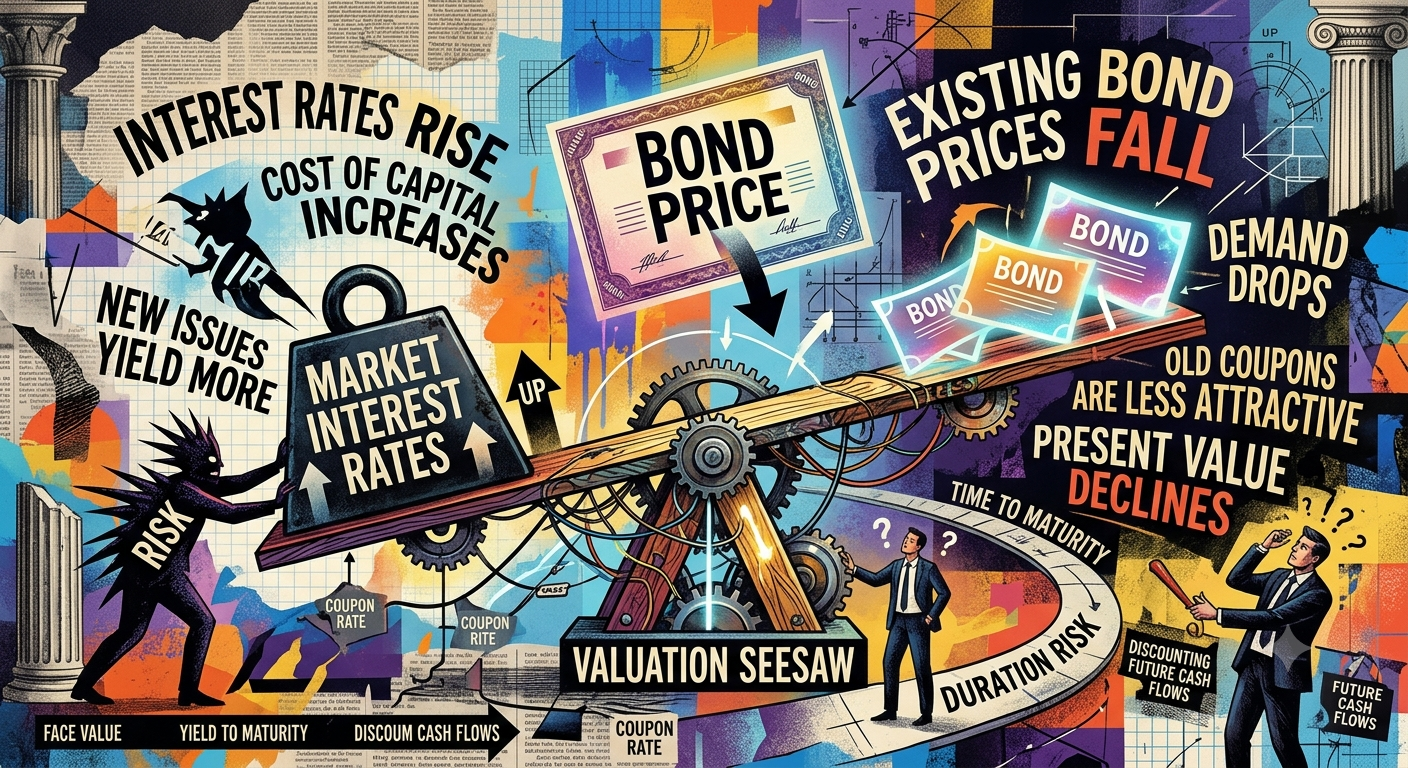
Bond prices and market interest rates move in opposite directions—a relationship often referred to as the Seesaw Rule.
Understanding Interest Rates
The interest rate represents the price of borrowing capital.
- Rising Rates (High Interest Rate Environment): Capital becomes scarce and costly. Investors demand higher yields across all asset classes.
- Falling Rates (Low Interest Rate Environment): Capital becomes abundant. Investors accept lower yields on fixed-income allocations.
Fixed Coupon vs. Fluctuation Market Yields
Because a bond’s contractual coupon rate remains fixed throughout its tenor, changes in prevailing market rates adjust the bond’s present value:
- When Market Rates Rise above the Coupon Rate:Newly issued market debt yields higher returns. To attract buyers, existing bonds with lower fixed coupon payments must trade at a discount (below face value).
- When Market Rates Fall below the Coupon Rate:Existing bonds offering higher fixed coupon rates become attractive. Investors are willing to pay a premium (above face value) to secure these cash flows.
Market Rates Rise
Rates ▲ | Price ▼Newly issued debt offers higher yields. Demand for existing, lower-yielding fixed coupon debt drops, causing its market price to fall to a discount.
Market Rates Fall
Rates ▼ | Price ▲Newly issued debt yields decline. Existing bonds with higher locked-in coupon rates become more valuable, trading at a premium.
4. Financial Accounting for Bonds (IFRS 9 Framework)
When corporations hold or issue bond investments, accounting entries depend on business models and contractual cash flow characteristics.
Asset Accounting (Holder’s Perspective)
| Classification Category | Full Accounting Name | Valuation Metric | Income Statement / Balance Sheet Impact |
| AC Financial Asset | Amortized Cost | Amortized Cost | Held solely to collect contractual cash flows. Market value fluctuations are excluded from financial statements. |
| FVOCI Financial Asset | Fair Value through Other Comprehensive Income | Fair Value | Held to collect cash flows and for potential sale. Fair value changes pass through Equity (OCI) rather than Net Income. |
| FVTPL Financial Asset | Fair Value through Profit or Loss | Fair Value | Active trading purposes. Period-end fair value adjustments pass directly into Current Net Income. |
Issuer Accounting (Liability Perspective)
When bonds are issued at a discount (Market Rate > Coupon Rate) or premium (Market Rate < Coupon Rate), the resulting difference is recorded in a contra-liability or adjunct-liability account. Over the life of the bond, issuers must apply the Effective Interest Method to systematically amortize this difference into periodic interest expense, ensuring the carrying value equals face value at maturity.
5. Risk Management & Executive Action Checklist
Managing bond positions requires balancing interest rate exposure, valuation risk, and debt structures.
Capital Structure Timing
Issue long-term, fixed-rate corporate bonds during low-interest-rate cycles to lock in favorable financing costs and mitigate future refinancing risk.
Earnings Volatility Control
Align corporate treasury allocations with appropriate IFRS 9 classifications (AC or FVOCI) to prevent market yield shifts from creating unmanaged earnings volatility.
Duration & Credit Monitoring
Monitor duration risk on fixed-income investments while tracking issuer credit ratings to safeguard corporate reserves against rating downgrades.
6. Strategic Takeaways
- Bonds as Capital Tools: Debt issuance allows companies to optimize their Weighted Average Cost of Capital (WACC) while avoiding equity dilution.
- Valuation Dynamics: Because fixed coupon payments do not adjust to broader market trends, prevailing interest rates determine market price discounts or premiums.
- Accounting Realities: Applying the effective interest method ensures financial reporting reflects true economic yields over time rather than simple cash flows.