
As the fiscal year draws to a close, corporate finance teams across Silicon Valley and Wall Street enter a high-stakes ritual: closing the books. Behind the scenes, CFOs and controllers spend countless late nights executing Adjusting Entries.
To the untrained eye, adjusting entries may seem like esoteric accounting bureaucracy. In reality, they form the bedrock of financial integrity under US GAAP (Generally Accepted Accounting Principles).
Whether you are a venture-backed founder preparing for a Series C due diligence, a PE-backed CEO optimizing EBITDA, or a corporate finance executive navigating an annual audit, failing to understand year-end adjustments can lead to misstated earnings, IRS penalties, or destroyed deal valuations.
Here is what every executive must understand about adjusting entries, revenue recognition, and financial strategy in the modern American business landscape.
1. Core Terminology: The Financial “Retouching” Process
Before diving into strategic implications, let us establish the fundamental framework:
- Adjusting Entries: Journal entries made at the end of an accounting period to allocate revenues and expenses to the exact period in which they actually occurred.
- Accrual Basis Accounting: The US GAAP standard requiring revenues to be recognized when earned and expenses when incurred, regardless of when physical cash changes hands.
- Cash Basis Accounting: An informal system where transactions are recorded only when cash enters or leaves a bank account—unacceptable for GAAP-compliant audited statements.
- Matching Principle: The accounting mandate requiring companies to match expenses directly against the revenues they helped generate during the same reporting period.
The Analogy: Adjusting Entries as Financial Photoshop
When capturing product photos or executive headshots, raw images often require exposure adjustments and color balance to reflect reality accurately. Retouching is not about manipulating facts; it is about eliminating lighting distortions to reveal the true picture.
In corporate accounting, adjusting entries serve as this high-fidelity adjustment layer. Throughout the year, cash flows into and out of corporate accounts at irregular intervals. Adjusting entries remove cash-flow timing distortions to present an accurate snapshot of operational performance.
2. Accrual Accounting vs. Cash Basis: The US GAAP Reality
Under US GAAP, companies cannot simply report cash receipts as revenue or cash disbursements as expenses.
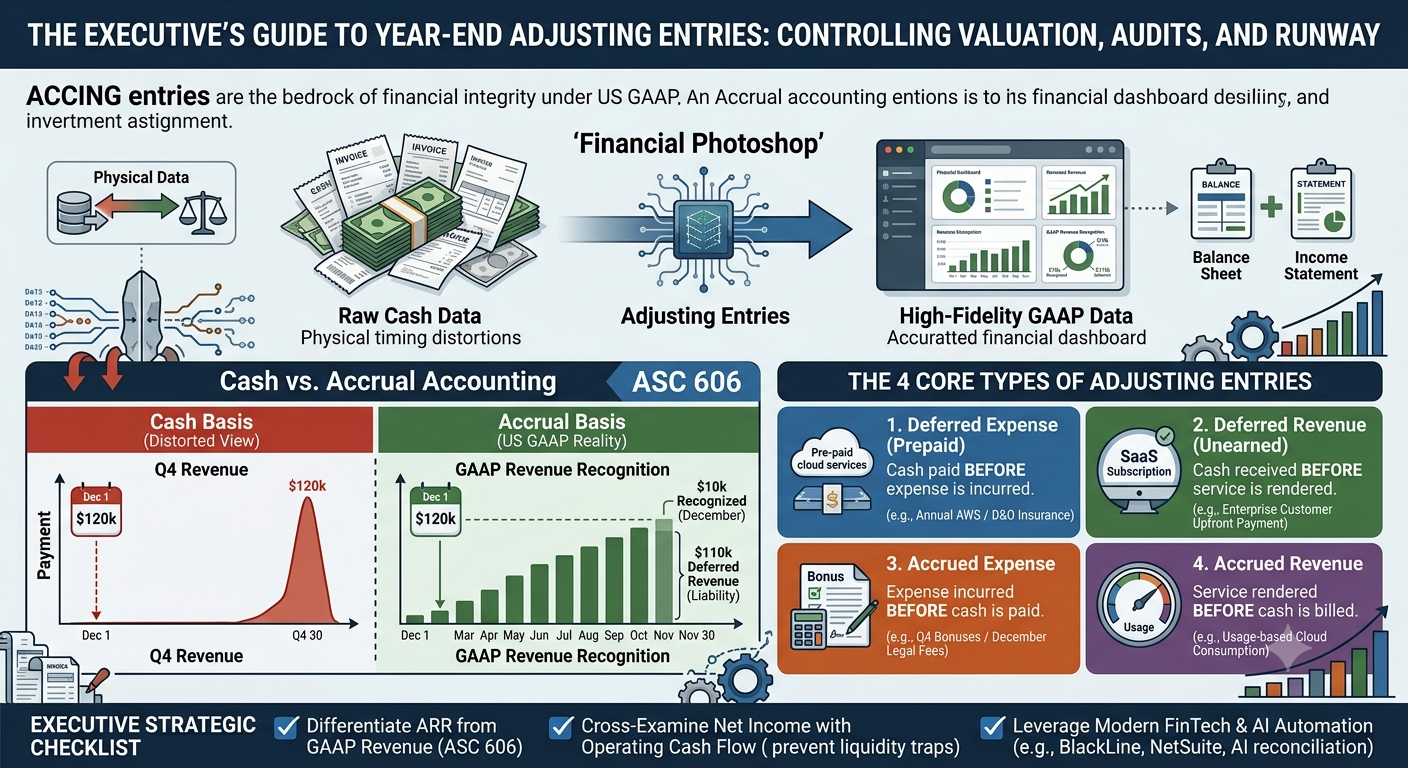
Cash Basis (Distorted View)
A enterprise SaaS client pays $120,000 upfront on Dec 1 for a 1-year contract. Under cash accounting, the entire $120k is recorded as December revenue, artificially spiking Q4 earnings while depressing Q1-Q3 of the following year.
Accrual Basis (US GAAP Reality)
Only $10,000 (1/12th) is recognized as earned revenue in December under ASC 606. The remaining $110,000 is booked as Deferred Revenue (Liability) and recognized ratably over the next 11 months.
3. The 4 Core Types of Adjusting Entries
Year-end adjustments fall into four primary categories based on whether cash flow precedes or follows economic execution.
Cash paid BEFORE expense is incurred
Example: Prepaying $240,000 for annual AWS server capacity or corporate D&O insurance. The unexpired balance sits on the balance sheet as a prepaid asset until consumed.
Cash received BEFORE service is rendered
Example: An enterprise customer pays upfront for a multi-year software subscription. Revenue stays in deferred revenue liabilities until performance obligations are satisfied under ASC 606.
Expense incurred BEFORE cash is paid
Example: Q4 executive performance bonuses or legal fees incurred in December but invoiced in January. Must be accrued as a current liability to match Q4 expenses.
Service rendered BEFORE cash is billed
Example: Usage-based cloud API consumption delivered in late December that won’t be invoiced until the standard January billing cycle. Recognized as unbilled revenue.
4. Consequences of Neglecting Year-End Adjustments
For growing companies, bypassing proper adjustment protocols leads directly to operational and financial risks:
- M&A Due Diligence Disruption: Quality of Earnings (QoE) audits conducted by private equity or venture firms will aggressively write down misstated revenue. Booking upfront cash collections as instant revenue artificially inflates EBITDA, leading to severe valuation write-downs or broken deals during M&A due diligence.
- IRS & Tax Compliance Risk: Under IRS rules (Section 461 Economic Performance Test), deductions taken for accrued expenses that do not meet strict economic performance standards will be disallowed, leading to back taxes, interest, and non-compliance penalties.
- Governance & Internal Controls Failures: For public companies or venture-backed scale-ups aiming for an IPO, missing or incorrect accruals signal weak internal controls under Sarbanes-Oxley (SOX) Section 404, prompting formal auditor qualifications.
5. Executive & CFO Insights: The Modern US Business Reality
Differentiate ARR from GAAP Revenue
SaaS founders often confuse Annual Recurring Revenue (ARR) with GAAP Revenue. While ARR measures contracted forward-looking run-rate, GAAP Revenue is strictly governed by ASC 606 revenue recognition rules after applying deferral adjustments.
Cross-Examine Net Income with Operating Cash Flow
A company can report high GAAP net income while bleeding cash due to working capital inefficiencies. Executives must cross-analyze the Statement of Cash Flows (specifically Cash Flow from Operations) against accrued earnings to prevent liquidity traps.
Leverage Modern FinTech & AI Automation
Manual spreadsheet adjustments increase human error during year-end closes. Deploying automated close management platforms (e.g., BlackLine, Sage Intacct, NetSuite, or AI reconciliation agents) streamlines accrual calculations and audit trail generation.
6. Key Takeaways for Business Leaders
- Financial Accuracy: Adjusting entries adjust raw cash receipts to match true economic performance during the reporting period.
- Compliance Core: Accrual adjustments under US GAAP ensure audit readiness and prevent tax non-compliance penalties.
- Strategic Discipline: CFOs and CEOs must evaluate financial health using both GAAP accrual statements and cash flow metrics to maintain long-term solvency and enterprise value.