
Have you ever heard of the Transformer? It is the revolutionary AI architecture that completely disrupted the tech world, transitioning artificial intelligence from a simple text calculator into a system capable of fluid, human-like conversation. Before this brilliant new star arrived on the computer science scene, the reigning champion of the AI world was the Recurrent Neural Network (RNN).
The RNN was like a diligent student who meticulously transcribed a lecture word by word, syllable by syllable. The Transformer, however, entered the classroom with the staggering ability to scan an entire page at a single glance. The secret behind this structural superpower is a specialized cognitive lens known as the “Attention Mechanism”—the ability to know exactly what matters and what to ignore.
1. Understanding Through an Everyday Analogy: The Hidden Picture Master
Imagine you are looking at a highly complex, cluttered illustration, and your sole objective is to find a hidden “puppy.” When you look at the canvas, does your brain examine every single square inch with the exact same amount of energy?
Of course not. You casually breeze past the background trees or distant clouds, and you immediately focus your eyes on the patches of grass or the areas surrounding the doghouse where a puppy is most likely to be.
The Attention Mechanism operates on this exact principle. When an artificial intelligence processes a long sentence, it does not treat every single word with equal importance. Instead, it acts like a student with a bright yellow highlighter, automatically pinpointing and emphasizing the exact words that are absolutely crucial to solving the problem at hand.
2. Unmasking Pronouns in Real-World Contexts
Let’s look at a concrete, practical linguistic example to see how this plays out in real-time processing:
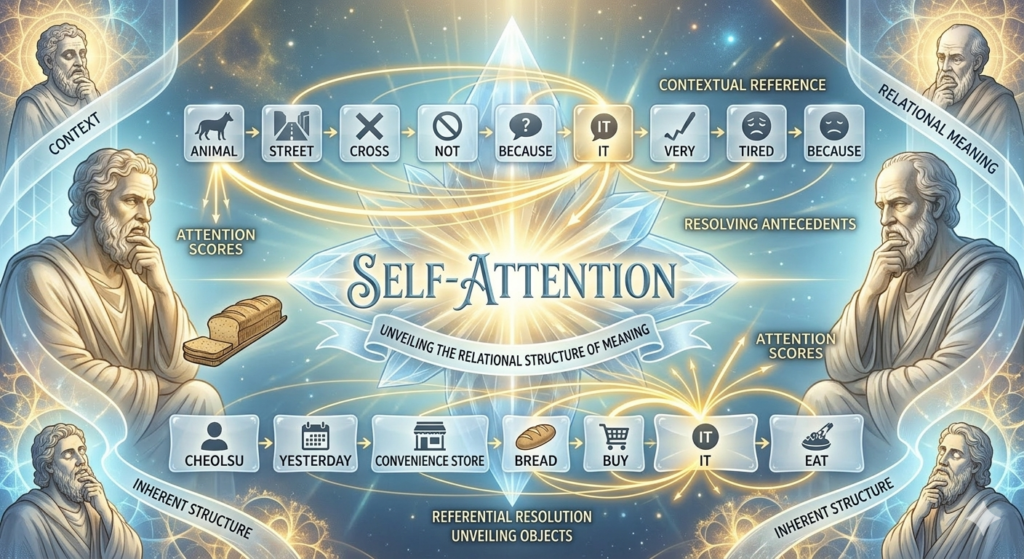
“John bought a delicious pastry at the convenience store yesterday and ate it at school.”
If we ask the system, “What exactly does the word it refer to?” look at how the different generations of AI respond:
- The Old RNN Student: (Struggling under the weight of sequential memory) “Let’s see… John… yesterday… convenience store… wait, this sentence is way too long! What was I talking about at the beginning? Is ‘it’ referring to John? Or the store?”
- The Transformer with Attention Eyes: (Scanning the entire block of text instantaneously) “The word immediately following ‘it’ is ‘ate,’ which means ‘it’ must be something edible. Looking back at the entire sentence at once, the only noun that fits the description of food is ‘pastry.’ Let’s draw a powerful vector arrow directly connecting ‘it’ to ‘pastry’!”
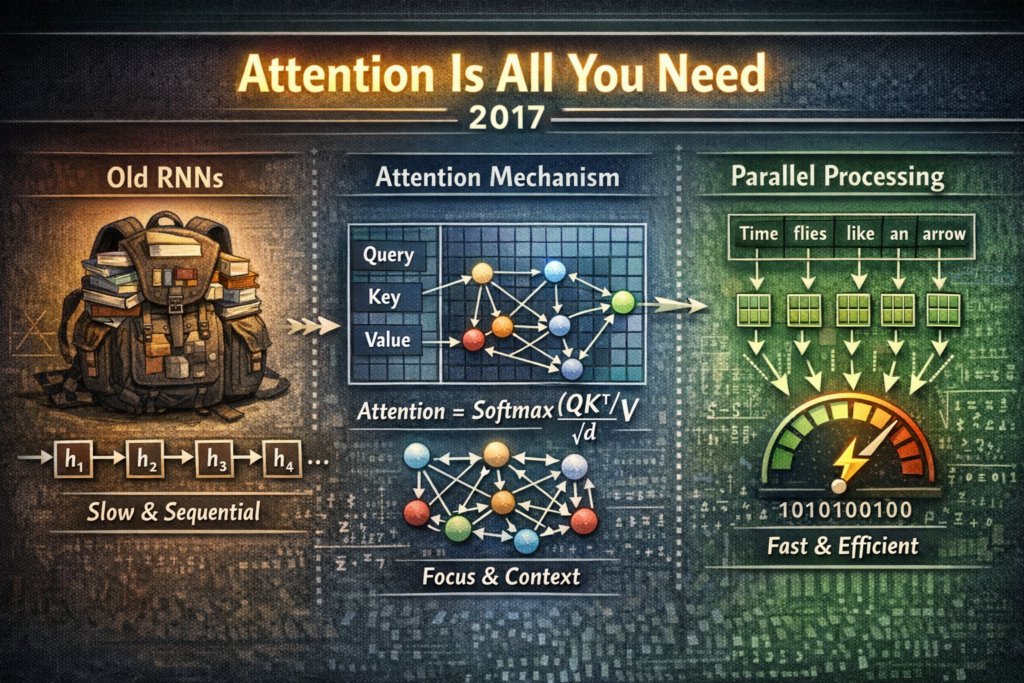
3. “Attention Is All You Need” — The Day the AI World Shook
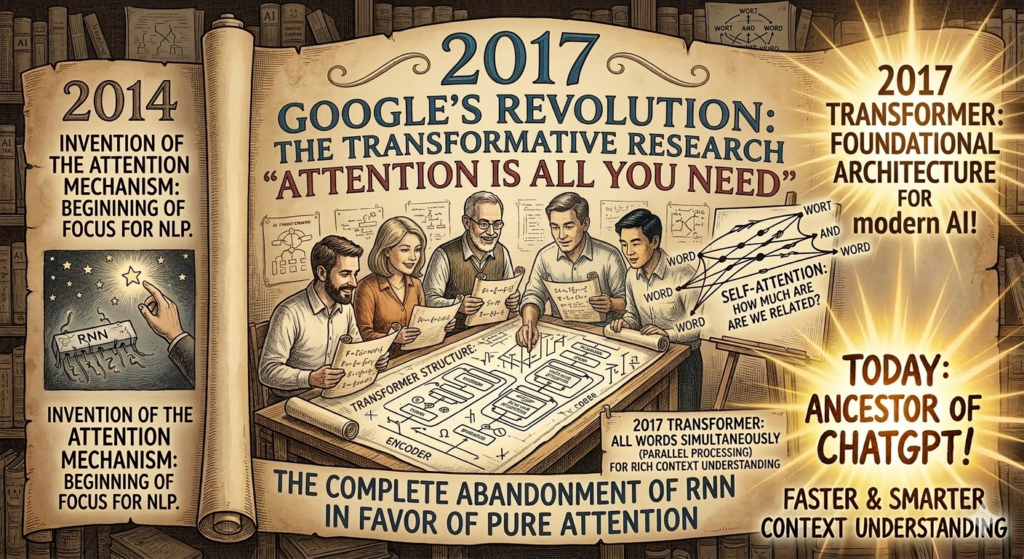
In 2017, a group of brilliant researchers at Google published a legendary scientific paper that completely shattered the established paradigms of artificial intelligence academic research. The title was incredibly bold and supremely confident: “Attention Is All You Need.”
Dropping the Heavy Baggage
Prior to this publication, traditional language AI systems relied heavily on complex recurrent architectures. They had to pack information into a metaphorical digital backpack and carry it sequentially through every single step of a sentence. As a result, by the time they reached the end of a long paragraph, they had completely forgotten the context established at the very beginning. Google’s research team radically declared, “Let’s throw away this cumbersome, sequential baggage entirely.”
The Magic of Parallel Processing
Instead of forcing data to wait in a long, tedious chronological line, the Transformer flattens the entire sentence, displaying all words simultaneously. This enables the system to compute relationships between words at lightning speed. By shattering the “prison of sequential order,” the Transformer unlocked an unprecedented capacity for parallel processing, allowing computers to train on massive datasets in a fraction of the time.
This single, daring conceptual pivot is the exact ancestral origin of modern generative platforms like ChatGPT. It gave machines the computational superpower required to read, digest, and synthesize tens of thousands of books in the blink of an eye.
4. Four Structural Reasons Why Attention is a Total Revolution
To truly maximize search engine visibility and understand the mechanics of modern technology, we can break down the superiority of the Attention Mechanism into four definitive pillars:
- Lightning-Fast Speed: Because the architecture bypasses sequential processing, it scans entire text blocks simultaneously, drastically reducing the time required to map linguistic connections.
- No Distance Limitations: In older models, if a subject at the absolute beginning of a document related to a pronoun at the very end, the connection was lost. The Attention Mechanism establishes a metaphorical “direct-dial hotline,” matching related words instantly no matter how far apart they sit.
- Multi-Head, Multi-Dimensional Vision: The system acts as if it has multiple pairs of eyes running concurrently. One “head” focuses on grammatical subject-verb agreements, while another simultaneously maps deeper semantic meanings.
- Flawless Contextual Disambiguation: Consider homonyms or polysemous words where the meaning changes entirely based on context. By calculating an instantaneous correlation score with surrounding vocabulary, the model can instantly differentiate whether a word implies a physical vessel or a piece of fruit.
5. The Behind-the-Scenes History: Overcoming the Corporate Bottleneck
In the early days of corporate AI deployment, enterprise translation engines were plagued by a critical flaw known as the “Bottleneck Phenomenon.” Because these legacy systems had to compress massive strings of text into a single, fixed-size memory vector, the network would essentially choke when forced to process complex legal contracts or long enterprise documents.
In 2014, pioneering researchers introduced the initial concept of an attention mechanism as a minor patch to help RNNs cope with this data pressure. The real explosion, however, occurred during Google’s 2017 historical breakthrough. Google realized that instead of using attention as a secondary crutch for older systems, they should build an entirely new architecture from scratch based only on attention.
By feeding all words into a dynamic matrix concurrently, words could instantly cross-examine one another, asking, “How closely related are you to me?” This conceptual leap completely eliminated the corporate processing bottleneck once and for all.
6. Self-Attention: The Crown Jewel of Modern Language Models
The absolute core engine driving this architecture is a proprietary process called Self-Attention.
When humans read a sentence, we naturally determine the meaning of an ambiguous word by looking at its immediate environment. Self-Attention is the mathematical formalization of this exact human trait inside a computer. The technology forces every single word in a given dataset to scan the entire surrounding text, score its relationship to every other token, and dynamically update its contextual meaning based on those scores.
Without the introduction of this framework in 2017, the modern AI renaissance would have been structurally impossible. The Transformer serves as the foundational bedrock upon which all top-tier enterprise AI models are constructed today:
- The Birth of GPT: The “T” in ChatGPT stands directly for Transformer. Without this architecture, an AI that truly understands the subtle nuances of human conversation could never exist.
- The Search Revolution: Search algorithms like Google’s BERT rely entirely on this framework to discern the true user intent behind complex search queries, ensuring highly accurate results.
- The Era of Frontier Models: Every industry-leading model dominating the landscape today—from Google’s Gemini to Meta’s open-source Llama series—is standing proudly on the shoulders of the Transformer giant.
7. Comparative Summary: Legacy Engines vs. The Transformer Era
| Category | Legacy Sequential Engines (RNN) | The Transformer Era (Attention) |
| Core Processing Style | Chronological, word-by-word analysis | Simultaneous, holistic sentence scanning |
| Data Handling Limit | Suffers from systemic bottlenecks over long texts | Maintains permanent context across massive text lengths |
| Training Efficiency | Extremely slow; cannot leverage modern GPUs efficiently | Highly parallelized; trains at blazing fast speeds |
| Primary Industry Use | Outdated translation software and basic text tools | Advanced generative platforms, search engines, and frontier models |
Conclusion: Key Takeaways
- The Architecture of Tomorrow: The 2017 paradigm shift proved that raw computational scale is nothing without smart algorithmic focus. True machine intelligence is driven by the capacity to selectively prioritize high-value data points.
- A Unified Foundation: By eliminating the structural limitations of distance and sequential order, the Transformer has become the universal architecture powering everything from advanced text generation to complex genomic sequencing and modern computer vision.
- The Ultimate Competitive Edge: For modern organizations looking to integrate automated platforms, understanding that your tools are rooted in the Transformer framework is key to properly configuring semantic search, internal knowledge management, and customer-facing automation.
AI Disclosure
This comprehensive educational resource was developed in a structured, professional technical alignment with Google Gemini. All core theoretical mechanics, historical contexts, and linguistic analyses were originally created, reviewed, and finalized by the human author to ensure complete technical accuracy and cross-market standard compliance.