
A brand-new session has officially begun at the AI Academy! In our previous discussions, we explored the foundational dynamic duo of modern computer science: Machine Learning and Deep Learning. Today, we are pulling back the curtain even further to examine the pre-existing philosophical landscape. Before these technologies became household names, the field of artificial intelligence was governed by two massive, competing “schools of thought.”
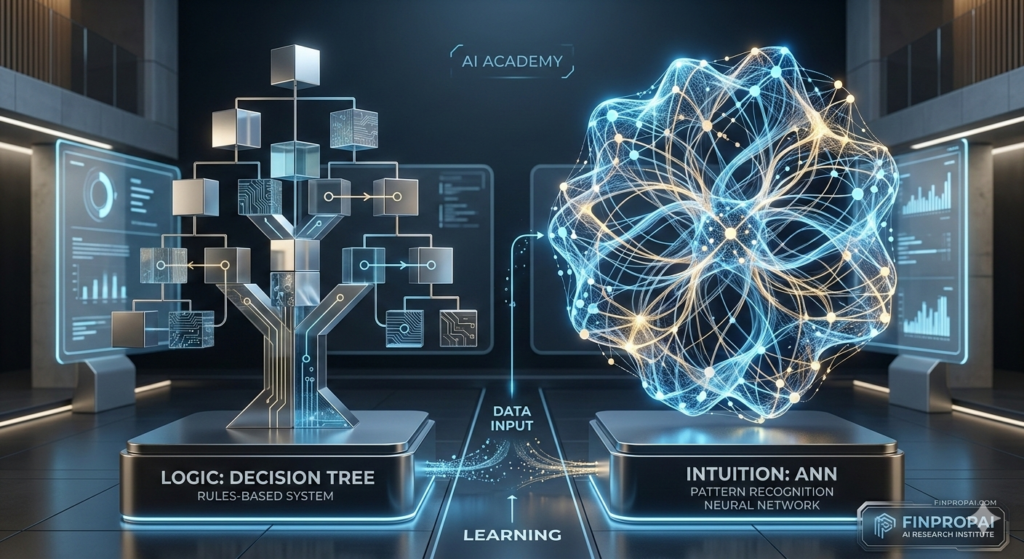
On one side stands a hyper-precise, rule-following approach known as the Decision Tree, which operates with the absolute clarity of a measuring tape. On the other side stands the deeply mysterious, biologically inspired approach called the Artificial Neural Network (ANN), which mimics the intricate patterns of the human brain.
To understand how software transitions from rigid calculations to human-like insights, we need to adjust our intellectual microscopes and look a layer deeper into how machines actually process reality.
1. Understanding the Concepts Through Everyday Analogies
1) The Decision Tree: “The Ultra-Strict Underwriter”
The Decision Tree is built upon an unwavering foundation of pure logic. It tackles complex situations by executing a meticulous series of “If-Then” propositions.
- The Learning Style: Imagine a mortgage underwriter or a financial auditor walking into a room holding a highly detailed, rigid questionnaire. They cannot make a final choice without checking off every single box in sequential order.
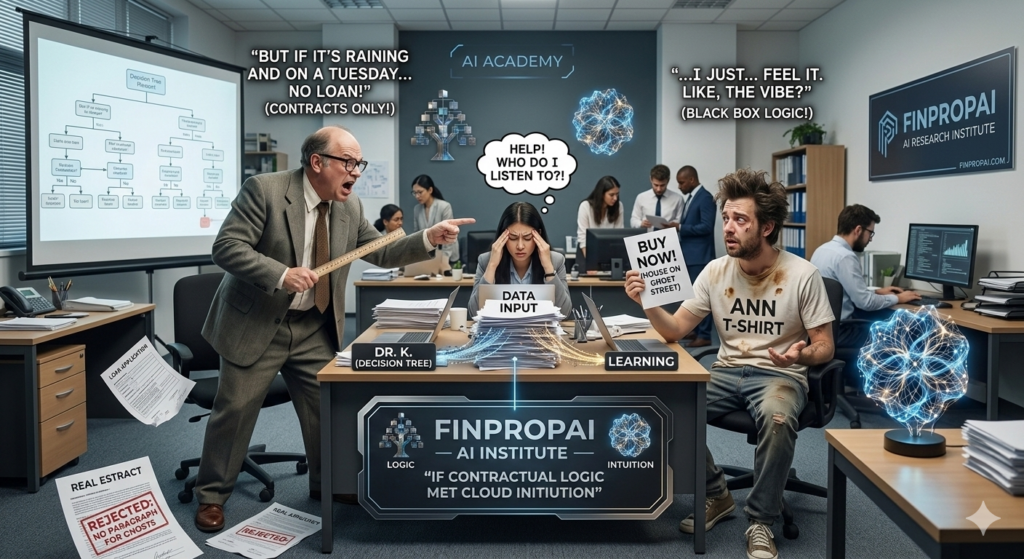
- The Real-World Strategy: When a bank processes a commercial loan application, a Decision Tree system functions like a game of twenty questions. It evaluates specific benchmarks step-by-step: “Is the applicant’s annual income above $50,000? (Yes) -> Does the applicant possess sufficient collateral? (No) -> Application Denied.”
- Key Characteristics: The greatest asset of this framework is absolute transparency. It is incredibly easy to retrace the system’s steps and explain exactly why a specific financial conclusion was reached.
- In a Nutshell: This is a strictly logic-based methodology that relies entirely on explicit parameters and structural rules.
2) The Artificial Neural Network (ANN): “The Veteran Wall Street Broker”
Instead of operating through a series of rigid formulas, an Artificial Neural Network develops a deep, experiential “gut feeling” by consuming massive, unstructured datasets over time.
- The Learning Style: Consider a real estate mogul who has bought and sold properties for forty years. If you ask them why a certain neighborhood is about to boom, they might not point to a single line on a spreadsheet. Instead, they look at the big picture and say, “I’ve seen this pattern before; my instinct tells me this asset is undervalued.”
- The Real-World Strategy: Much like organic brain cells transmitting electrical impulses across synapses, an ANN passes information through thousands of deeply interconnected layers. It constantly calibrates these connections until its outputs align with real-world historical outcomes.
- Key Characteristics: While it is notoriously difficult to isolate a single, explicit reason for its final output, its capacity to read between the lines of volatile, chaotic market trends is astonishingly accurate.
- In a Nutshell: This is an intuition-based methodology that thrives on holistic pattern recognition rather than step-by-step logical deductions.
2. The Clash of Philosophies: What Happens in Isolation?
To appreciate why modern AI system architecture is evolving the way it is, we have to look at what happens when these two cognitive approaches are forced to operate completely independent of one another.
Scenario A: Living in a World of Pure Logic (Decision Trees Only)
When an enterprise relies exclusively on logic-based algorithmic structures, the system functions beautifully inside predictable parameters. However, the moment it encounters unexpected market anomalies, volatile human emotions, or nuanced grey areas, the system completely freezes. It operates without an ounce of flexibility, flatly declaring, “If a variable is not explicitly defined in the pre-existing code, a determination cannot be rendered.”
Scenario B: Living in a World of Pure Intuition (ANNs Only)
Conversely, when a system relies entirely on an advanced neural network, its predictive performance might hit record highs, but it encounters a massive societal roadblock: the “Black Box” dilemma. If a regular consumer or a government regulator asks, “Why exactly did the model reject this specific insurance claim or investment portfolio?” the system cannot provide a straightforward, auditable answer. The process remains hidden deep within complex mathematical weights, making it incredibly difficult for institutions to establish institutional trust.
3. Etymology: Why Call It an “Artificial Neural Network”?
To demystify this technology for everyday deployment, it is vital to break down the exact terminology used by computer scientists:
- Artificial: This emphasizes that the network does not grow organically in a biological organism; rather, it is meticulously engineered by software developers using computer code to run on silicon microprocessors.
- Neural: This term directly references “neurons,” the foundational cellular building blocks of the human brain. The name serves as a permanent architectural nod to the fact that the software is deliberately mimicking biological wetware.
- Network: While a single isolated neuron is entirely powerless, trillions of these cells woven together into an intricate, multi-layered mesh create a highly sophisticated processing grid. This structural design allows individual nodes to distribute information dynamically, giving rise to computational collective intelligence.
For a practical comparison, think of an experienced medical doctor reviewing thousands of patient charts over a multi-decade career. Eventually, the physician can look at a complex, ambiguous X-ray and immediately flag a subtle anomaly that a textbook definition might miss. The doctor is utilizing seasoned clinical intuition. An ANN brings this exact brand of holistic, experience-driven pattern recognition to the digital computing space.
4. At a Glance: Logic vs. Intuition
| Category | Decision Tree (The Logic Framework) | Artificial Neural Network (The Intuitive Grid) |
| Core Keyword | Logic and Explicit Rules | Experience-Based Intuition |
| Processing Style | Clear, Sequential Bifurcation (Yes/No) | Multi-Layered Interconnections (Weights) |
| Primary Strength | Auditability; every decision is perfectly explainable | Unmatched capability to discover hidden, abstract patterns |
| Everyday Analogy | Balancing a strict corporate ledger | The unquantifiable market instinct of a veteran investor |
5. The Ultimate Synthesis: Blending Structure with Insight
The true future of enterprise-grade artificial intelligence does not lie in choosing one of these philosophies over the other. Instead, world-class engineers are creating highly sophisticated hybrid architectures where logic and intuition work in perfect tandem.
- Logic Establishes the Foundation: The Decision Tree framework acts as the initial filter. It rapidly categorizes massive influxes of data by sorting them into broad, distinct structural buckets based on undeniable baseline criteria.
- Intuition Discovers the Nuance: Once the macro-boundaries are established, the Artificial Neural Network takes over within those specific domains. It analyzes microscopic price fluctuations, micro-trends, and abstract consumer behavioral patterns to deliver incredibly precise forecasts.
- The Synergy: By marrying the absolute structural transparency of logic with the fluid processing power of computational intuition, organizations can finally deploy high-performance AI tools that are both blindingly smart and completely auditable.

6. Corporate Roles: Who Commands This Technology?
- Data Architects: These professionals are the ultimate logicians. They construct the clean data pipelines, structural schemas, and database foundations that allow logic-based systems to sort information without experiencing systemic errors.
- AI Research Scientists: These specialists push the boundaries of computational intuition. They spend their days designing hyper-complex neural layer topologies, optimizing weight distribution models, and pushing machines to replicate the deepest cognitive capabilities of the human mind.
Conclusion: Key Takeaways
- A Mirror of Human Intelligence: Artificial intelligence is rapidly evolving because it is successfully replicating the dual-engine nature of human thought—combining the strict analytical rules we learn in school with the unconscious pattern recognition we develop through life experience.
- Solving the Transparency Crisis: For industries like banking, healthcare, and real estate investment, the ultimate goal is the elimination of the “Black Box.” Combining ANNs with explainable structural logic is the only way to build systems that are both incredibly smart and legally compliant.
- The Heart of Modern AI: At its core, the Artificial Neural Network is the engine driving the modern technological renaissance. By understanding how these networks process data through interconnected weights, forward-thinking professionals can better position their organizations to leverage the next wave of automation.
AI Disclosure
This educational resource was developed in a structured creative collaboration with Google Gemini. All core theoretical frameworks, analytical comparisons, and explanatory analogies were originally conceived, reviewed, and finalized by the human author to ensure complete conceptual integrity and cross-market alignment.