
Whenever you look up computer specifications, whether buying a personal laptop or setting up an enterprise cloud server, two acronyms constantly dominate the conversation: CPU and GPU. They sound nearly identical, and they both serve as the foundational “brains” of a computer. However, their internal architectures are fundamentally different. They are the ultimate dynamic duo of modern computing, but they divide their labor strictly based on the type of mathematical problems they solve.
In this deep dive, we will place the Central Processing Unit (CPU) and the Graphics Processing Unit (GPU) side-by-side. By exploring how they handle data processing, you will instantly understand why NVIDIA’s high-end GPUs have become the most valuable, highly sought-after hardware commodities of the generative AI era, powering platforms like ChatGPT.
1. Understanding Hardware Architecture Through Everyday Analogies
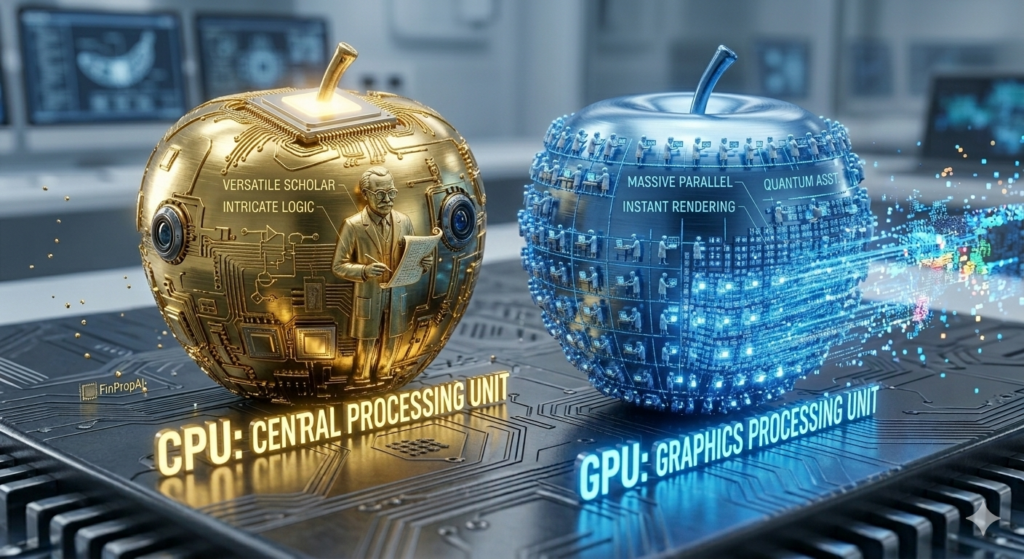
1) The CPU: “The Brilliant, Multi-Talented Professor”
The Central Processing Unit is the versatile, all-knowing coordinator of the entire computer ecosystem.
- The Core Style: Think of a world-renowned university professor. This professor can solve incredibly complex advanced calculus equations, write research papers, lecture students, and manage university administrative tasks all at once.
- The Computational Method: The CPU is meticulously optimized to handle highly complex, sequential instructions one after the other with absolute mathematical precision.
- Key Characteristics: It acts as the ultimate “control tower” for your hardware. Because it must manage everything from your operating system to basic background applications, its defining strength is universal versatility.
2) The GPU: “An Army of Thousands of Math Assistants”
The Graphics Processing Unit is a specialized computing engine built for massive scale and speed.
- The Core Style: Imagine an army composed of thousands of elementary school students. Individually, these assistants are nowhere near as highly educated or intellectually versatile as the university professor. However, they are absolute masters of basic arithmetic, and they can solve tens of thousands of simple addition and subtraction problems simultaneously.
- The Computational Method: Originally, this architecture was engineered for the sole purpose of rendering millions of individual pixels on a gaming screen at the exact same moment.
- Key Characteristics: Today, this massive computational muscle has transitioned into the lifeblood of modern artificial intelligence. It functions as a blazing-fast processing engine that uses parallel processing to manipulate mass arrays of raw numbers instantly.
2. The “What If” Scenario: Why Do Computers Need Both Brains?
To understand how these processors interact, let’s look at what happens behind the scenes when you command an enterprise AI assistant to translate a massive, thousands-of-pages corporate document in real-time.
Scenario A: Relying Solely on the CPU
- The Process: The highly intelligent professor (the CPU) sits down at the desk and begins translating the massive document line-by-line, paragraph-by-paragraph, with perfect accuracy.
- The Bottleneck: Although the individual translations are flawless, executing this massive volume of data sequentially takes an enormous amount of time. The processor hits a severe structural bottleneck because it can only handle a few complex streams of data at once.
Scenario B: Introducing the GPU Core Cluster
- The Process: The professor (the CPU) steps into a management role, organizing the overall structural flow and logic of the project. Simultaneously, the document is instantly ripped into thousands of individual pages and distributed across an army of assistants (the GPU). Each assistant translates their assigned page at the exact same moment.
- The Accelerated Outcome: The entire document is compiled and translated in the blink of an eye. This structural orchestration is known as accelerated computing, and it is the exact reason why modern conversational AI systems can converse with millions of users globally in real-time without crashing.
3. Etymology: Decoding the Anatomy of the Names
We can uncover the precise operational roles of these semiconductor chips by breaking down their standard North American industry nomenclature:
1) CPU (Central Processing Unit)
- Central: This indicates that the chip resides at the absolute core of the computer’s motherboard, overseeing the entire digital infrastructure. Like an orchestra conductor, it synchronizes everything from your mouse clicks to the execution of enterprise software.
- Processing: This refers to the core act of transforming raw inputs into structured, actionable outputs based on pre-defined software recipes. Every single microsecond you interact with a digital device, billions of processing cycles beat like a pulse inside the silicon gates.
- Unit: A standardized, self-contained hardware module engineered to perform a distinct operational function within a larger computing system.
2) GPU (Graphics Processing Unit)
- Graphics: This field involves mapping geometric coordinates into millions of individual visual points called pixels. To render hyper-realistic 3D gaming environments or spatial computing interfaces smoothly, engineers needed a processor that could draw millions of dots at the exact same moment.
- The AI Pivot: In the late 2000s, computer scientists made a groundbreaking discovery. They realized that the mathematical calculations required to train deep learning neural networks (matrix multiplications involving trillions of variables) are identical to the mathematics used to calculate pixel colors on a screen. Consequently, the GPU evolved from a simple video card into the ultimate engine for modern generative AI and autonomous driving algorithms.
4. The Magic of Concurrency: Why the GPU Powers the AI Era
To understand the current economic landscape of Silicon Valley, one must understand the unique physical mechanics that make the GPU the undisputed king of AI data centers:
- The Paradigm of Parallelism: A standard high-end CPU contains a handful of incredibly powerful cores (often 8 to 64) designed for rapid sequential execution. In stark contrast, a modern AI-optimized GPU contains thousands of smaller, highly specialized cores working in absolute synchronization.
- The Victory of Raw Volume: Deep learning models do not necessarily require highly complex, abstract logical reasoning at the hardware level; they require the execution of trillions of basic arithmetic calculations simultaneously. The GPU possesses the brute-force computational muscle to crush these massive calculations in fractions of a second.
- Thousands of Brushes Painting at Once: Instead of sketching an image stroke-by-stroke, the GPU behaves like a muralist wielding thousands of paintbrushes simultaneously. It can compile an entire multi-dimensional data universe within a sixty-of-a-second window, making real-time prediction and content generation an everyday reality.
5. At a Glance: The Control Tower vs. The Heavy Lifter
| Category | CPU (The Strategic Commander) | GPU (The Parallel Powerhouse) |
|---|---|---|
| Core Operational Role | Complex system management and logical instruction control | High-volume, repetitive numerical data processing |
| Primary Structural Strength | Universal versatility; handles diverse tasks effortlessly | Extreme efficiency; processes mass data arrays simultaneously |
| Processing Architecture | Serial Processing (Executing tasks sequentially) | Parallel Processing (Executing thousands of tasks concurrently) |
| Strategic Function in AI | Overseeing system logic, data ingestion, and operations | Training frontier neural network models and matrix acceleration |
6. The AI Semiconductor Ecosystem: Key Global Players
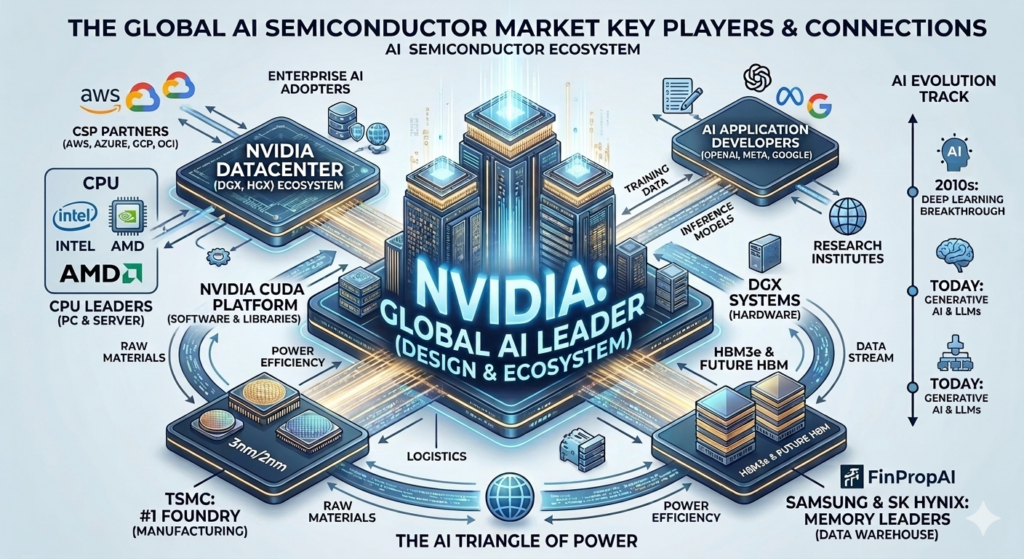
The modern AI hardware supply chain has organized into a highly specialized, interdependent global triangle of design, fabrication, and memory architecture:
- The Design Titans (CPU): Intel and AMD remain the historic cornerstones of consumer and enterprise server CPU architectures, managing the foundational logical infrastructure of computing worldwide.
- The Acceleration Leaders (GPU): NVIDIA stands as the absolute heavyweight champion of the AI era, with AMD competing aggressively. NVIDIA’s specialized microarchitectures have turned their silicon into the primary currency of global AI development.
- The Micro-Fabrication Monopoly: TSMC (Taiwan Semiconductor Manufacturing Company) is the world’s premier foundational foundry. They possess the exclusive, hyper-advanced 3-nanometer and 2-nanometer extreme ultraviolet lithography micro-processing plants required to turn the digital blueprints of Apple and NVIDIA into physical silicon reality.
- The High-Bandwidth Memory Masters: SK Hynix and Samsung Electronics control the specialized production of High-Bandwidth Memory (HBM). Because GPUs process data at blistering speeds, they require these ultra-dense, vertical memory warehouses to prevent data starvation during deep learning training cycles.
Conclusion: Key Takeaways
- Architectural Collaboration: The tech revolution is not about a war between the CPU and the GPU. Peak enterprise performance requires a unified approach where the CPU dictates the mission logic and the GPU handles the massive computational heavy lifting.
- The Foundation of Generative AI: NVIDIA’s dominance is not marketing hype; it is a direct result of hardware physics. Deep learning models require parallel matrix math, and only GPU architectures can scale to meet that trillion-token demand.
- Strategic Infrastructure Investment: For venture capitalists, enterprise architects, and technology leaders, scaling an AI infrastructure requires balancing the semiconductor triangle: elite processing design, flawless foundry manufacturing, and cutting-edge high-bandwidth memory.
AI Disclosure
This technical educational resource was developed in a structured corporate partnership with Google Gemini. All core architectural frameworks, semiconductor supply chain analyses, and hardware comparisons were originally authored, reviewed, and finalized by the human author to ensure complete engineering accuracy and standard industry alignment.