
The evolutionary pace of artificial intelligence is nothing short of breathtaking. As we witness this rapid transformation, a critical question emerges for tech leaders, developers, and investors alike: Should we double down on the “economics of scale,” or should we pivot toward “algorithmic wisdom”? Is an unconditional brute-force onslaught of data and compute always the correct answer, or will small, highly lean, and hyper-efficient models redefine the digital frontier?
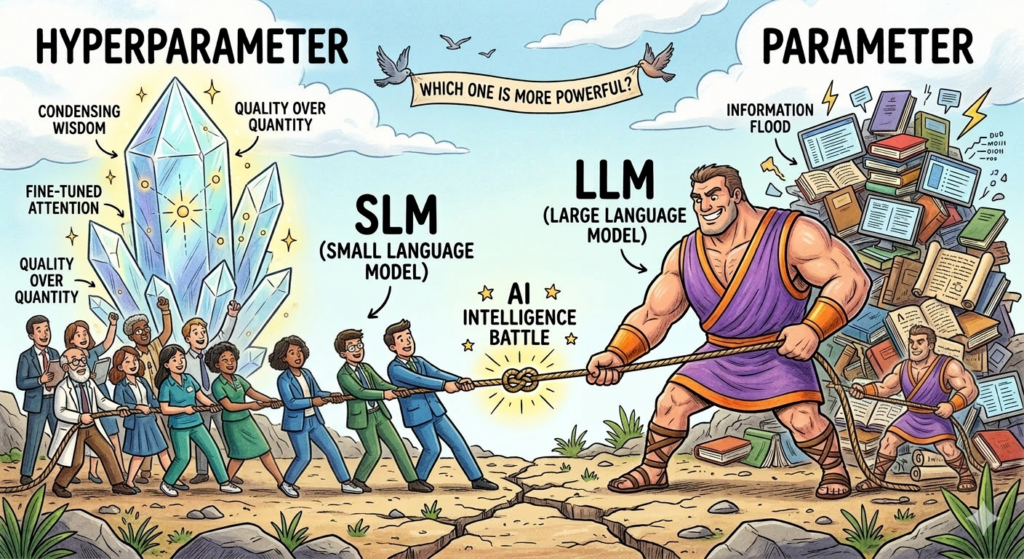
At the absolute center of this technological crossroads lies a crucial concept that acts as the literal brain cells of artificial intelligence. We are talking about Parameters and Hyperparameters. In the current tech landscape of 2026, this manifests as a fascinating David vs. Goliath battle: massive Large Language Models (LLMs) armed with trillions of self-learned parameters versus agile Small Language Models (SLMs) weaponized with sophisticated, human-engineered learning strategies. Let’s decode these core engines of AI to understand who will truly win the future of computing.
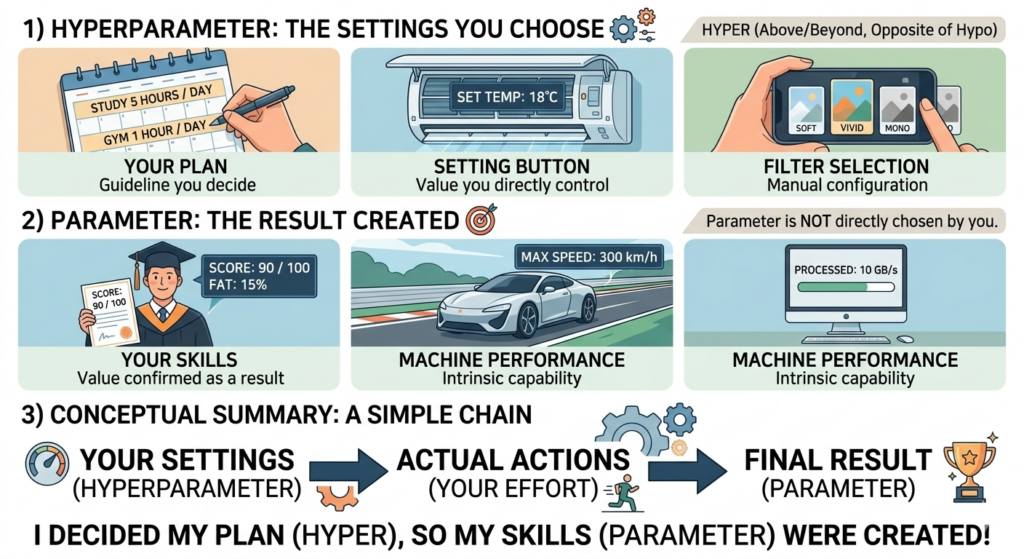
1. Everyday Analogies: Built Results vs. Manual Settings
To strip away the dense computer science jargon, let’s look at how these two concepts mirror our everyday lives and human experiences.
1) Parameter: “The Accumulation of Hard-Earned Results”
A parameter is not a value that you can directly modify or tweak on a whim. Instead, it represents the final, unalterable metrics left behind within a system or a human body as a direct consequence of historical actions.
- Human Analogy: Think of your personal metrics, such as scoring a “90 on a standardized exam” or reaching a “15% body fat composition.” These are the definitive, residual indicators of your internal capability and physical state.
- Machine Analogy: Consider a sports car’s “maximum top speed” or a microprocessor’s “actual data throughput rate.” These are the physical, inherent capabilities embedded within the object.
2) Hyperparameter: “The Manual Blueprint and Setup”
A hyperparameter is a foundational value or configuration that you intentionally determine, input, and lock in before any process or learning even begins. In linguistic terms, the prefix Hyper- signifies being “above” or “beyond”—acting as a superior framework that governs everything beneath it (the exact opposite of Hypo-).
- Human Analogy: Think of your planned routine, such as “studying for 5 hours a day” or “exercising for 1 hour every morning.” These are deliberate, pre-scheduled guardrails driven entirely by your own intent.
- Machine Analogy: This is identical to manually dialing in the “target temperature on an air conditioner” or selecting a specific “lens filter on a digital camera.” It is a configuration knob turned directly by human hands.
The Golden Rule: When you consistently execute your pre-defined Hyperparameters (your rigorous study plan), you successfully build your internal Parameters (your actual intelligence and real-world skills).
2. Defining the Concepts Inside the Machine
When applied directly to machine learning architectures, these definitions dictate how an AI thinks, adapts, and scales.
1) Parameter: The Volumetric Depth of an AI’s Knowledge Base
Parameters represent the internal mathematical weights and biases that an artificial intelligence generates completely on its own through deep learning. They represent the depth, nuance, and capacity of the machine’s synthetic intelligence.
- The Mega-Library Approach: Tech giants scaling massive foundation models choose to aggressively expand parameter counts into the trillions. They pull in massive compute clusters to construct a global archive, aiming for “emergent abilities” where the model suddenly unlocks advanced reasoning by sheer scale.
- The Curated Notebook Approach: Conversely, efficiency-focused developers build models with significantly fewer parameters, aiming to summarize and perfectly compress highly specific, elite knowledge bases.
- The Reality: Parameters are the actual physical pathways etched into the AI’s digital brain as a result of studying. A human engineer cannot manually alter these millions of individual numbers; they are the pure, organic output of training.
2) Hyperparameter: The Human-Engineered Learning Curriculum
Hyperparameters are the overarching rules, constraints, and operational guidelines that human engineers hardcode into the system before the training clusters are turned on. They act as the supreme supervisory framework governing the learning process.
- The Operational Role: A hyperparameter explicitly tells the system: “Since you are a massive model with vast storage, execute a meticulous, fine-grained sorting architecture,” or “Since you are a lightweight model, repeat this specific localized training subset 100 times over a short window.”
- The Reality: This is the ultimate study guide designed by humans. If this curriculum is engineered with absolute precision, a small AI model can achieve near-genius performance across specialized tasks, despite possessing a fraction of a giant model’s footprint.
3. Global AI Enterprise Model Comparison (2026 Landscape)
To maximize search visibility and understand the commercial market, we can analyze how the industry’s leading architectures segment across distinct operational tiers:
| Model Scale | Representative Architectures | Estimated Parameter Count | Core Strategic Advantage | Architectural Analogy |
|---|---|---|---|---|
| Extra Large (XL) | GPT-4o / Gemini 1.5 Pro | ~1.5 Trillion to 2 Trillion | Broad cross-domain data integration and emergent reasoning | A massive, national archive containing all human knowledge |
| Medium | Claude 3.5 Opus | ~200 Billion to 300 Billion | Hyper-sophisticated logical inference and creative synthesis | An elite research scientist extracting answers from highly specialized data |
| Medium Tier | Llama 3.1 (70B) | ~70 Billion | Optimal cost-to-performance ratio for enterprise servers | A robust, regional hub library built for practical utility |
| Small (SLM) | Llama 3.1 (8B) | ~8 Billion | Ultra-low latency, optimized for localized on-device processing | A compact, personal study room filled only with essential books |
| Micro SLM | Phi-3 Mini | ~3.8 Billion | Extreme domain-specific vertical performance acceleration | A pocket-sized technical dictionary engineered for single-task mastery |
4. The Density Pivot: How Scale and Strategy Shape Performance
The structural density of an AI’s internal parameters completely shapes its economic viability and deployment destiny.
Case A: Trillion-Parameter Scale (The Data Deluge)
When you scale a neural network’s parameters into the trillions, you are creating a vast digital universe. By exposing this massive web to astronomical amounts of data, the model undergoes a cognitive evolution, unlocking an all-knowing intelligence capable of cross-referencing disparate fields instantly. However, maintaining this massive infrastructure requires staggering capital expenditure, massive power grid draw, and high server maintenance costs.
Case B: Sharp Hyperparameters (The Condensation of Wisdom)
What happens when you intentionally restrict parameters but deploy hyper-sharp, mathematically optimized hyperparameters? You create a highly dense, hyper-effective professional workspace. While the model’s physical footprint is less than 1% of an ultra-large model, its human-designed learning strategy ensures no storage is wasted. It acts as an agile, hyper-focused intelligence that delivers rapid, pinpoint answers on localized hardware, running natively on a standard smartphone or a local enterprise server.
5. The Secret of Data Dieting: Maximizing Efficiency
How can a highly compact model with significantly fewer parameters outpace a giant foundation model on specific enterprise benchmarks? The secret lies in a strict data diet:
- Uncompromising Data Quality: Instead of scraping raw, noisy internet text, efficient models train exclusively on highly curated, synthetically generated, or expert-vetted datasets. Deeply ingesting one page of flawless textbook logic yields a higher functional intelligence than skimming ten thousand pages of chaotic internet forums.
- Absolute Domain Specialization: Instead of attempting to master every human subject, the parameters are strictly focused on a distinct vertical, such as financial predictive modeling, legal compliance, or syntax-perfect code generation. By narrowing the scope, the model’s specialized pathways become incredibly dense.
- Fine-Tuned Attention Filters: The training curriculum implements sharp attention mechanics, forcing the model to ignore conversational noise and respond strictly to the core context of a prompt. This operates exactly like an elite student highlighting only the vital formulas in a textbook.
- Deep Iterative Learning: With a smaller data footprint, the model can run deep, repetitive cycles over the same high-value data. This repetitive compression forces the parameters to lock into incredibly solid, highly resilient connection pathways, resulting in a narrow yet profound capacity for logical reasoning.
6. Conceptual Clarity: Niche Specialization vs. Hyperparameters
A common misconception in the enterprise tech space is conflating a specialized model with an optimized hyperparameter strategy. These two pillars are completely distinct:
- The Battlefield vs. The Combat Strategy: Domain specialization (Niche) dictates where the AI will fight—such as selecting healthcare or corporate law. Hyperparameters are the specialized martial arts moves developed to win that specific fight.
- The Real Estate vs. The Operations: Specialization is the act of opening a highly targeted boutique retail shop rather than a massive department store. Hyperparameters represent the hyper-efficient inventory and supply chain systems that make that small boutique more profitable per square foot than the department store.
- Scope vs. Core Intelligence: Simply shrinking the scope of your data (specialization) does not automatically make an AI smart. It is the introduction of sharp human guidelines (hyperparameters) that condenses that narrow data into a high-functioning, practical intelligence.
7. Comparative Summary: Parameters vs. Hyperparameters
| Category | Parameter (The Learned Mind) | Hyperparameter (The Human Blueprint) |
|---|---|---|
| Core Definition | The internal weights and learned knowledge of the AI | The pre-set rules governing the training process |
| Determining Agent | Discovered and optimized automatically by the machine | Explicitly hardcoded by the human engineer |
| Primary Structural Role | Dictates the depth and scale of the model’s memory | Controls the speed, efficiency, and curve of learning |
| Business Alignment | Leverages the raw economics of scale (LLMs) | Leverages operational economics and efficiency (SLMs) |
Conclusion: Key Takeaways
- Strategic Balance is Vital: The future of AI is not a race to build the largest model. True enterprise ROI requires matching trillion-parameter general models with highly compressed, hyperparameter-optimized specialized systems.
- The Rise of the Lean Machine: Through strict data dieting and precise curriculum design, modern SLMs are proving that small architectures can deliver elite, lightning-fast domain performance at a fraction of the operational cost.
- Human Engineering Matters: As compute resources become increasingly valuable, the role of the AI engineer shifts from simply throwing raw data at a cluster to building elegant, hyper-sophisticated hyperparameter blueprints that maximize every single parameter.
AI Disclosure
This specialized technical analysis was generated in structured corporate alignment with Google Gemini. All core architectural comparisons, structural definitions, and dataset efficiency frameworks were originally authored, thoroughly reviewed, and meticulously edited by the human author to ensure complete engineering fidelity and industry standard compliance.