
The boundary between “a smart encyclopedia” and “a sharp problem solver” is rapidly dissolving. In the past, interacting with AI was like talking to a well-read scholar: it provided accurate answers, but only when prompted. It was passive, requiring constant guidance—much like a child who only completes their chores when a parent dictates every single step.
Today, we are witnessing the shift from the era of “Prompt Engineering,” where the quality of the output depended on how precisely you commanded the AI, to the era of the AI Agent. We are moving toward systems that don’t just answer questions but autonomously finish complex tasks, delivering finished results without the need for hand-holding. In this post, we’ll explore why this shift is the most significant transformation in productivity today.
1. Understanding the Concept: The Intern vs. The Senior Lead
To grasp the difference between standard AI and an AI Agent, think of it in terms of workplace delegation.
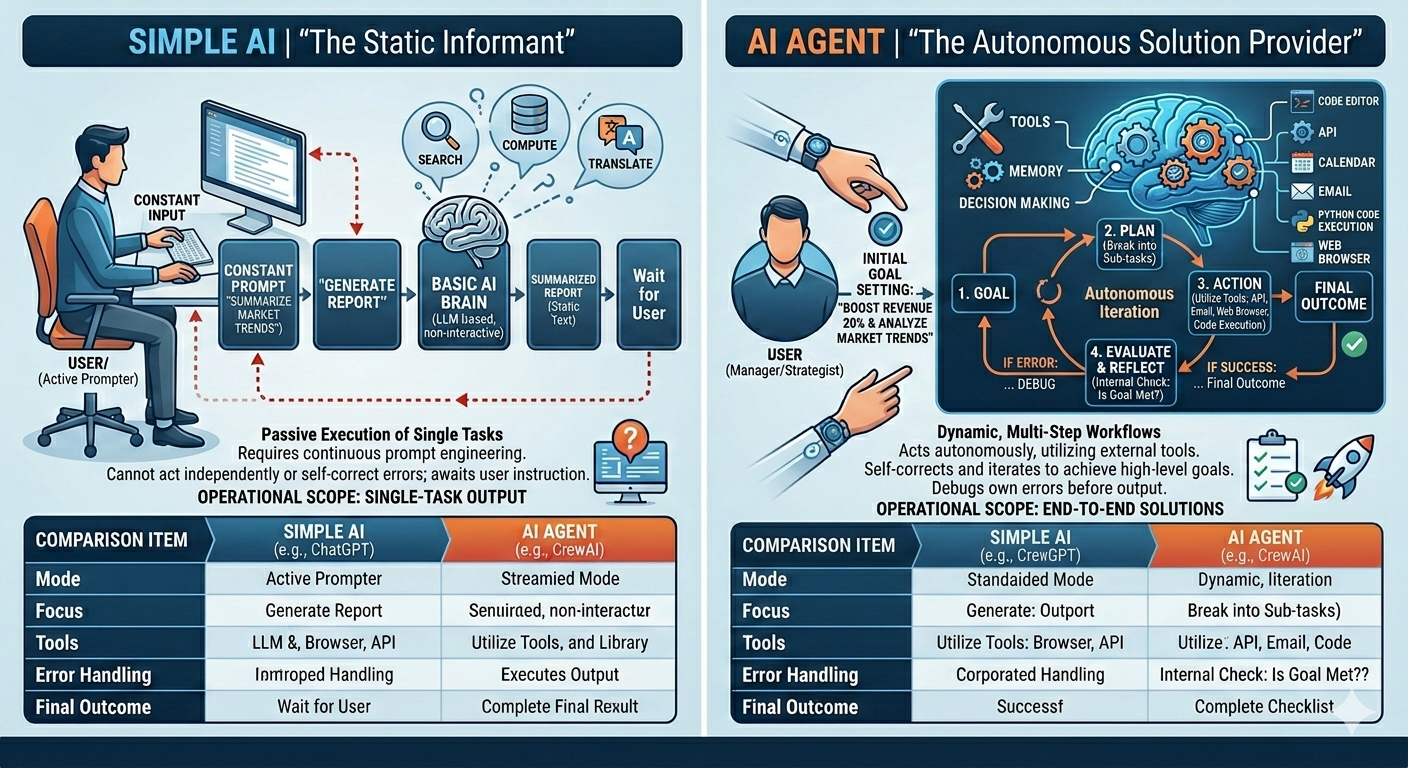
- The Standard AI (The Intern): You hand over a pile of reports and say, “Summarize this.” It performs the task perfectly but stops the moment the task is done, waiting for your next command. It has the “brain” (the Large Language Model) but lacks the “hands and feet” to act independently.
- The AI Agent (The Senior Lead): You give a high-level goal: “Increase our team’s Q3 revenue by 20% and set up meetings with our key clients.” The Agent doesn’t wait for step-by-step instructions. It breaks the goal into sub-tasks, researches market trends, drafts outreach emails, and coordinates schedules. If it hits a roadblock, it iterates—”This approach didn’t work”—and adjusts its strategy until the goal is met.
Key Terminology
- LLM (Large Language Model): The “brain” that processes vast knowledge and generates human-like language.
- AI Agent: A system that combines the LLM’s brain with tools (API calls, web browsers, code execution) and memory to act as a self-directed entity.
- Autonomous Iteration: The ability of the system to run a loop of “Plan ➔ Execute ➔ Reflect ➔ Correct” without human intervention until the mission is accomplished.
2. Scenario Comparison: A Real-World Mission
Let’s imagine a common business challenge: “Analyze global financial trends for our upcoming buyer meetings and coordinate the schedule.”
| Comparison Item | Scenario A: Standard Chatbot (e.g., Basic ChatGPT) | Scenario B: Autonomous AI Agent (e.g., CrewAI) |
|---|---|---|
| Operational Mode | One-off responses per prompt | Autonomous planning and execution based on a goal |
| Tool Usage | Text-based information only | Direct use of Email, Calendar, API, and Python scripts |
| Error Handling | Needs manual correction from the user | Analyzes logs, debugs, and retries independently |
| Final Outcome | Provides a text-based report | Executes the report, emails buyers, and syncs calendars |
| Human Effort | High (Step-by-step management) | Low (Goal setting and final approval) |
3. Industry Impact: Where Productivity Explodes
AI Agents are not just a convenience; they are architectural changes in how businesses function.
- Software Engineering: In the past, developers requested code snippets from AI. Now, AI software engineers (like Devin) can be tasked with “Add a payment gateway to this app.” The Agent analyzes the entire codebase, patches bugs, runs tests, and pushes the final update to GitHub independently.
- Marketing & Customer Success: While basic chatbots handle FAQs, an Agent tracks individual customer history and real-time inventory. It can proactively engage a customer: “I see the product you bought last year has an upgraded model. It’s 10% off today—should I send you the payment link?” This turns a cost center into an active sales engine.
4. The Shift in Human Responsibility
With standard AI, the human is a “prompter”—an operator who must constantly feed instructions. With AI Agents, the human becomes a “manager” or “strategist.” You set the objective and define the KPIs, while the system handles the “how.”
Summary Table: AI vs. AI Agents
| Category | Standard AI (Simple AI) | AI Agent |
|---|---|---|
| Core Identity | Information provider | Autonomous solution provider |
| Human Role | Constant instruction & input | Goal setting & final approval |
| Computing Logic | Input ➔ Output (Static) | Goal ➔ Plan ➔ Execute ➔ Evaluate (Dynamic) |
| Value Delivered | Faster information retrieval | Replacement of entire work processes |
Conclusion: Key Takeaways for Today’s Leaders
The era of AI that merely “talks” is ending, and the era of AI that “acts and takes responsibility” has begun. To remain competitive, you must move beyond simply crafting better prompts. Focus on understanding how to define clear, outcome-oriented goals for AI Agents. The real winners in the coming years will be those who master the art of delegating complex, end-to-end workflows to these autonomous systems, letting the AI do the “heavy lifting” while they focus on the high-level strategy.
AI Disclosure: This post was created in collaboration with Google Gemini. All core content was authored, reviewed, and edited by the author.