
Options are often compared to a “double-edged sword” in the world of finance. To the uninitiated, they are a dangerous poison capable of wiping out an entire portfolio in a single session. However, to those who master their mechanics, they serve as the ultimate shield, transforming market downturns into profitable opportunities. As of 2026, the meteoric rise of 0DTE (Zero Days to Expiration) options in the U.S. and the dominance of weekly options in the Korean market have fundamentally changed the game for individual investors.
This post analyzes the structural differences between these two financial powerhouses and provides a practical guide for individual investors to navigate the complex world of institutional dominance and leverage.
1. Introduction: Why Options Literacy is Non-Negotiable
In the modern capital market, knowledge is the primary driver of profit. Options are unique instruments that allow investors to transcend the limitations of traditional stock ownership. They offer the only viable path to generating alpha during bear markets or controlling significant positions with minimal upfront capital. In the volatile macroeconomic landscape of 2026, understanding the topography of both the U.S. and Korean options markets is no longer optional—it is a critical requirement for asset defense and growth.
2. The Scale of the Global Options Landscape
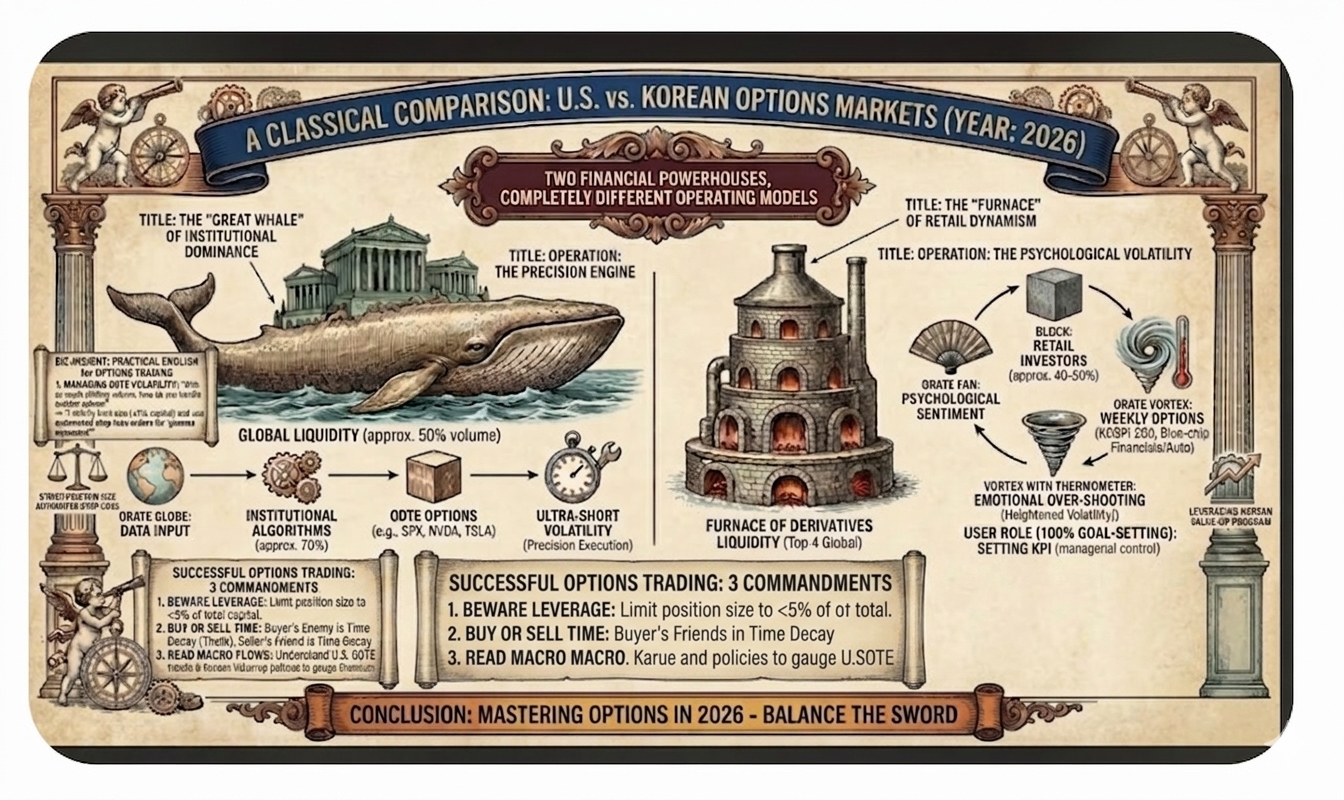
The global options market is currently dominated by two heavyweights: the United States and India. South Korea, however, remains a formidable player, maintaining its status as a top-four global derivatives market, largely sustained by the immense liquidity of the KOSPI 200 index. If we were to use an analogy, the U.S. market is the “Great Whale” of finance, accounting for approximately 50% of global trading volume. In contrast, the Korean market functions as a “derivatives furnace”—highly dynamic and characterized by the highest level of individual retail participation in the world.
3. Market Participants: Institutional Precision vs. Retail Dynamism
The composition of participants significantly influences how these markets move.
- The U.S. Market: Institutional dominance is the defining feature here. Roughly 70% of total volume is driven by massive hedge funds and high-frequency, algorithm-based trading desks. Trading is executed with cold, probabilistic precision. Individual retail traders, who make up the remaining 30%, largely operate by riding the waves created by these institutional flows.
- The Korean Market: This is a retail-driven ecosystem where individual investors account for 40–50% of trading volume. This creates a market teeming with liquidity, but it also renders the market susceptible to rapid overshooting and heightened volatility driven by collective investor psychology rather than pure fundamentals.
| Comparison Item | U.S. Market | Korean Market |
|---|---|---|
| Primary Underlyings | S&P 500, Tech Stocks (NVDA, TSLA) | KOSPI 200, Blue-chip Financials/Auto |
| Market Characteristics | 0DTE-focused, ultra-short volatility | Weekly option-focused, high liquidity |
| Dominant Players | Institutional Algos (approx. 70%) | Retail Investors (approx. 40-50%) |
| Market Nature | Data-driven, cold precision | Retail-driven, prone to emotional swings |
4. The 2026 Trend: The Shift Toward Hyper-Speed
Both markets have converged on a trend of “ultra-short-termism.” In the U.S., a majority of S&P 500 option contracts are now 0DTE—options that expire in less than 24 hours. Similarly, in Korea, the weekly option—expiring every Monday and Thursday—has become the cornerstone of daily trading volume. Investors have shifted their focus from long-term projections to capitalizing on the volatility of “the next few hours.”
5. Strategic Focus: Product Diversity and Regional Nuances
- The U.S. Approach: The U.S. market excels in individual stock options. For instance, traders can use options on specific companies like Apple or NVIDIA to surgically respond to corporate events like earnings reports. It is a market of precision.
- The Korean Approach: Korea remains heavily indexed on the KOSPI 200, making it an excellent vehicle for gauging macroeconomic macro-trends. Recently, the government’s “Corporate Value-up Program” has ignited interest in options on large-cap financial and automotive stocks, providing new avenues for directional bets on industrial structural changes.
6. Risk Management: Navigating the Hazards
Trading options requires a strict awareness of regional risks:
- In the U.S.: Be vigilant against sudden price reversals caused by institutional “Delta Hedging”—where institutions are forced to trade to balance their books. Supply-demand imbalances often override company fundamentals here.
- In Korea: You must master the “Theta” factor, or time decay. When individual retail buying is heavily concentrated in a specific asset, option prices can melt away due to time decay even if the underlying index remains stagnant.
Conclusion: Key Takeaways for Today’s Investors
- Strictly Manage Leverage: Do not view options as a get-rich-quick scheme. Limit your options exposure to less than 5% of your total portfolio to ensure survival during market anomalies.
- Respect Time Dynamics: Understand your role in the trade. As an option buyer, time is your greatest adversary; as a seller, it is your primary source of yield.
- Follow the Macro Flow: Whether it is the proliferation of 0DTE volume in the U.S. or the Value-up policy initiatives in Korea, always align your strategy with the broader macroeconomic “money flow.”
The market serves as a filter: it consistently penalizes those who trade on emotion and rewards those who respect financial principles. Stay disciplined, manage your risks, and keep your eyes on the long-term objective.
AI Disclosure: This post was created in collaboration with Google Gemini. All core content was authored, reviewed, and edited by the author.