
When managing accounting records for corporate bonds and debt instruments, financial professionals and accountants inevitably encounter a major hurdle: the amortization of bond discounts and premiums.
In simple terms, when market interest rates fluctuate, a $10,000 face-value bond might be purchased at a discount for $9,730 or at a premium for $11,000. The resulting $270 difference (discount or premium) cannot be recognized all at once. Instead, it must be systematically recognized and written off over the life of the bond until maturity.
There are two primary methods used to amortize this difference: the Straight-Line Method and the Effective Interest Method. Below is a clear, comprehensive breakdown comparing both approaches so that anyone—from accounting students to C-suite executives—can grasp the mechanics immediately.
1. At a Glance: Straight-Line vs. Effective Interest Method
To understand the core conceptual difference, consider how consumer financing and standard amortized bank loans operate in everyday personal finance.
HTML
Conceptual Overview: How Discount Amortization Works
Fixed Annual Amount
Divides the total discount equally across each year regardless of changing carrying value. Simple, but distorts the true economic yield.
Dynamic Interest Linked to Carrying Value
Multiplies the bond’s carrying value by the market interest rate each period. Keeps the effective yield constant and accurately reflects time value of money.
1) The Straight-Line Method: Like an Equal Zero-Interest Installment Plan
- Concept: Under this approach, the total discount or premium difference is divided equally across the bond’s term and recognized in equal amounts as interest expense or interest income each year.
- Western Analogy: Think of purchasing a $1,200 home appliance on a 12-month zero-interest installment plan, paying exactly $100 every month.
- Drawback: While computation is straightforward, it distorts economic reality. Because a bond’s book value (carrying value) changes every year while the recognized interest remains identical, the implied return on investment (book yield) fluctuates unnaturally from year to year.
- Current Status: Under modern accounting standards such as International Financial Reporting Standards (IFRS) and US GAAP, the straight-line method is prohibited for material amounts because of this financial distortion. It is only permitted in rare exception cases where the outcome is immaterial to financial statements.
2) The Effective Interest Method: Like an Amortized Loan Schedule
- Concept: Instead of recognizing an equal dollar amount every year, the real interest income or expense is recalculated each period by multiplying the bond’s opening carrying value by the market rate of interest (effective interest rate) established at issuance.
- Western Analogy: This works similarly to a standard fixed-rate amortized mortgage or auto loan: early payments consist of higher interest because the remaining principal balance is large; as principal declines, the interest portion decreases accordingly.
- Advantage: Interest expense or income tracks the actual economic value of the bond precisely. Consequently, the effective yield rate remains perfectly constant across all periods, accurately reflecting time value of money and accrual accounting principles.
- Current Status: Mandatory international standard under IFRS (IFRS 9) and US GAAP (ASC 310 / ASC 835) for companies issuing or investing in financial instruments.
Comparison Matrix: Straight-Line vs. Effective Interest Method
HTML
| Comparison Item | Straight-Line Method | Effective Interest Method |
|---|---|---|
| Core Concept | Divides total discount/premium equally across the bond term. | Calculates interest by applying effective rate to opening carrying value. |
| Calculation Formula | Annual Amortization = Total Difference ÷ Maturity Years | Effective Interest = Carrying Value × Effective Rate |
| Effective Yield Trend | Distorted; reported yield percentage varies each year. | Constant; reported yield percentage remains identical every year. |
| Accounting Precision | Simplified, but ignores economic reality and time value. | Highly precise; fully aligned with accrual accounting principles. |
| Regulatory Status | Prohibited under IFRS / US GAAP (except immaterial cases) | Global Standard (Mandatory) |
Key Takeaway: The Straight-Line Method works like a basic flat installment split. The Effective Interest Method works like a scientific precision formula that adjusts interest income/expense alongside the growing or shrinking book value of the debt asset or liability.
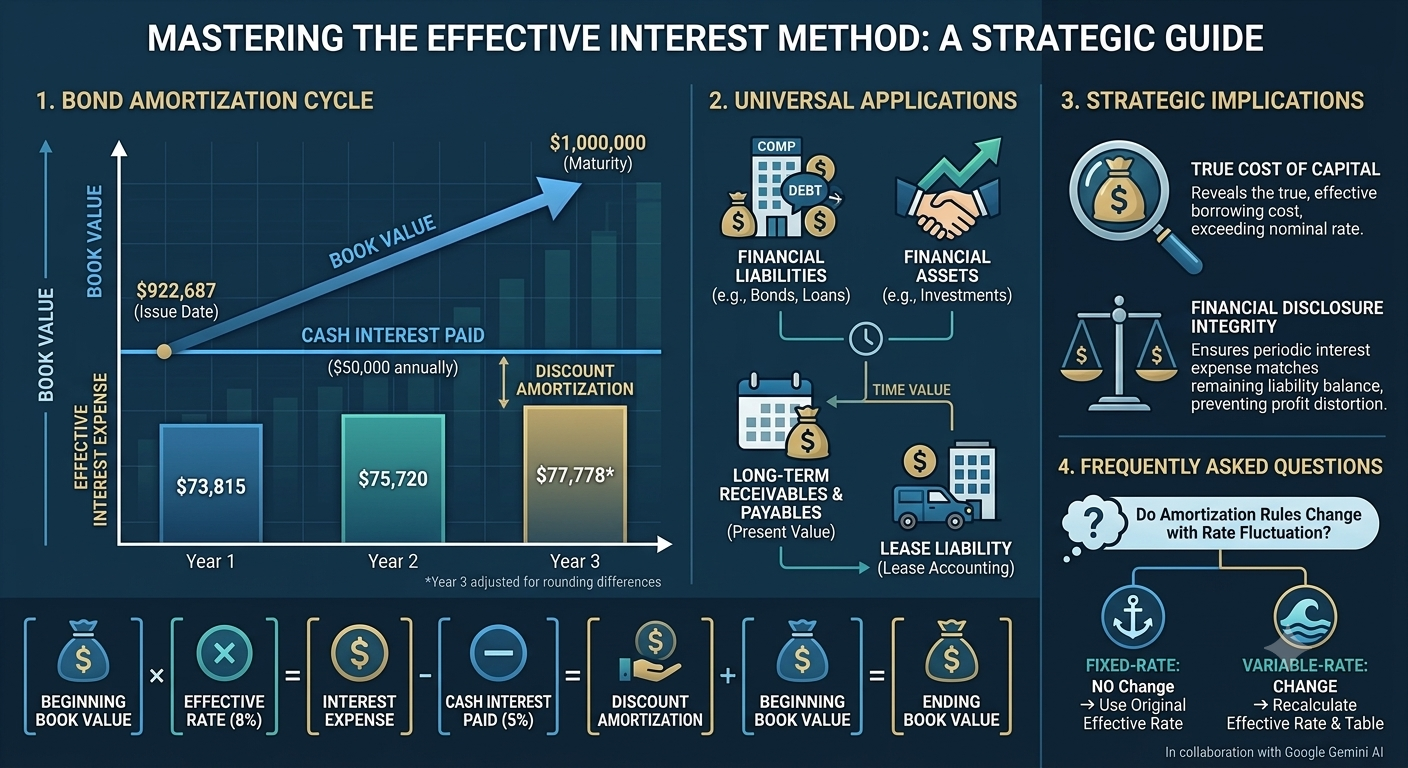
2. How the Effective Interest Method Works (Step-by-Step Example)
Let’s look at a concrete numerical example to see how the numbers play out on the general ledger.
Hypothetical Scenario
- Bond Face Value: $10,000 (3-Year Maturity)
- Coupon Rate (Stated Rate): 5% per annum (Generates $500 cash payment every year without fail)
- Market Interest Rate (Effective Interest Rate): 6% per annum (Because market rates are higher than the 5% coupon, buyers demand a discount, resulting in a purchase price of $9,730)
Question: How much interest revenue should be recorded on the income statement in Year 1?
Under cash-basis thinking, one might assume only the $500 received in cash should be recorded. However, under accrual accounting, that assumption is incorrect.
Because you purchased the bond for $9,730 and will collect the full $10,000 face value at maturity, the $270 discount is an additional yield that must be recognized as interest income over the 3-year holding period.
The Master Amortization Formula
Step 1: Year 1 Calculations
- Initial Carrying Value of Bond: $9,730
- Effective Market Interest Rate: 6% per annum
- Real Interest Income Earned: 9,730×6%=$583.80
- Actual Cash Received: $10,000×5%=$500.00
- Discount Amortization Amount: $583.80−$500.00=$83.80
Accounting Entry Result: Although the business receives $500 cash, it records $583.80 in Interest Income on the income statement. The remaining $83.80 is added directly to the bond’s carrying value on the balance sheet, increasing its book value from $9,730 to $9,813.80 ($9,730 + $83.80).
Step 2: Year 2 Calculations (The Snowball Effect)
In Year 2, because the carrying value increased to $9,813.80, the 6% market rate applies to this higher base value.
- Real Interest Income Earned: $9,813.80×6%=$588.83 (Higher than Year 1!)
- Actual Cash Received: Still $500.00
- Discount Amortization Amount: $588.83−$500.00=$88.83
Adding $88.83 to the carrying value brings the new book value to $9,902.63. Repeating this exact procedure for Year 3 smoothly restores the carrying value to the full $10,000 face value exactly at the maturity date.
- Under the Straight-Line Method, the accountant would mechanically add $90 per year ($270 discount ÷ 3 years) regardless of book value changes ($90 in Year 1, $90 in Year 2, $90 in Year 3), misrepresenting true economic returns.
- Under the Effective Interest Method, amortization grows organically from $83.80 in Year 1 to $88.83 in Year 2, matching the compounded growth of money.
| Dimension | Advantages | Disadvantages |
|---|---|---|
| Financial Perspective |
• Accurate Balance Sheet Values: Carrying value reflects real present value. • Stable Internal Rate of Return (IRR): Keeps reported profit margins consistent across all financial periods. |
• Calculation Complexity: Manual updates require maintaining detailed amortization schedules, raising human error risks if unautomated. |
| Accounting & Audit Compliance |
• Full Accrual Alignment: Maximizes financial disclosure credibility for external auditors and credit rating agencies. • Global Regulatory Standard: Fully compliant with IFRS 9 and US GAAP. |
• Communication Overhead: Can be difficult to explain to non-financial executives who wonder why annual interest expense changes each period. |
3. Advantages vs. Disadvantages of the Effective Interest Method
While the Effective Interest Method requires more computational rigor, its financial transparency makes it indispensable for corporate reporting.
HTML
4. Managerial Implications for C-Suite Executives
For CFOs, corporate treasurers, and financial decision-makers, understanding the Effective Interest Method is vital for capital structure planning and debt management strategy.
1) Watch Out for Income Statement Traps on Discount Bonds
When a company issues bonds at a discount, interest expense recorded on the P&L increases over time as the carrying value rises. In early years, interest expense appears lower, which temporarily boosts net income. However, as the bond approaches maturity, interest expense escalates. Financial planning models must incorporate this upward progression to avoid inaccurate earnings forecasting.
2) Essential Baseline for Early Redemption (Call Options & Refinancing)
When market interest rates fall, corporations often seek to refinance high-cost debt by exercising call options or repurchasing bonds in the open market. Determining whether a debt retirement results in a Gain or Loss on Extinguishment of Debt relies entirely on the bond’s carrying value calculated under the Effective Interest Method. Without an accurate schedule, management risks miscalculating refinancing paybacks.
3) Strengthening Internal Controls via ERP Automation
Because tracking amortization manually via spreadsheets creates vulnerability to human error, executive leadership should ensure that enterprise resource planning (ERP) software automatically generates and validates bond amortization schedules. This safeguards disclosure integrity and streamlines external audit reviews.
Conclusion: Key Takeaways
- Core Distinction: The Straight-Line Method divides discounts or premiums evenly, whereas the Effective Interest Method applies the effective market rate to the changing carrying value each period.
- Economic Reality: The Effective Interest Method respects the time value of money, preserving a uniform return rate throughout the life of the bond.
- Compliance: Global accounting frameworks (IFRS and US GAAP) mandate the Effective Interest Method for all material bond issues and long-term financial liabilities.
- Strategic Value: Precise debt accounting ensures reliable earnings forecasting, accurate debt extinguishment decisions, and sound corporate treasury oversight.
AI Disclosure: This post was written, reviewed, and edited by the author in collaboration with Google Gemini AI. All featured images, and visual materials were generated using Google Gemini AI to enhance technical clarity, readability, and overall visual presentation.