
A corporation’s asset base extends far beyond physical inventory sitting in warehouses; it includes liquid reserves deployed into equity stakes, debt instruments, and strategic corporate investments. In financial reporting, these holdings are categorized as Marketable Securities or Financial Assets.
While physical inventory serves the singular operational purpose of being held for sale, financial assets present a multi-dimensional valuation challenge. Their accounting treatment depends on the interaction between constantly fluctuating secondary market prices and corporate management’s underlying investment intent.
Understanding how financial asset valuations impact corporate financial statements, recognizing the structural differences across major global accounting standards (IFRS 9, US GAAP, and K-GAAP), and evaluating the quality of reported earnings are critical responsibilities for financial leaders.
1. Why Valuing Financial Assets Is Inherently Complex
While stock and bond market quotes appear readily accessible, recognizing these asset value fluctuations on corporate balance sheets presents a fundamental accounting dilemma. Two common financial instruments illustrate this challenge:
1) Equity Investments: The Used Car Valuation Dilemma
Suppose a pre-owned vehicle you purchase increases in estimated resale value from $20,000 to $25,000 this month. While your overall net worth on paper has increased, no actual liquid cash enters your bank account until you sell the vehicle.
Corporate equity holdings function similarly. Booking unrealized market value increases as immediate net income creates paper profits. If equity markets drop sharply the following month, those paper gains disappear like a mirage. Accounting frameworks must determine whether these unrealized mark-to-market fluctuations belong on the current-period income statement or should be isolated elsewhere on the balance sheet.
2) Debt Instruments: The Pre-paid Annual Subscription Analogy
Consider purchasing an annual prepaid service contract—such as a non-refundable $1,200 annual subscription. As time passes, the resale value of that remaining contract on secondary markets decreases. However, if your sole intention is to hold the subscription for the full term to consume the underlying service rather than re-sell it, interim secondary market price changes do not affect your actual economic realization.
Fixed-income bonds operate on similar principles. When an enterprise purchases bonds with the intent of holding them to maturity to collect contractual principal and interest payments, tracking daily secondary market interest rate fluctuations on the balance sheet offers little relevance to the firm’s real economic outcome.
2. Inventory Valuation vs. Financial Asset Valuation
Although inventory and marketable securities both represent core enterprise assets, financial reporting frameworks apply contrasting principles to their measurement.
3. The Foundation of Classification: Holding Intent and Cash Flow Profiles
How a financial asset is recognized on the balance sheet depends on two foundational criteria: Investment Intent (how management plans to utilize the asset) and Contractual Cash Flow Characteristics (how cash flows enter the business).
- Short-Term Trading Intent: Assets acquired primarily to generate capital gains from short-term market price volatility are categorized as active trading holdings.
- Strategic Equity & Partnership Intent: Equity holdings acquired to secure long-term strategic commercial relationships or collect recurring dividend distributions are classified as strategic equity assets.
- Principal and Interest Collection Intent: Fixed-income instruments acquired strictly to collect contractual interest payments and principal recovery at maturity function as pure debt receivables.
4. Classification Framework Under IFRS 9
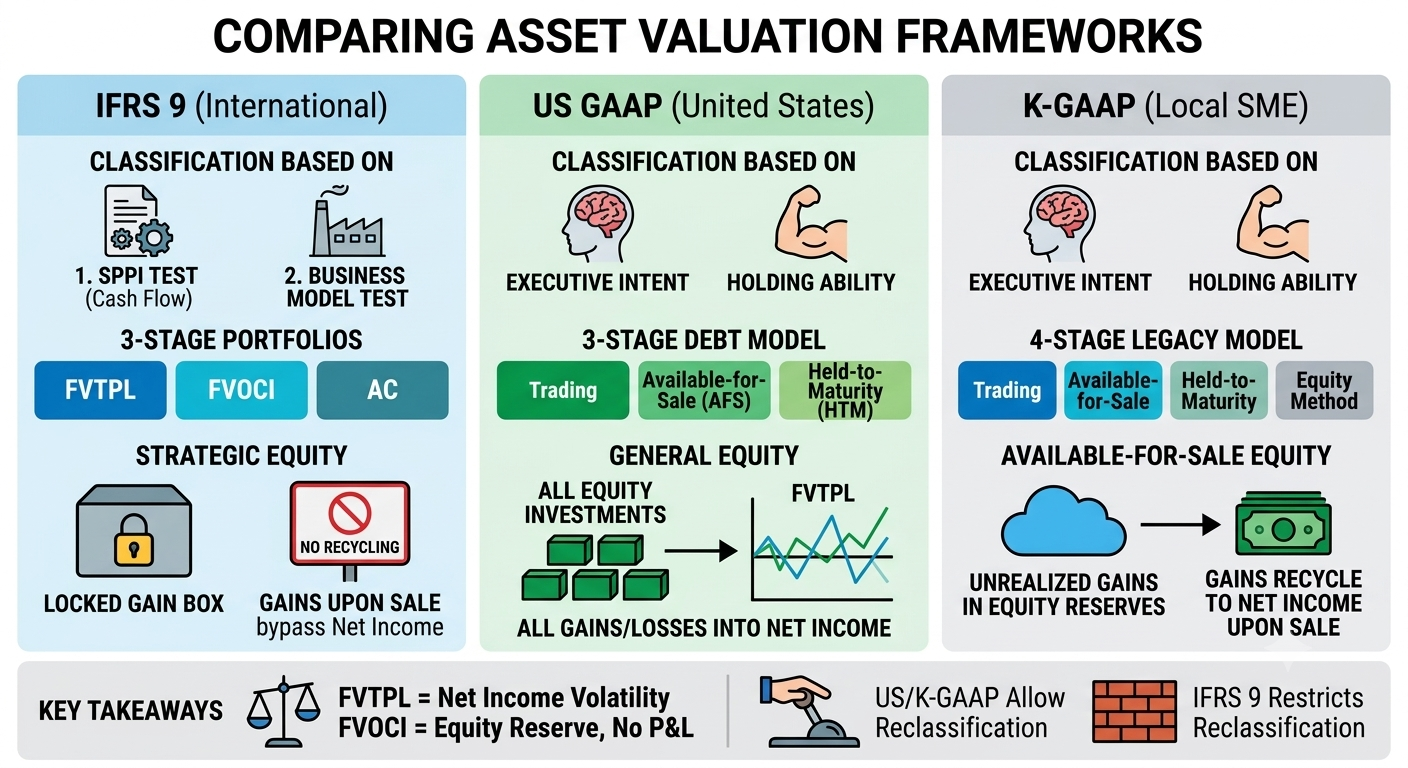
To minimize opportunistic earnings management, IFRS 9 replaces subjective classification choices with two mandatory test gates: the Contractual Cash Flow Characteristics Test (Solely Payments of Principal and Interest, or SPPI) and the Business Model Test. Passing or failing these tests places the asset into one of three distinct classification boxes:
5. Comparative Analysis: IFRS 9 vs. US GAAP vs. K-GAAP
Financial asset classification standards differ significantly across International Financial Reporting Standards (IFRS 9), United States Generally Accepted Accounting Principles (US GAAP), and Korean Generally Accepted Accounting Principles for non-public enterprise SMEs (K-GAAP).
Framework Comparison Matrix
Key Architectural Differences
1) Impact of Equity Fluctuations on Reported Net Income
- US GAAP: Applies a strict, transparent rule. All general corporate equity holdings—regardless of management’s intent to hold them for decades—must be recorded at fair value, with quarterly market fluctuations flowing directly through current net income. This can create significant volatility on the P&L statement during turbulent equity markets.
- IFRS 9: Offers an irrevocable election at initial acquisition to designate strategic equity investments as FVOCI. This isolates unrealized valuation swings within an equity reserve on the balance sheet. However, IFRS 9 enforces a strict “No Recycling” rule: even when the strategic equity is sold for significant cash gains, that profit can never enter current period net income; it transfers directly within equity reserves into Retained Earnings.
- K-GAAP: Provides greater flexibility for SMEs. Strategic investments categorized as Available-for-Sale accumulate unrealized gains within equity reserves, but upon sale, those accumulated gains recycle into current-period net income, allowing firms to demonstrate realized performance.
2) Objective Testing vs. Management Intent
- IFRS 9 relies on objective, systematic testing—verifying SPPI contractual terms and documented business model frameworks.
- US GAAP and K-GAAP retain traditional criteria, giving substantial weight to documented executive intent and financial capability (e.g., formal board resolutions declaring the ability to hold fixed-income bonds to maturity).
3) Asset Reclassification Restrictions
- IFRS 9 restricts asset reclassifications to prevent earnings manipulation. Switching financial assets between portfolios is permitted only when an enterprise completely transforms its operational business model (such as entirely shutting down a business division).
- US GAAP and K-GAAP permit reclassification between portfolios under strict administrative conditions when management’s holding intent changes.
6. Operational Discrepancies: Large Public Enterprises vs. SMEs
- Public Enterprises (IFRS 9 Compliance): Corporate treasuries employ third-party valuation firms to establish quarterly fair values for marketable securities. For unlisted equities or private venture stakes, companies deploy complex valuation models, such as Discounted Cash Flow (DCF) analyses or option pricing models.
- Small-to-Medium Enterprises (SME Standards): Due to limited administrative resources, non-public companies frequently maintain unlisted holdings at historical acquisition cost. This administrative simplicity carries a risk: if an unlisted investee suffers severe credit deterioration, the firm may fail to record timely impairment charges, overstating asset values on the balance sheet.
Conclusion: Key Takeaways
- Accounting Framework Dictates Net Income Volatility: Holding the exact same equity portfolio yields vastly different earnings results depending on the governing accounting framework. Under US GAAP, equity price swings directly impact current net income. Under IFRS 9, strategic FVOCI equities isolate unrealized swings from net income, but profits can never be recycled into P&L upon ultimate sale.
- Beware Paper Profits vs. Liquid Cash: Executive leadership must distinguish between mark-to-market accounting gains and actual operational liquidity. Paper valuation gains on financial assets do not fund operational working capital, debt service, or physical capital expenditures.
- Objective Testing Governs IFRS 9 Asset Portfolios: Classifying debt and equity under IFRS 9 requires passing formal SPPI cash flow tests and business model evaluations, restricting subjective reclassifications.
- Active Impairment Monitoring for Private Investments: Non-public companies holding private equity at historical acquisition cost must establish regular credit impairment reviews to prevent overstating balance sheet asset values.
AI Disclosure: This content was developed through a collaborative process between the author and Google Gemini AI. The author structured, translated, reviewed, and finalized the financial analysis to adhere to standard North American accounting principles and corporate financial standards.