
In our previous discussion, we explored the fundamental nature of corporate bonds and how interest rate fluctuations trigger the “seesaw effect” on bond prices. Once a corporation successfully raises capital by issuing bonds, corporate executives and financial leaders face an even more critical question:
“Should we hold our outstanding corporate bonds until maturity, or is now the right time to refinance them with new debt?”
Just as a homeowner refinances a mortgage when market interest rates fall, corporations must continuously rebalance their cost of capital by refinancing or redeeming their debt. Knowing the exact timing formulas and strategic implications of bond redemption and refinancing can define the success or failure of financial planning and period-end reporting.
1. Key Terminology and Practical Concepts
Before formulating a strategy, it is essential to understand the core terms governing corporate debt management:
- Redemption: The final payment of principal and accrued interest to investors to fully settle and terminate the debt obligation.
- Refinancing: Issuing new bonds to pay off maturing or higher-interest existing bonds (essentially swapping old debt for new debt).
- Call Option (Callable Provision): A contractual right embedded in a bond that allows the issuing corporation to repurchase the bond from investors at a specified price prior to its official maturity date.
- Debt Restructuring: Re-negotiating terms with creditors to extend maturity dates or adjust interest rates in order to improve a firm’s financial health.
Why Corporate Bond Refinancing Mirrors a Home Mortgage Refinance
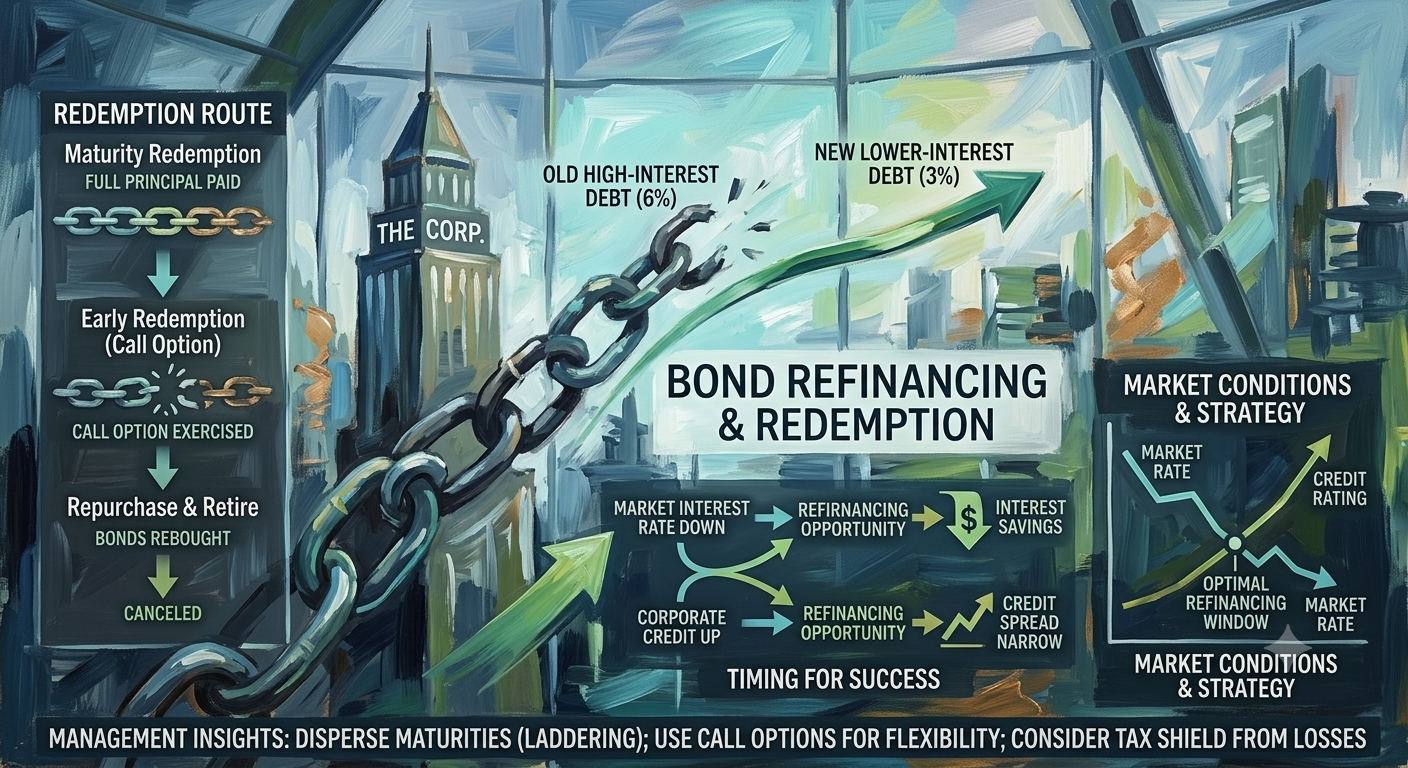
Imagine securing a fixed-rate mortgage at 6% per year. A year later, prevailing market interest rates plummet to 3%. If you do nothing, your household incurs unnecessary interest expenses every month.
A financially savvy homeowner takes out a new mortgage at the current 3% rate to pay off the older, more expensive 6% loan in full. Even after accounting for prepayment penalties or closing costs, the long-term interest savings far outweigh the initial fee. Corporate refinancing operates on the exact same financial principle: replacing high-cost debt with lower-cost capital to maximize cash efficiency.
2. Bond Redemption Methods and Accounting Treatments
Corporations typically remove bond liabilities from their balance sheets through three primary methods:
Path 1: Maturity Redemption
This is the standard approach. On the maturity date, the issuing corporation repays the nominal face value to investors and retires the bond. From an accounting perspective, this results in a straightforward entry: debiting the bond liability account to eliminate it from the balance sheet while crediting cash to reflect the cash outflow.
Path 2: Early Redemption and Gain/Loss on Debt Extinguishment
If a corporate bond includes an embedded call option, the issuer can force an early payoff when market interest rates decline.
The accounting core of early redemption lies in comparing two values: the bond’s amortized carrying value on the balance sheet versus the actual cash settlement amount paid to redeem it.
Gain / Loss on Debt Extinguishment=Amortized Carrying Value−Cash Settlement Amount
- If the cash paid is less than the carrying value, the firm records a Gain on Debt Extinguishment (non-operating income).
- If the cash paid is greater than the carrying value (due to call premiums or market conditions), the firm records a Loss on Debt Extinguishment (non-operating expense), directly impacting net income for the period.
3. Strategic Decision Framework: When to Refinance vs. Retire
Financial managers must continuously evaluate prevailing macroeconomic interest rates and internal cash flows to optimize timing.
4. Strategic Takeaways for Business Leaders
1. Architect Call Options Strategically During Initial Issuance
Even if adding a callable feature requires paying a slightly higher coupon rate upfront, corporate borrowers should prioritize embedding call options. This structure grants management the operational flexibility to actively restructure liabilities whenever market interest rates fall or corporate liquidity improves.
2. Diversify Debt Maturity Ladders
Concentrating tens of millions of dollars in bond maturities within a single fiscal year creates severe refinancing risk. If that specific year coincides with a credit crunch or rate spike, even profitable firms risk sudden liquidity crises. Establishing a bond maturity ladder—staggering maturities across 3-year, 5-year, and 7-year intervals—ensures predictable capital management.
3. Leverage Tax Shield Dynamics from Extinguishment Losses
When a corporation redeems high-coupon debt early, any resulting loss on debt extinguishment is generally tax-deductible under North American tax codes. During high-profit fiscal years, retiring expensive debt early can generate an effective tax shield, lowering overall corporate tax liabilities while permanently restructuring the balance sheet.
Conclusion: Key Takeaways
- Bond Refinancing replaces expensive liabilities with lower-yield securities to optimize corporate interest burdens.
- Timing Is Everything: Interest rate cuts and credit rating upgrades offer prime windows for refinancing, whereas high-rate environments favor paying down principal directly with excess cash.
- Proactive Capital Structure Management: Executive leadership must protect financial flexibility by laddering maturity profiles and negotiating embedded callable provisions during initial bond structurings.
AI Disclosure: This post was written, reviewed, and edited by the author in collaboration with Google Gemini AI to enhance technical clarity, readability, and structural flow. The images and visual aids included in this post were generated by Google Gemini AI.