
If traditional corporate management relied heavily on retrospective bookkeeping—essentially acting as a post-mortem review of historical receipts—modern predictive management begins long before a single product rolls off the assembly line. It starts with the calculated engineering of a Standard Costing system.
Establishing a standard cost framework is highly comparable to an elite culinary chef writing a definitive master recipe book. Long before service begins, the chef explicitly documents the precise weight of each ingredient, the exact cooking times, and the baseline utility expenses required for execution. For a contemporary enterprise, this baseline serves as the ultimate strategic anchor point.
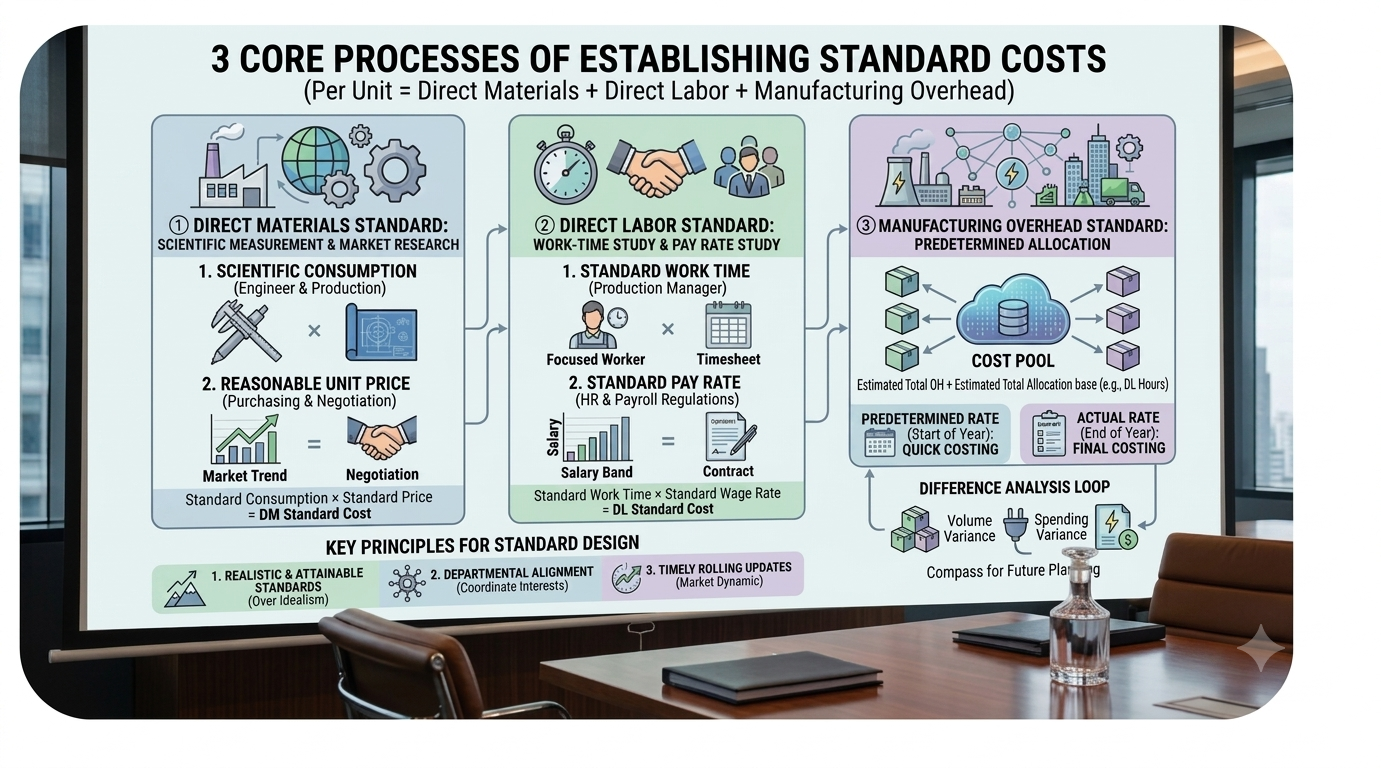
To build this predictive system, financial planners and operational engineers must systematically break down the three primary elements of product costs: direct materials, direct labor, and manufacturing overhead.
1. The Three Structural Pillars of Standard Cost Construction
The total standard cost of a single finished unit is mathematically defined as the sum of three core buckets: Direct Materials + Direct Labor + Manufacturing Overhead.
① Direct Materials Standard: Quantity and Procurement Benchmarks
- The Core Formula: Standard Quantity × Standard Price
- The Engineering Process: Industrial engineers analyze product designs to measure the exact volume of raw components required for a single finished unit. This calculation includes a scientifically determined allowance for normal, unavoidable scrap or waste. Once this standard quantity is locked, the procurement division reviews global supply contracts and macro-market indices to establish the standard price per unit of material.
- Practical Example: In a commercial baking operation, a standard recipe calls for 100 grams of flour per loaf of bread. If the procurement team locks in a standard purchase price of $0.05 per gram, the baseline standard direct materials cost is exactly $5.00 per loaf.
② Direct Labor Standard: Workforce Efficiency and Wage Benchmarks
- The Core Formula: Standard Labor Hours × Standard Labor Rate
- The Engineering Process: Plant operations managers conduct thorough time-and-motion studies to calculate the exact hours a reasonably skilled technician requires to complete one unit under normal operating conditions. This time allocation explicitly factors in mandatory human rest periods and routine equipment setups. The human resources department then provides the standard hourly labor rate, mapped out from corporate payroll frameworks and localized labor market benchmarks.
- Practical Example: If producing a standard loaf of artisanal bread requires 0.1 direct labor hours of work, and the standard corporate wage rate for a line baker is $15.00 per hour, the standard direct labor cost is established at $1.50 per unit.
③ Manufacturing Overhead Standard: Systemic Allocation of Indirect Costs
Corporate expenses that cannot be tied directly to a specific unit—such as factory electricity, facility leases, plant security, and heavy machinery depreciation—must be systematically distributed using a structured accounting methodology known as Overhead Allocation. Managing this element requires an advanced understanding of the relationship between predetermined and actual overhead rates.
- The Core Formula: Standard Allocation Base Quantity per Unit × Predetermined Overhead Rate
- The Dual-Rate Mechanism:
- Predetermined Overhead Rate: This is an estimated rate calculated before the fiscal year begins. It divides the total projected annual manufacturing overhead costs by the total expected annual operational base, such as total direct labor hours or machine hours. This estimated rate allows corporate accountants to assign costs to products instantly as they are produced, avoiding a multi-month delay.
- Actual Overhead Rate: This represents the true cost rate determined at the conclusion of the fiscal year by dividing the total actual overhead expenditures by the total actual hours worked.
- Reconciliation & Variance Control: Because estimates rarely align perfectly with reality, a mathematical delta—known as an overhead variance—will inevitably emerge at year-end. Corporate controllers dissect this delta to evaluate whether the gap was driven by equipment running below capacity, which spreads fixed costs over fewer units (Volume Variance), or if the utility companies simply increased their baseline rates (Budget Variance). This variance breakdown acts as a financial compass for future planning.
2. Three Critical Pitfalls to Evade During System Design
Designing a standard costing system is not a sterile, purely mathematical data-entry project. Financial architects must account for organizational psychology and market dynamics, or risk a total collapse of their management control systems.
The Behavioral Balance Between Ideal and Practical Standards
An Ideal Standard assumes perfect factory conditions: zero equipment downtime, an entirely flawless workforce, and zero raw material defects. Setting the corporate bar at this level is psychologically destructive. Employees quickly experience burnout, stop trying to meet the impossible targets, and the accounting system produces nothing but permanent, highly discouraging unfavorable variances.
Instead, leadership must implement an Attainable Standard. This framework incorporates reasonable human mistakes, routine preventive maintenance schedules, and normal material spoilage, creating a challenging yet realistic target that motivates staff.
Balancing Interdepartmental Trade-offs
A common structural failure in cost design is allowing individual departments to optimize their own metrics at the expense of the larger organization. For instance, if a purchasing department is pressured to meet an aggressively low standard material price, they may source low-grade, inferior raw inputs.
While the purchasing team celebrates a favorable price variance, the factory floor faces a massive spike in product defects and production delays. This shifts the financial burden to the manufacturing team in the form of severe unfavorable efficiency and labor variances. Standard designs must prioritize total organizational optimization over isolated department goals.
Implementing Timely Rolling Forecast Updates
In volatile economic climates characterized by fragile global supply chains and fluctuating currency exchange rates, clinging to a frozen standard cost structure for an entire year is dangerous. Rigid, outdated standards distort product pricing models and mask true profitability.
Organizations must deploy a dynamic cost management framework driven by trigger alerts. For example, if a core commodity price shifts by more than 5% for consecutive weeks, a rolling forecast mechanism should immediately recalculate the standard baseline to keep corporate decisions aligned with reality.
3. The Domino Effect of Flawed Standards: Pitfalls and Corrective Strategies
When a corporate financial blueprint is drawn incorrectly from the start, the distorted standard cost system acts as a boomerang that blindfolds executive decision-makers.
| System State | Resulting Operational Vulnerabilities (Left-Aligned Content) | Essential Leadership Interventions (Left-Aligned Content) |
| Standards Are Too Tight | Trippers organizational burnout and widespread loss of motivation. Personnel may quietly source low-grade materials or push machinery beyond safe limits to hit targets, spiking defects and injury rates. | Recalibrate metrics toward realistic, attainable standards based on empirical shop-floor capabilities. Tie cost metrics directly to quality-driven key performance indicators to protect brand equity. |
| Standards Are Too Loose | Locks in hidden operational waste and creates a false sense of security. Employees hit targets with minimal effort, stalling continuous improvement while the company slowly loses its market edge. | Conduct quarterly data audits to trim excess slack from budgets. Integrate continuous improvement philosophies, such as lean manufacturing practices, to gradually tighten benchmarks. |
| Standards Are Obsolete | Distorts corporate pricing strategies and breaks down profit margin analysis. The firm risks underpricing products and selling at an unmapped loss, or overpricing themselves out of the market. | Establish a trigger-based dynamic system that forces an automated standard cost recalculation whenever market indices or foreign exchange rates cross a predefined 5% variance threshold. |
4. Strategic Integration for Long-Term Corporate Success
To maximize its value, a standard costing system must evolve beyond a basic cost-control tool and become a strategic asset that drives growth.
Fair Performance Evaluation via Controllable Variances
The fundamental goal of variance analysis is to fix systemic operational issues, not to hunt for scapegoats. If global shipping disruptions drive up raw material costs, the purchasing department cannot control that outcome. This is an uncontrollable variance.
Conversely, if material is wasted due to poor floor supervision, that is a controllable variance. Management performance reviews and incentive systems must clearly separate these two categories. This ensures employees are evaluated fairly, fostering a culture where staff feels secure proposing authentic cost-saving ideas.
Real-Time Decision-Making Through Digital Transformation
The days of waiting weeks for end-of-month accounting reports to discover financial leaks are over. Modern enterprises must connect Internet of Things sensors on the factory floor directly with next-generation Enterprise Resource Planning software.
This integration allows dashboard displays to flag unfavorable efficiency variances the moment a production line slips below standard thresholds. Frontline managers can then take immediate corrective action before minor operational issues turn into major balance-sheet losses.
Blending Standard Costs with Target Costing and Kaizen Principles
Instead of merely maintaining existing cost standards, forward-thinking enterprises combine standard costing with Target Costing during the initial product development phase, engineering the product from the start to meet market-driven price points.
Once mass production begins, management layers on Kaizen Costing principles, systematically adjusting the standard milestones downward each month. This hybrid model transforms standard costing from a static accounting ledger into a dynamic engine for continuous margin expansion.
Conclusion: Key Takeaways
- Establish Balanced Benchmarks: Move away from impossible, idealistic goals; build attainable standards that factor in normal operational friction to maintain employee engagement.
- Protect the Whole Ecosystem: Prevent individual departments from hitting isolated cost goals that cause costly, inefficient disruptions downstream.
- Adopt Real-Time Analytics: Upgrade from old, slow bookkeeping methods to automated, tech-driven tracking systems that identify cost variances instantly.
- Evaluate Staff Fairly: Separate uncontrollable external market forces from controllable internal actions to maintain a fair, high-performing corporate culture.