
f traditional corporate management was limited to old-fashioned bookkeeping—essentially treating finance as a retrospective review of historical cash flows—modern business leadership is focused on engineering an enterprise’s future roadmap. In today’s volatile economic environment, executive committees face a clear choice: they can either pilot an unguided ship through a dense fog of financial uncertainty, or they can act as strategic captains armed with the definitive corporate blueprint of Standard Costing.
The ultimate weapon for a growing enterprise is not a blunt reduction in total spending, but a sophisticated analytical framework that systematically identifies and eliminates operational waste by contrasting planned expectations against real-world performance.
1. Demystifying Cost Standards and Variances through Everyday Metaphors
To understand these core corporate finance tools intuitively, look at a standard personal health and fitness regimen. Imagine you design a daily dietary target to consume exactly 2,000 calories. This preset budget serves as your benchmark. At the end of the week, you step onto a digital scale and discover you have gained weight.
To fix this issue, you run a personal audit. You compare your actual caloric intake against your baseline target to uncover the root cause of the breakdown. Did you exceed your budget because you purchased high-calorie, premium gourmet items, or did you fall short simply because you ate excessively large portions? This evaluation allows you to isolate the problem and adjust your behavior moving forward.
- Standard Cost: This serves as the definitive reference model for corporate expenditures. It represents a scientifically engineered target that details the exact volume of raw material, direct labor hours, and operational funding required to manufacture a single unit under highly efficient working conditions.
- Variance Analysis: This is the precise financial practice of dissecting the structural gap between your baseline targets and real-world results. By comparing your preset standard costs with the actual money spent during production, accounting teams track down exactly where, how, and why a financial deviation occurred.
- Core Meaning: This specialized management control process uses historical data, statistical models, and operational engineering to establish baseline manufacturing costs in advance. By systematically evaluating real-world performance against these pre-engineered standards, corporate executives gain the power to isolate, control, and eliminate hidden waste across the organization.
2. Industry Pairings: Application in Mass Manufacturing and Franchise Operations
The strategic execution of a standard cost framework shifts dynamically based on an enterprise’s industrial classification and production model.
Mass Production Manufacturing (High-Precision Standardization)
In asset-heavy production sectors led by industrial companies like Ford, General Motors, Tesla, or Samsung, factories produce millions of identical components along highly automated assembly lines.
Because a tiny delay or minor defect can quickly scale into millions of dollars in losses, these firms establish incredibly strict standards down to individual screw prices and assembly-line cycle times measured in fractions of a minute. Any tiny variance on the factory floor triggers an immediate alert, allowing frontline engineers to fix operational bottlenecks before they impact corporate profitability.
Franchise and Hospitality Chains (Recipe-Driven Consistency)
In global franchise models led by brands like McDonald’s, Starbucks, or Subway, cost control is maintained through strict recipe standardization.
The precise weight of a single sandwich ingredient, the exact beverage pour size, and the automated cooking times are engineered identically across thousands of locations worldwide. By managing variances from these strict recipes, corporate headquarters ensure that a consumer receives the exact same product quality, while the company maintains uniform profit margins across every international market.
3. The Continuous Lifecycle of Variance Analysis
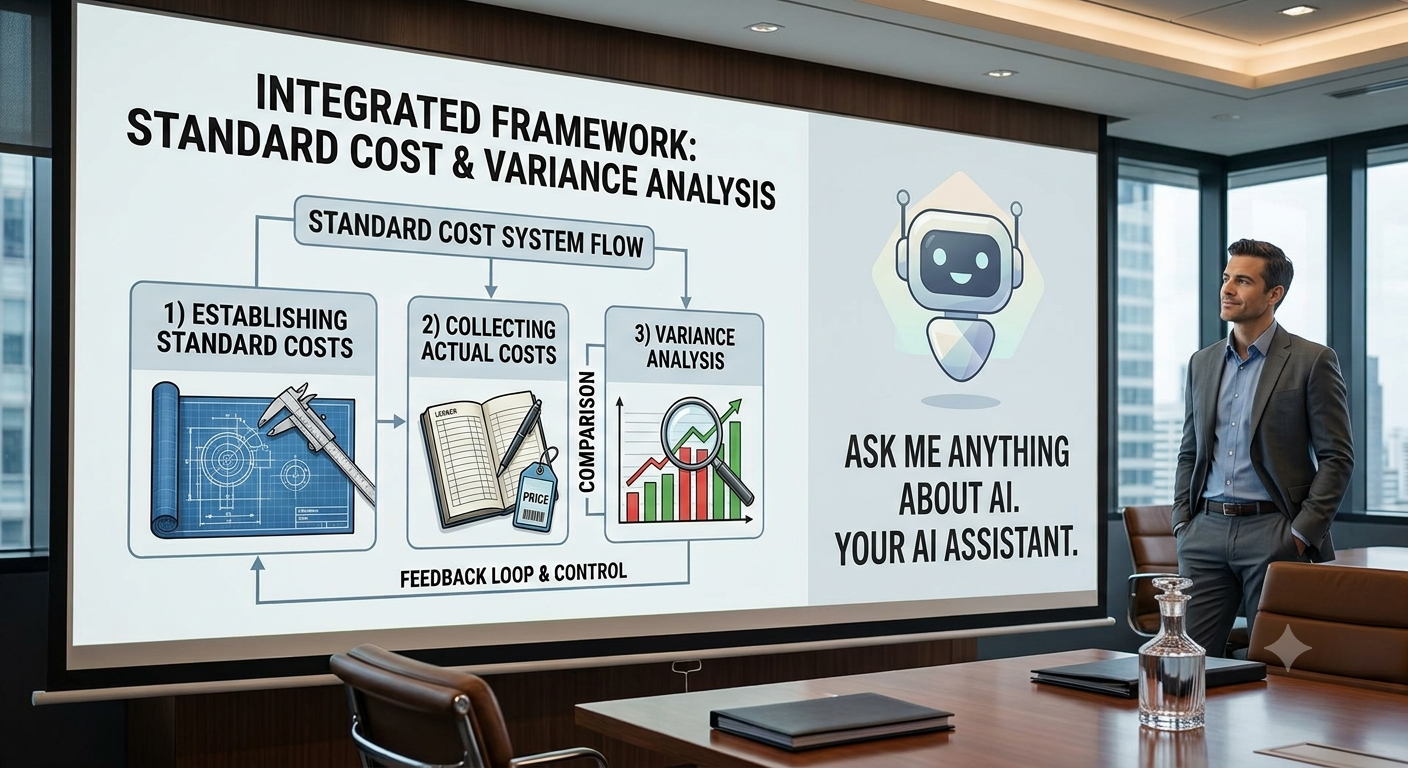
Implementing a world-class variance analysis program requires adherence to a highly structured, continuous operational lifecycle:
- Establishing Standards: Industrial engineers and financial controllers collaborate to analyze past performance data and machine specifications. Together, they establish the standard material volume and direct labor hours required per finished unit.
- Accumulating Actual Costs: Following a production cycle, corporate accounting teams collect the real-world expenses incurred on the shop floor, gathering data on true raw material acquisition rates and actual payroll wages.
- Calculating Variances: Financial controllers subtract the actual costs from the pre-engineered standard costs to determine the total mathematical delta for the performance period.
- Analyzing Root Causes: Analysts break down the overall delta into granular vectors. They isolate whether the financial deviation was driven by external macroeconomic shifts, like market price hikes, or by internal operational issues, such as poor labor efficiency causing material waste.
- Taking Corrective Action: Executive leadership uses these insights to optimize the business. This might involve updating supplier contracts, deploying targeted employee training programs, or adjusting standard baselines to reflect new market realities.
4. The Risk of Operating Without Strategic Variance Tracking
Running a contemporary enterprise without a functional standard cost tracking framework is identical to piloting a commercial airliner without an instrument panel. On the surface, production might look stable, but underlying financial problems can quietly destroy the business from within.
- An Unmapped Descent into Deficits: When an executive committee reviews a basic profit-and-loss statement and notices a sudden surge in quarterly expenses, managers often blame generic market inflation. Without detailed variance tracking, the firm cannot identify the true drivers of loss, leaving internal operational waste and material theft completely hidden.
- Departmental Blame and Cultural Friction: Lacking a clear baseline standard means an enterprise cannot differentiate between external procurement costs and internal workforce performance. This leads to unfair performance reviews where senior leaders inadvertently blame factory managers for global supply chain spikes, destroying employee morale and causing deep organizational friction.
5. Strategic Comparison of Standard Cost Systems
| Evaluation Category | Advantages of Standard Costing (Center-Aligned) | Disadvantages of Standard Costing (Center-Aligned) |
| Cost Control | Uses management-by-exception to instantly flag and stop operational waste. | Demands significant time, corporate data, and financial capital to build and maintain. |
| Performance Evaluation | Provides an objective, metric-driven framework to assess departmental goals fairly. | Can foster internal friction if evaluations focus too narrowly on rigid numbers. |
| Product Pricing | Delivers highly accurate cost projections to simplify product pricing strategies. | Struggles to adapt quickly to rapid, unexpected shifts in global material rates. |
| Workforce Motivation | Offers manufacturing teams clear, measurable targets to improve daily productivity. | Can create severe workplace stress if standards are designed too aggressively. |
Strategic Management Insight: To prevent an accounting system from becoming overly rigid, executive leadership must systematically separate uncontrollable variances caused by external macroeconomic shifts from controllable variances driven by internal operational execution.
Conclusion: Key Takeaways
- Adopt Predictive Management: Move away from retrospective financial tracking and implement proactive, engineered standards to guide corporate spending decisions.
- Isolate Cost Drivers: Use advanced variance tracking to separate external market price shifts from internal workforce production efficiencies.
- Maintain Operational Balance: Ensure cost-reduction goals do not compromise product quality, safety standards, or brand equity.
- Evaluate Performance Fairly: Structure corporate incentive programs around controllable metrics, protecting employees from external macroeconomic volatility.
* This article was created in collaboration with Google Gemini AI. The author independently created, reviewed, and edited the content to ensure professional quality.