
In the past, corporate management functioned like a top-down hierarchy, moving in unison at the command of a single CEO. Today, modern management resembles a living organism—each department must think and act for itself. As of 2026, companies face a critical choice: remain a slow-moving ship reliant on headquarters for every decision, or evolve into an agile captain of a Decentralized Organization, equipped with a “motor” of delegated authority and a “dashboard” of precise performance metrics. The key for large-scale enterprises is to empower individual units while establishing a robust system of responsibility accounting to analyze results and hold leaders accountable.
Understanding the Concept: An Everyday Analogy
Think of managing a large retail department store. If headquarters tries to micromanage every customer interaction, the store will fail. Instead, you grant the floor manager full authority to issue discounts or hire staff (Decentralization), then at the end of the month, you evaluate the revenue and margins generated on that floor (Performance Measurement) to verify the manager’s competence. This process provides autonomy while ensuring a clear “report card” at the end of the year.
Key Frameworks
- Decentralization: The systematic delegation of decision-making authority from top management to lower-level unit managers.
- Responsibility Accounting: A system that evaluates performance based on “controllable” results. Organizations are divided into cost, profit, or investment centers, allowing managers to be measured only on what they can influence.
- Corporate “Cell Division”: Like a biological cell, headquarters creates smart, smaller units that operate as independent entities. This allows top executives to focus on long-term strategy while field leaders act as “kings of their own territory” to respond quickly to market changes.
Pros and Cons of Decentralization
| Perspective | Advantages | Disadvantages |
| Decision Speed | Managers react instantly to market changes. | Lack of unified direction or company-wide strategy. |
| CEO Burden | Top leadership focuses on long-term strategy. | Harder to detect detailed risks or inefficiencies. |
| Motivation | Autonomy fosters the next generation of leaders. | Pressure to deliver can cause neglect of long-term investment. |
| Resource Use | Efficient, local-centric resource allocation. | Duplication of support functions (HR, Accounting, etc.). |
Industry Application
- Retail & Distribution (e.g., E-mart, Lotte Mart): Regional managers are empowered to customize product mixes and marketing to fit specific local demographics.
- Global Tech (e.g., Google, Naver): Companies operate via Company-in-Company (CIC) structures, allowing search, shopping, and cloud teams to act like independent startups.
- Multinational Corps (e.g., Coca-Cola, McDonald’s): Local country heads have full authority over product development and pricing to align with regional cultural nuances.
- Diversified Manufacturing (e.g., Amorepacific, LVMH): Brands are managed as separate investment centers, preventing internal interference between mass-market and luxury divisions.
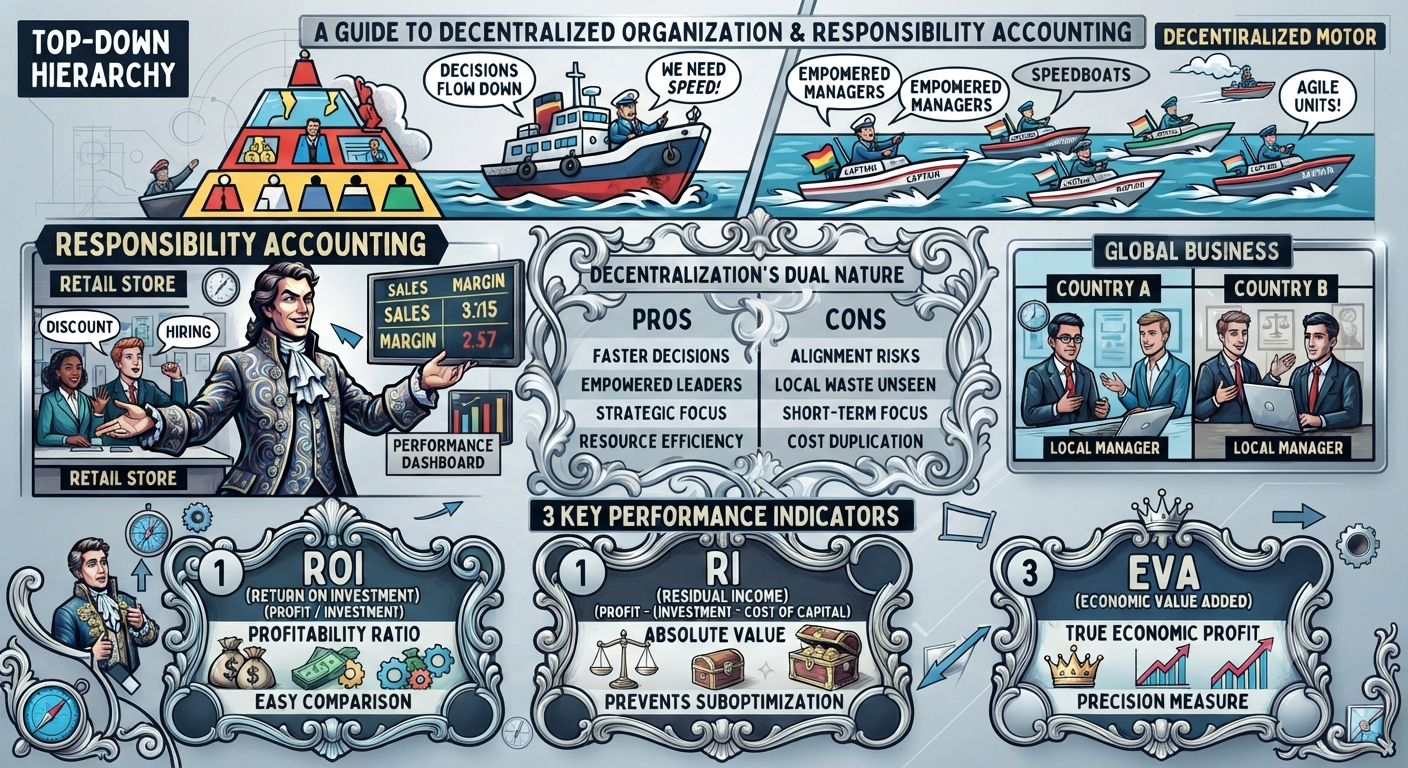
3 Key Performance Metrics for Decentralized Units
When units are given investment authority, “report cards” must be precise:
- Return on Investment (ROI): Measures net income as a percentage of investment. It is great for comparing units of different sizes, but it can lead to “Suboptimization,” where managers reject profitable projects just to keep their ROI ratio high.
- Residual Income (RI): The absolute dollar amount remaining after deducting the cost of capital from net income. It forces managers to accept any project that adds value, preventing the ROI-based rejection error. However, since it is an absolute number, it favors larger divisions, making it hard to compare units of different scales.
- Economic Value Added (EVA): Calculates the true value added for shareholders by subtracting the capital charge from operating profit. It strips away accounting distortions but can be complex for field managers to interpret.
Special Mention: EBITDA
EBITDA (Earnings Before Interest, Taxes, Depreciation, and Amortization) is a favorite in capital-intensive industries or M&A. It strips away accounting choices (like depreciation methods or interest structures) to show pure “cash-generating power.”
- The Trap: It ignores investment (asset) accountability. If a manager buys expensive equipment with debt, EBITDA remains high because it ignores depreciation and interest, potentially encouraging over-investment.
What Happens Without Performance Systems?
Without rigorous responsibility accounting, decentralization becomes a “runaway train”:
- Unchecked Expansion: Managers may aggressively inflate assets with company money, harming cash flow.
- The Silo Effect: Departments compete for resources or steal customers from one another, leading to internal conflict rather than collective growth.
“Delegation without standards is chaos; decentralization without measurement is a fantasy.”
Conclusion: Key Takeaways
- Balance Autonomy with Accountability: Decentralization accelerates organizational speed, but only when coupled with precise performance metrics.
- Select the Right Metric: ROI, RI, and EVA all serve different purposes; choose the one that aligns business unit goals with overall corporate strategy.
- Look Beyond the Numbers: Financial indicators are crucial, but complement them with non-financial KPIs like customer satisfaction or employee retention to avoid short-term bias.
- Proactive Leadership: Differentiate between “controllable results” and “market variables” when evaluating managers to ensure fair and effective leadership development.
※ This post was created in collaboration with Google Gemini AI. The author independently created, reviewed, and edited the content to ensure professional quality