
How does an artificial intelligence system reach doctor-level diagnostic precision or accurately answer complex analytical questions? It does not simply memorize vast databases. Instead, AI relies on two fundamental operational phases: Training and Inference.
To succeed in artificial intelligence engineering, understanding these two pillars is essential. Training represents the intensive study phase where an AI builds its core intelligence from massive datasets. Inference represents the operational deployment phase, where the model applies its learned knowledge in real-time to solve new problems. Let us explore the technical depth, mathematical mechanics, and practical distinctions between these two critical processes.
1. Everyday Analogies for Conceptual Understanding
1) Training = The Graduate Student Studying for Bar Exams
Training is the process of generating an AI model’s internal intelligence—represented mechanically as parameter weights—from raw data.
- Educational Methodology: Imagine a scholar studying tens of thousands of complex practice exams over several years. The student repeatedly attempts questions, checks answers, analyzes errors, and refines their mental frameworks to minimize mistakes.
- Technical Mechanics: When the AI’s output deviates from the ground truth, it calculates the mathematical loss and propagates error feedback backward through the network, making micro-adjustments to millions or billions of neural connections (weights).
- Resource Requirements: This process requires massive compute clusters, high-end GPU/TPU infrastructure, and significant energy over weeks or months.
2) Inference = The Senior Consultant On-Site
Inference applies a fully trained model to real-world applications, generating predictions or answers for new, unseen user queries.
- Operational Methodology: Studying is complete. When a user asks a question, the AI uses its established “knowledge network” to produce an immediate response, much like a seasoned attorney delivering expert legal advice on the spot.
- Technical Mechanics: Input data moves exclusively forward through the frozen network parameters. The system performs a single computational pass to generate the output without modifying its parameters.
- Resource Requirements: Real-time speed and low latency are critical. Inference runs efficiently across cloud API servers, edge devices, and consumer laptops.
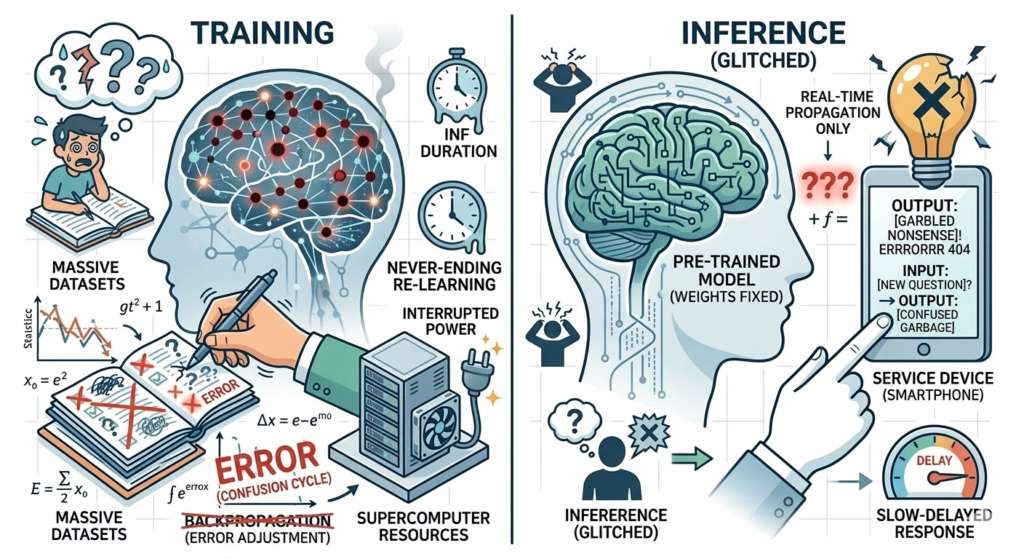
2. Why Architectural Separation Matters
What If AI Had to Train Every Time You Asked a Question?
Without separating training from inference, an AI would need to re-analyze its entire historical dataset before answering a simple query like “What is the weather today?” Responses would take days or weeks, making commercial software services virtually impossible to deliver.
The Modern Two-Phase Architecture
Modern machine learning separates computation into a two-stage lifecycle:
- Pre-computation (Training Phase): Massive data is processed ahead of time on supercomputing clusters, producing a compact static model file containing optimized parameter weights.
- Runtime Execution (Inference Phase): The static model file is deployed to production servers or local devices. User queries pass through the frozen weights, enabling platforms like ChatGPT and real-time translators to deliver answers in seconds.
3. Deep Technical Breakdown: Forward and Backpropagation
Phase 1: Training Mechanics
    [Input Data] ───(Forward Propagation)───► [Model Prediction]
                                                        │
                                                        ▼
    [Weight Updates] ◄───(Backpropagation)─── [Calculate Error/Loss]
- Step 1: Forward Propagation (Prediction Pass)Raw data enters the neural network at the input layer and flows forward through hidden layers to produce an initial prediction.
- Step 2: Loss EvaluationThe model calculates a mathematical loss function that measures the deviation between its prediction and the ground truth label.
- Step 3: Backpropagation (Feedback Loop)Using calculus (specifically the chain rule), the system calculates gradients starting from the output layer back to the input layer. This pinpoints exactly how much each parameter contributed to the error.
- Step 4: Parameter UpdateAn optimization algorithm (such as Stochastic Gradient Descent or Adam) adjusts the network’s internal parameters (weights and biases) to minimize loss on future passes.
Phase 2: Inference Mechanics
    [New User Query] ───(Forward Pass Only)───► [Instant Response]
                        (Weights Locked)
- Locked Parameters: Once training completes, the model’s parameters are locked. The system no longer updates its weights or learns from new input data during standard inference.
- Execution Flow: Incoming user data moves strictly forward through the network in a single pass.
- Speed & Latency: Because backpropagation and weight update calculations are omitted, computational overhead is drastically reduced, enabling sub-second response times.
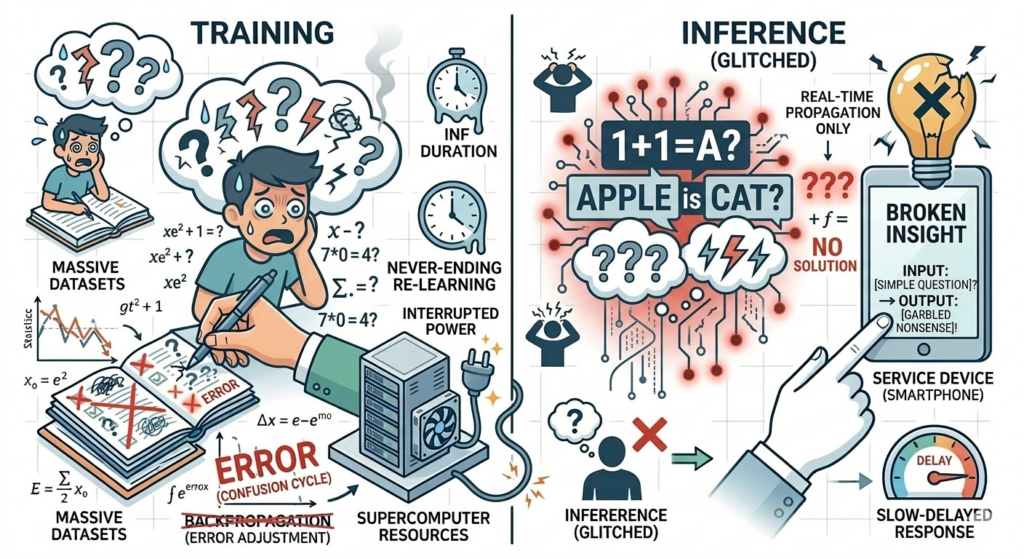
4. The Edge Revolution: On-Device AI Architecture
The industry focus has expanded from training mega-models toward optimizing inference efficiency for low-power hardware.
- Legacy Infrastructure: Previously, executing neural network inference required enterprise-grade data centers and continuous internet connectivity.
- Modern On-Device AI: Through optimization techniques such as quantization, model pruning, and knowledge distillation, AI models can run locally on consumer smartphones, PCs, and embedded chips using dedicated Neural Processing Units (NPUs). This transition lowers server operating costs, removes network latency, and enhances user data privacy.
5. Technical Comparison Table
Conclusion: Key Takeaways
- Functional Division of Labor: Training focuses on knowledge acquisition through iterative learning, whereas Inference focuses on real-time execution and application.
- The Mathematical Divide: Training relies on backpropagation to calculate error gradients and update model parameters. Inference relies strictly on forward passes across locked parameters to ensure fast execution.
- Economic Strategy: Training requires high capital investment in compute infrastructure upfront. In contrast, inference efficiency determines recurring software margins and operational serving costs.
- Edge AI Evolution: Model compression techniques now allow complex inference workloads to run locally on consumer edge hardware, reducing cloud infrastructure dependency while strengthening user data security.
AI Disclosure: Images and foundational research for this article were created in collaboration with Google Gemini AI. The final content was translated, rewritten, reviewed, and published by the author.