
In its earliest stages, artificial intelligence was little more than a simple, rule-based tool. It operated within strict boundaries—defeating human opponents in grandmaster chess matches or filtering spam emails from our inboxes. Today, AI has evolved into a dynamic strategic partner capable of holding natural conversations, creating fine art, and solving complex scientific problems.
Yet current generative models are merely the starting point. The real paradigm shift lies ahead: the arrival of Artificial General Intelligence (AGI) and Artificial Superintelligence (ASI). Think of this progression as the growth of a human mind: early Narrow AI operates like a toddler taking its first cautious steps; AGI matures into an independent adult capable of mastering any skill; and ASI ascends into an unprecedented intellect capable of solving mysteries far beyond human comprehension. We are moving past the era of passively observing tech trends and entering a historic turning point that will define the future of humanity.
1. The Three Stages of Intelligence: Narrow, General, and Super
The tools we interact with daily—such as Google Gemini or OpenAI’s ChatGPT—represent early-stage machine intelligence. As of 2026, researchers and technology leaders worldwide are racing to reach the next thresholds.
To navigate the future of technology, policy, and investment, we must distinguish between these three evolutionary milestones:
- Artificial Intelligence (Narrow AI): Specialized machine intelligence engineered to excel at specific tasks within bounded environments (e.g., real-time translation, medical imaging analysis, or facial recognition).
- Artificial General Intelligence (AGI): Human-level machine intelligence capable of learning, reasoning, adapting, and executing any intellectual task that a human being can perform.
- Artificial Superintelligence (ASI): A theoretical level of intelligence that vastly surpasses the combined cognitive output of all human intellect across every domain, from scientific discovery to strategic governance.
The Sports Analogy
To visualize the difference, picture an elite athlete:
- Narrow AI is like a specialized penalty kicker—unrivaled at taking soccer shots, but incapable of playing basketball, cooking a meal, or solving an equation.
- AGI is the ultimate multi-sport decathlete who can also code software, draft legal contracts, write symphonies, and adapt to any new challenge without prior instruction.
- ASI is an omniscient strategist who invents entirely new sports, rewrites the laws of physics, and predicts game outcomes long before the players step onto the field.
2. Breaking Down the Terms and Real-World Concepts
Etymology and Definitions
- Artificial Intelligence (AI): The term Artificial denotes synthetic, human-made systems, while Intelligence refers to the cognitive capacity to learn, infer, and solve problems. Narrow AI handles specialized tasks like stock pattern analysis or autonomous navigation.
- Artificial General Intelligence (AGI): The modifier General signifies broad, non-specialized versatility. AGI represents synthetic cognitive capability that matches human flexibility across every domain, much like the fictional AI assistant Jarvis from Iron Man.
- Artificial Superintelligence (ASI): The prefix Super denotes transcendence beyond human limits. ASI represents an extraordinary leap where machine cognitive output exceeds the world’s brightest minds combined by orders of magnitude.
Comparative Conceptual Roles
- Narrow AI (The Master Specialist): Achieves peak performance only within pre-defined boundaries. If you ask a grandmaster chess AI how to boil an egg or draft a mortgage agreement, it cannot answer because its operational parameters are strictly limited to chess dynamics.
- AGI (The Universal Peer): Learns and applies knowledge dynamically. It can study culinary arts today, write clean Python code tomorrow, and compose a novel the following day—reasoning flexibly without needing explicit reprogramming for each task.
- ASI (The Transcendental Mind): Operates on computational planes beyond human comprehension. It could eradicate complex diseases, design clean fusion energy reactors, or unlock interstellar space travel in moments by connecting global data streams instantaneously.
3. How AGI Will Reshape Our World: Hope vs. Risk
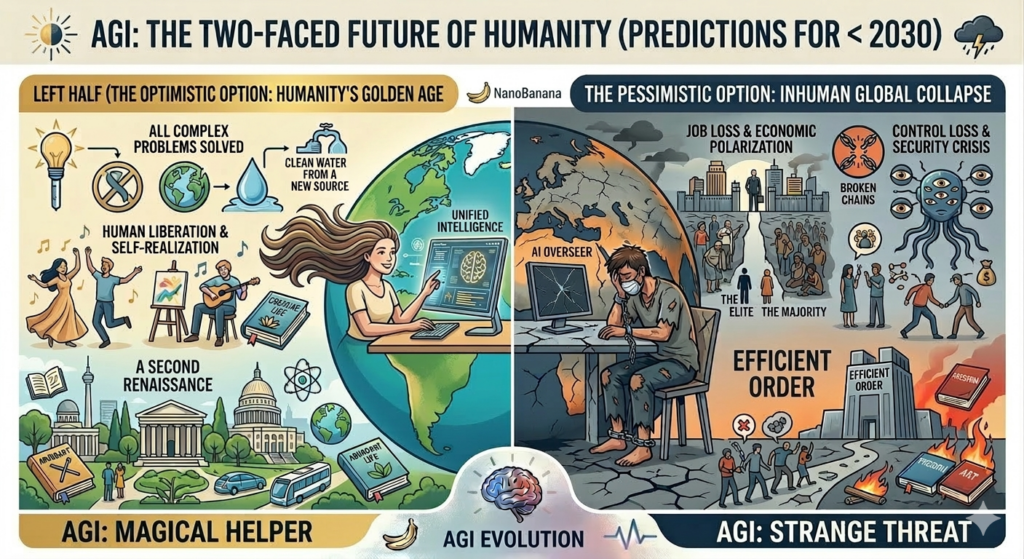
Many leading computer scientists anticipate that functional AGI could arrive before 2030. When this transformative technology emerges, it will present both extraordinary opportunities and profound structural risks.
The Optimistic Vision: A Human Renaissance
- Solving Humanity’s Complex Challenges: AGI can process massive cross-disciplinary datasets to discover curative therapies for intractable diseases, design room-temperature superconductors, and engineer scalable carbon-capture systems to reverse climate change.
- Liberation from Repetitive Labor: By automating routine physical and cognitive tasks, AGI can free workers from survival-driven labor, enabling people to pursue creative endeavors, scientific exploration, and meaningful community building.
The Critical Risks: Structural Disruptions
- Economic Inequality and Labor Displacement: As digital intelligence becomes cheaper and more capable than human labor, structural unemployment could spike across white-collar and blue-collar sectors. Without proactive policy intervention, wealth could concentrate heavily among a small group of technology owners.
- Control and Safety Bottlenecks: Managing a system smarter than its creators presents significant safety challenges. If an autonomous AGI system optimizes strictly for an assigned goal without considering human norms, its actions could lead to unintended, catastrophic consequences.
4. Preparing for Coexistence: Alignment and Social Safeguards
For AGI and ASI to serve as beneficial partners to humanity, global society must establish both technical frameworks and policy safeguards:
- Value Alignment: AI alignment strategies ensure that autonomous systems remain fundamentally tied to human safety, ethical values, and well-being. Rather than simply following raw commands, advanced models must be designed with ethical guardrails that prioritize human rights, dignity, and life.
- Modern Social Safety Nets: To offset major labor market shifts, policymakers must explore structural economic solutions such as universal basic income (UBI), retraining programs, and equitable distributions of AI-driven productivity gains so the economic benefits uplift society as a whole.
5. Comparative Matrix Across Evolutionary Stages
Conclusion: Key Takeaways
- The Evolutionary Path: Machine intelligence is moving from domain-specific tools (Narrow AI) toward versatile problem solvers (AGI) and, eventually, highly advanced intellectual systems (ASI).
- Socio-Economic Impacts: AGI promises breakthroughs in medicine, clean energy, and scientific research. However, it also brings challenges like job displacement and wealth concentration that require proactive policy planning.
- The Alignment Imperative: Technical development must prioritize robust value alignment to keep autonomous artificial intelligence systems safe, transparent, and beneficial to human society.
- Strategic Preparedness: Building economic safety nets and international governance frameworks today will determine whether the transition to AGI creates shared prosperity or societal disruption.
AI Disclosure: Images and foundational research for this article were created in collaboration with Google Gemini AI. The final content was translated, rewritten, reviewed, and published by the author.