
Introduction
As artificial intelligence rapidly evolves, it has shifted from a tool for quantitative analysis to an active partner capable of generating original content. Today, the two most critical drivers of enterprise strategy are Generative AI and Predictive AI. While both rely on machine learning and vast datasets, their underlying mechanics, strategic goals, and operational impacts are fundamentally distinct. This guide breaks down their core concepts, evolutionary positions, relative technical maturity, and real-world implementations.
1. Concept: Predictive AI
Predictive AI analyzes historical and real-time structured data using machine learning algorithms to forecast future outcomes, probabilities, and operational patterns. It forms the mathematical backbone of traditional enterprise AI.
- Core Mechanics: Leverages regression analysis, decision trees, time-series forecasting (e.g., ARIMA), and classification models.
- Primary Focus: Quantitative precision, statistical accuracy, and risk reduction.
- Key Examples:
- Recommendation Engines: Netflix/YouTube content curation algorithms, Amazon personalized product feeds.
- Finance & Risk: Credit card Fraud Detection Systems (FDS), algorithmic stock volatility models.
- Logistics & Navigation: Google Maps Estimated Time of Arrival (ETA), automated inventory forecasting tools.
2. Concept: Generative AI
Generative AI processes massive datasets across text, images, audio, and code to synthesize new, original content in response to user prompts.
- Core Mechanics: Powered by Large Language Models (LLMs), Transformers, Diffusion Models, and Generative Adversarial Networks (GANs).
- Primary Focus: Synthesis, contextual comprehension, and natural language outputs.
- Key Examples:
- Text Generation: ChatGPT, Claude, Gemini (copywriting, summarization, complex reasoning).
- Visual & Video Synthesis: Midjourney, DALL-E 3, Sora, Stable Diffusion (graphic design, dynamic media production).
- Code Generation: GitHub Copilot, Cursor (automated software engineering).
3. Position in AI Evolution
- Predictive AI (Analytical AI Era): Represents the 3rd generation of AI, driving the machine learning boom of the 2010s. It laid the foundation for enterprise data automation, image classification, and risk management.
- Generative AI (Creative & Agentic AI Era): Represents the 4th generation of AI, catalyzed by Transformer architectures in the 2020s. It marks a shift from passive analysis to active generation, serving as a critical bridge toward Artificial General Intelligence (AGI).
4. Direct Comparison
| Attribute | Generative AI | Predictive AI |
| Primary Objective | Synthesize original data & content | Forecast future trends & probabilities |
| Input Data Type | Prompts, unstructured data (text, images, audio) | Structured data (numerical logs, tables, metrics) |
| Output Format | Documents, code, images, audio | Probability scores, numerical metrics, classifications |
| Core Architecture | Transformers, LLMs, Diffusion, GANs | XGBoost, Random Forest, ARIMA, Regressions |
| Industry Benchmarks | ChatGPT, Midjourney, Copilot | Netflix Engine, Fraud Detection Systems, Google Maps ETA |
| Evaluation Metric | Creativity, contextual relevance, coherence | Accuracy, Precision, Recall, RMSE |
| Business Value | Workflow automation, design, client engagement | Risk mitigation, supply chain optimization |
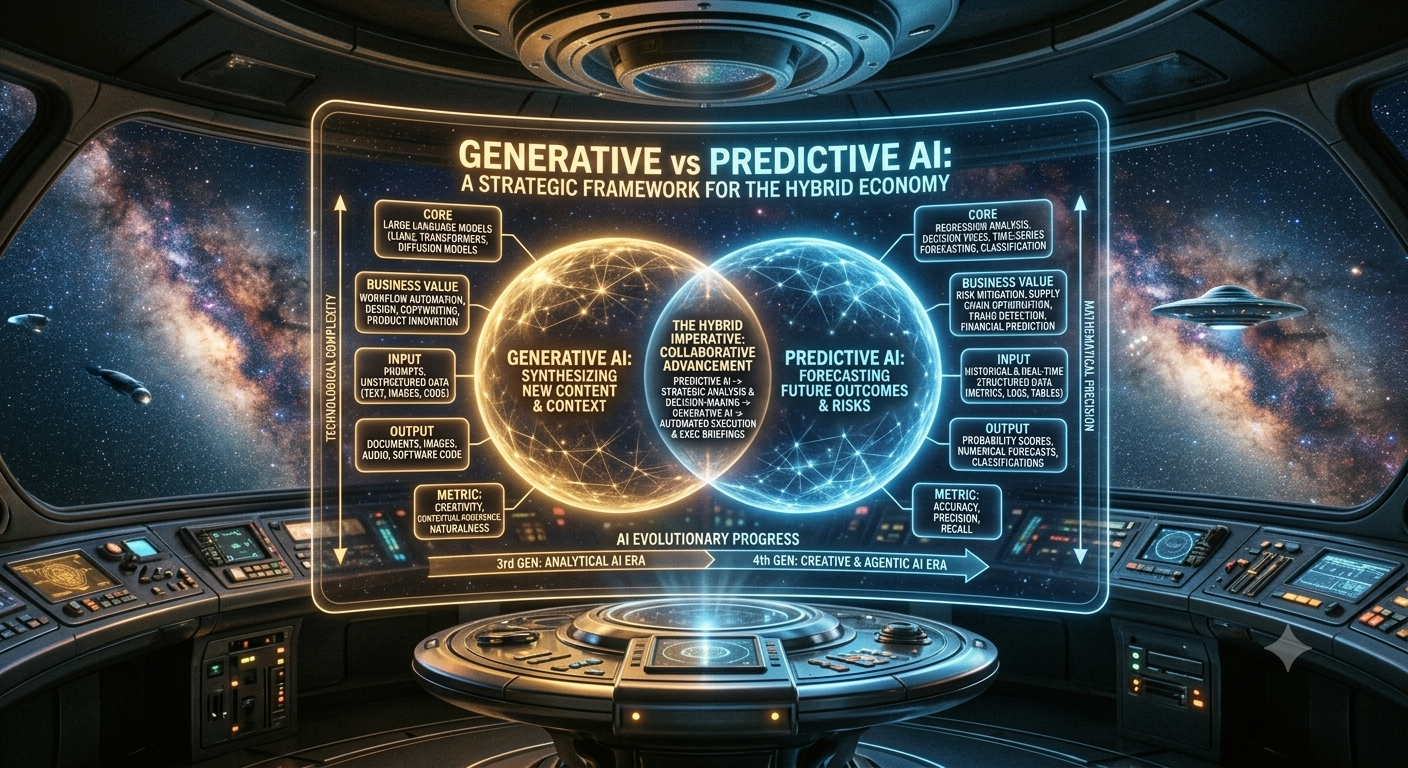
5. Technical Maturity: Which One Is More Advanced?
Determining which technology is “more advanced” depends entirely on the axis of technological maturity you evaluate. Rather than one being strictly superior, they represent two different peaks of engineering.
1) Structural Complexity & Multi-Modal Scale: Generative AI Leads
- Massive Parameters & Attention Mechanisms: Models like GPT-4, Claude, and Gemini process hundreds of billions (or trillions) of parameters, extracting abstract contextual nuance to generate new information.
- Multimodal Capability: Simultaneously understanding and outputting text, code, audio, and vision requires unprecedented neural network engineering.
2) Mathematical Precision & Reliability: Predictive AI Leads
- Real-Time Ultra-Low Latency: High-Frequency Trading (HFT), autonomous driving risk checks, and weather modeling demand sub-millisecond precision where errors are non-negotiable.
- Zero Hallucination: Unlike Generative AI, which risks factual hallucinations, mature Predictive AI operates on rigorous statistical guardrails to yield consistent, deterministic answers.
Summary:
- Complexity of Human Context & Creation: Generative AI
- Precision of Quantitative Estimation & Speed: Predictive AI
Modern enterprise tech stacks favor a hybrid architecture—using Predictive AI for accurate backend decisioning and Generative AI for frontend interface and content synthesis.
6. Future Outlook
The future of enterprise technology lies in the synergistic convergence of both models within autonomous AI Agent workflows. Predictive models will continuously detect operational risks, market shifts, or inventory shortages, while Generative models will automatically draft executive action plans, update technical documentation, or trigger personalized customer communication in real time.
7. Real-World Enterprise Applications
- Financial Services:
- Predictive AI: Flags high-risk transactions and detects anomalies (FDS) in real time.
- Generative AI: Drafts tailored wealth management advisory reports based on market data.
- E-Commerce & Supply Chain:
- Predictive AI: Forecasts seasonal demand to optimize warehouse inventory levels.
- Generative AI: Generates personalized ad copy and renders dynamic product imagery.
- Healthcare & Life Sciences:
- Predictive AI: Evaluates patient readmission risks and disease trajectory metrics.
- Generative AI: Synthesizes novel protein sequences for drug discovery.
8. Key Takeaways
- Complementary Capabilities: Generative and Predictive AI are partners, not competitors. One excels at creation, the other at estimation.
- Hybrid Architecture Delivers Highest ROI: Deploy Predictive AI for precise analytical judgment, then route those outputs into Generative AI to automate execution and reporting.
- Data Strategy Alignment: High-performing Predictive AI requires clean, structured data governance; Generative AI relies on context-rich unstructured data repositories.