
We are currently living in an era where Artificial Intelligence (AI) becomes noticeably smarter every single day. Looking at this rapid evolution, a fundamental question naturally comes to mind: Does AI absolutely have to consume massive amounts of data and grow exponentially larger to become more intelligent? Or is there a smarter, more efficient way for AI to learn—much like a human child who selectively absorbs the core essentials of a topic?
Today, we will dive into a fascinating, high-stakes battle that will shape how AI integrates into our daily lives. This is the ultimate showdown between the “Scaling Law” (the brute-force giant) and the “Small Language Model” (the efficient prodigy).
1. Understanding the Rivals Through Everyday Analogies
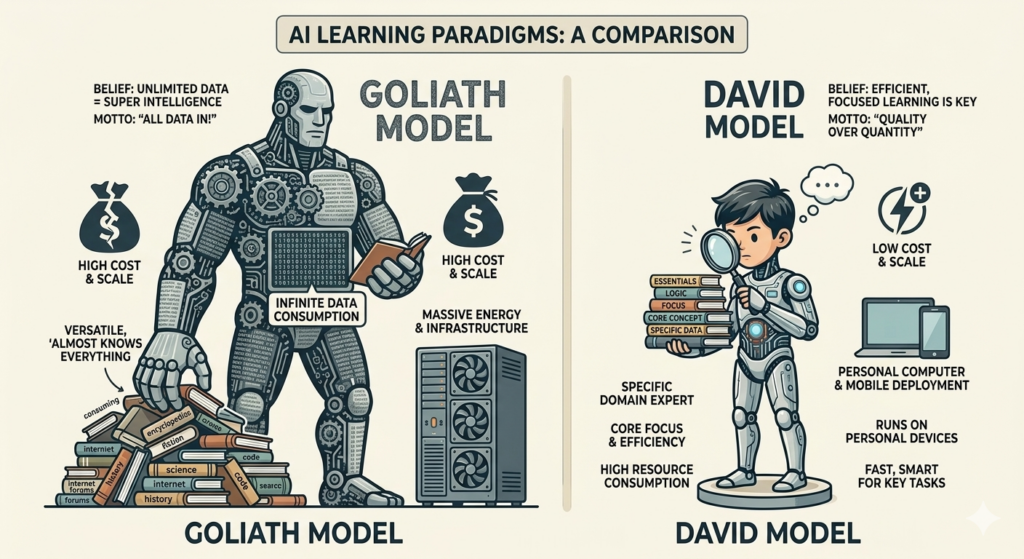
1) The Scaling Law: “The Workaholic Giant”
The Scaling Law is built on a straightforward, unyielding belief: the more data you feed an AI, the smarter it will inevitably become.
- The Learning Style: Imagine a student who insists on reading every single book on Earth. This student firmly believes that they will be exponentially smarter by reading 10,000 books instead of just 1,000.
- The Real-World Strategy: Tech companies following this path shout, “Pour every single piece of data into the machine! If we make the model big enough, it will eventually experience a breakthrough and develop emergent abilities on its own!”
- Key Characteristics: This giant has a massive digital footprint, making the training process astronomical in terms of cost and computing power. However, once the training is complete, the giant transforms into an all-knowing polymath capable of answering almost anything.
2) The Small Language Model (SLM): “The Laser-Focused Child Prodigy”
Instead of blindly consuming massive quantities of information, the SLM prioritizes high-quality, hyper-efficient learning.
- The Learning Style: This student declares, “There is no need to read every single book in the world!” Instead, they focus entirely on curated study guides and master the core concepts through repetitive, perfect practice.
- The Real-World Strategy: These models are engineered to be incredibly lightweight. They are specifically optimized to run smoothly right inside localized, everyday hardware like smartphones or personal laptops without needing a constant internet connection.
- Key Characteristics: While small in physical size, this prodigy can match—or even outperform—the giant when it comes to specific, specialized domains such as mathematics, legal analysis, or computer coding.
2. The “What If” Scenarios: Why Are They Clashing?
Scenario A: When the Giant Dominates (Scaling Law)
- The Condition: This approach wins when an enterprise has access to virtually unlimited capital and massive supercomputing infrastructure.
- The Result: The AI begins to unlock highly creative, unpredictable problem-solving skills that humans never explicitly taught it. Top-tier, industry-leading conversational AI platforms like OpenAI’s ChatGPT operate exactly on this foundational principle.
Scenario B: When the Child Prodigy Wins (SLM)
- The Condition: This approach wins when operating in environments with poor internet connectivity, strict privacy requirements, or tight budget constraints.
- The Result: The SLM delivers incredibly sharp, intelligent answers while using less than 1% of the electricity required to call upon a massive, server-hosted giant. This efficiency is exactly what allows AI to be integrated directly into your home appliances and mobile devices.
3. Behind the Names: Decoding “Scaling” and “SLM”
To truly understand this technological shift, it helps to look at what these terms actually mean in the tech industry:
- Scaling: In English, to “scale” means to increase size, amount, or production. Just like inflating a giant balloon, the core philosophy here is to continuously pump more data and raw computing power into the system to push its boundaries.
- SLM (Small Language Model): As the name implies, these are smaller language models. Instead of relying on sheer physical mass, engineers use clever algorithmic optimizations and architectural tweaks to squeeze maximum intelligence out of a compact framework.
4. The Ultimate Showdown: Brute Force vs. Specialized Wisdom
- The Scaling Law’s Ultimate Weapon: “Absolute Volume” By flooding the neural network with trillions of data tokens, the model shatters previous benchmarks and forces its way through the traditional boundaries of machine intelligence.
- The SLM’s Ultimate Weapon: “Data Dieting” Engineers aggressively trim the fat. They completely filter out low-quality, noisy data and feed the model only the most pristine, high-value information. This results in an AI that is incredibly lean yet fiercely capable.
5. At a Glance: The Giant vs. The Prodigy
| Category | Scaling Law (The Giant’s Might) | SLM (The Prodigy’s Wisdom) |
|---|---|---|
| Core Weapon | Trillions of data points and massive compute | Hyper-optimized learning algorithms and clean data |
| Pros | All-knowing, versatile, and highly adaptive | Fast, cost-effective, and incredibly lightweight |
| Cons | Requires enormous capital and electrical power | May struggle with highly complex, abstract reasoning |
| Best Suited For | Massive enterprise cloud servers | Smartphones, smart appliances, and local PCs |
6. The Corporate Battleground: Who is Winning Which Race?
Right now, global big tech companies are drawing their battle lines, with some betting the farm on one strategy, while others attempt to conquer both fronts simultaneously.
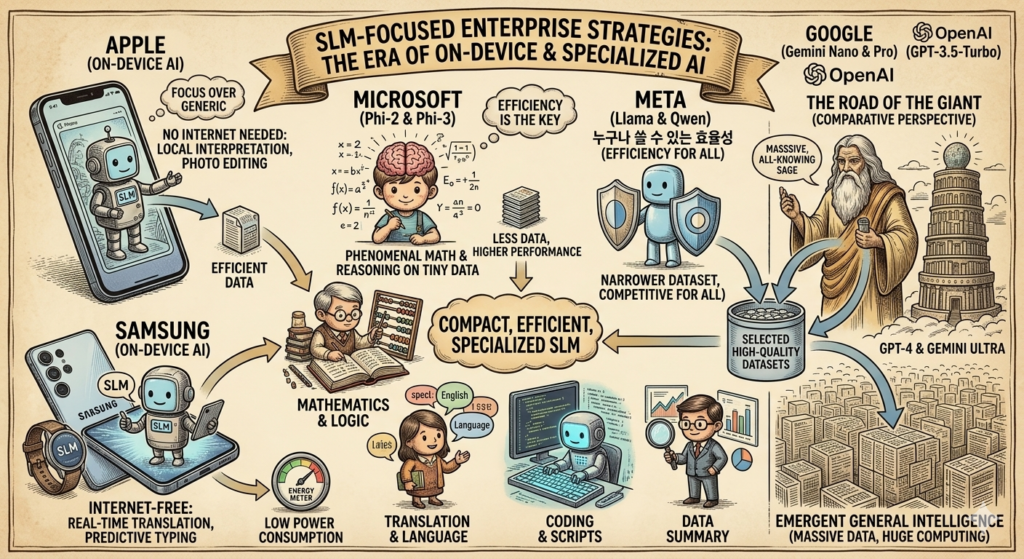
- OpenAI & Google: These tech titans are predominantly walking the Path of the Giant. By pouring billions of dollars into models like GPT-4 and Gemini Ultra, they are focused on building a comprehensive, all-powerful artificial general intelligence that mirrors human versatility.
- Meta: Meta has taken a highly disruptive approach by focusing on accessible efficiency with their Llama series. They have successfully proven that you can drastically shrink a model’s size while maintaining near-giant performance, sharing these tools openly with developers worldwide.
- Microsoft: While heavily invested in OpenAI, Microsoft has simultaneously pioneered the Prodigy Strategy with their ultra-compact Phi model lineup. They shocked the AI community by showing that a remarkably small model, when trained on meticulously curated “textbook-quality” data, can solve complex math logic effortlessly.
- Apple & Samsung: For these consumer electronics leaders, SLMs are an absolute necessity for On-Device AI. To provide instant live translations, photo editing, and personalized assistance directly on your phone without sending private data to a distant server, they are aggressively embedding small, hyper-efficient models directly into their latest hardware.
Conclusion: Key Takeaways
The future of artificial intelligence will not be a story of one side completely destroying the other. Instead, it is about total technological harmony.
- The Bifurcated AI Landscape: We are moving toward a world where massive, god-like AI giants live in the cloud to solve humanity’s most complex scientific mysteries, while an army of agile, specialized child prodigies live inside our pockets and appliances to manage our daily tasks.
- Efficiency is the New Currency: As data centers face severe energy grid constraints, the ability to build smarter—not just bigger—is becoming the ultimate competitive advantage for modern tech companies.
- The Right Tool for the Right Job: For businesses looking to adopt AI, success lies in balance. Use the scaling giants for heavy-duty, creative, and unpredictable tasks, but rely on localized SLMs to protect user privacy, slash operational costs, and maximize speed.
AI Disclosure
This article was created in a highly collaborative technical partnership with Google Gemini. All core concepts, structural outlines, and strategic insights were originally authored, thoroughly reviewed, and meticulously edited by the human author to ensure industry accuracy and accessibility.