
The global semiconductor ecosystem is undergoing a major structural shift. Chinese NAND flash giant YMTC (Yangtze Memory Technologies Corp) has officially initiated its Star Market (STAR Market) IPO process to raise approximately 33 billion RMB ($4.8 billion USD). Coming on the heels of DRAM manufacturer CXMT’s capital expansion, this public listing is not merely a corporate fundraising event. It signals a new phase in the geopolitical battle for semiconductor supremacy.
Understanding the implications of YMTC’s aggressive expansion requires examining basic hardware roles, evaluating market dynamics, and assessing strategic impacts on incumbents like Kioxia, Micron, Samsung Electronics, and SK Hynix.
1. Hardware Primer: Understanding Memory and Foundry Ecosystems
To evaluate the competitive dynamics, it is essential to distinguish between non-volatile storage and Contract Manufacturing (Foundry), as well as the roles of different memory types within computing architectures.
- NAND Flash: Non-volatile memory that retains stored data even when power is disconnected. It serves as the primary storage medium in smartphones, PCs, enterprise solid-state drives (SSDs), and hyperscale data centers.
- Foundry: Pure-play contract manufacturers (e.g., TSMC, SMIC) that fabricate chips designed by fabless semiconductor firms.
[ Semiconductor Roles & Data Flow ]
2. Domestic Champions: China’s Semiconductor Triad
To reduce reliance on Western tech, China has cultivated leaders in three distinct pillars:
- SMIC (Foundry): Focuses on mature nodes while attempting advanced sub-7nm fabrication despite being blocked from acquiring Extreme Ultraviolet (EUV) lithography systems.
- CXMT (DRAM): Rapidly expanded in legacy memory categories like DDR4 and LPDDR4x, though lagging in HBM and leading-edge DDR5 nodes.
- YMTC (NAND): Scaled 200+ layer 3D NAND utilizing its proprietary Xtacking architecture, despite inclusion on the U.S. Entity List limiting its access to global Western supply chains.
3. YMTC SWOT Positioning and Market Momentum
- Revenue Surge: YMTC generated 47 billion RMB in Q1 revenue alone, surpassing its total annual sales from fiscal year 2024.
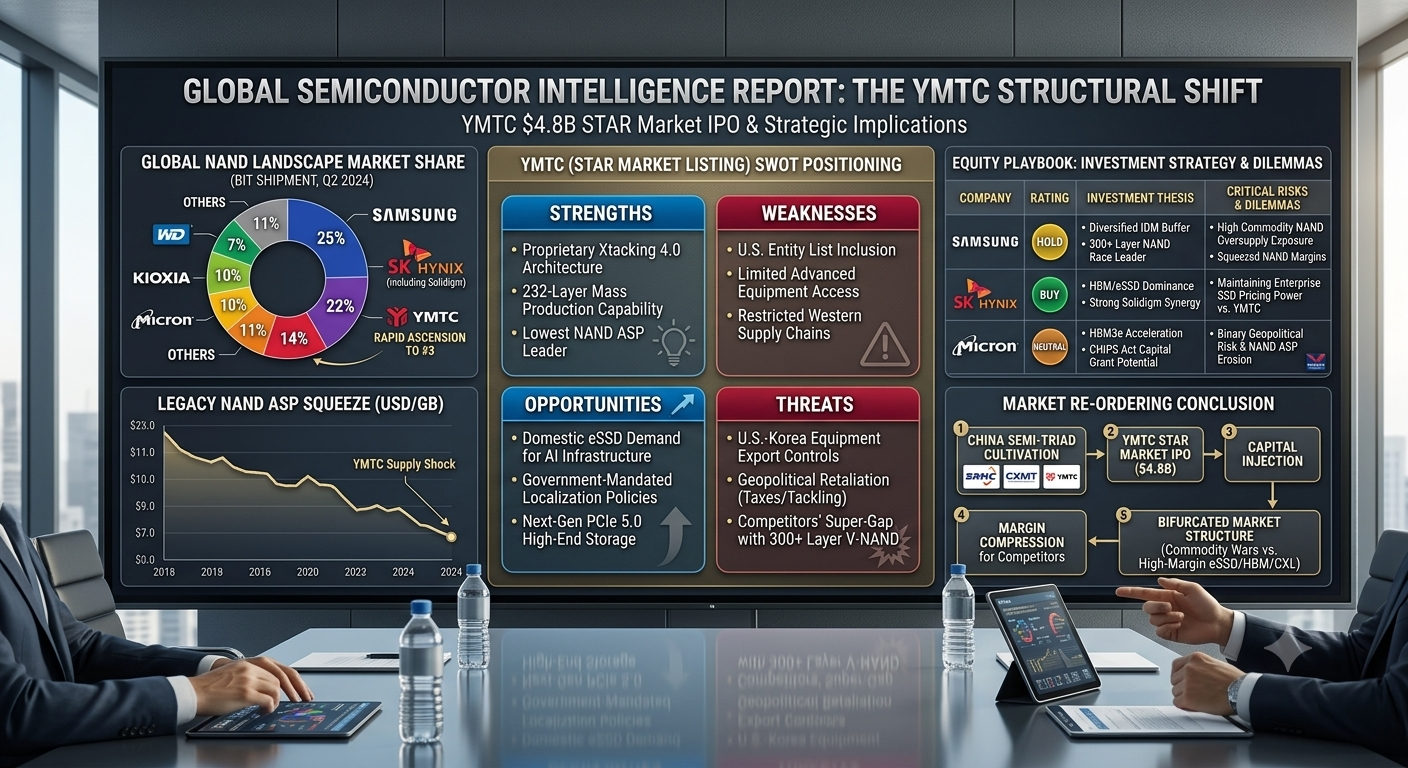
- Global Market Ranking Shift: Capturing a 14% NAND bit shipment share in Q2, YMTC surpassed Japan’s Kioxia to become the world’s third-largest supplier, behind Samsung Electronics (25%) and SK Hynix (22%).
📊 YMTC SWOT Analysis
Strengths
- Proprietary Xtacking Technology
- 200+ Layer High-Density Stacking Capability
Weaknesses
- Listed on U.S. Entity List
- Loss of Global Western Big Tech Customers
Opportunities
- Surging Domestic eSSD Demand for AI Infrastructure
- Government-Mandated Localization Policies
Threats
- U.S.-Korea Semiconductor Equipment Export Controls
- Competitors’ Super-Gap with 300+ Layer NAND
4. Market Impact Analysis: Industry Structural Disruption
Capital injected from YMTC’s $4.8 billion listing creates distinct operational threats across both legacy commodity segments and advanced enterprise storage markets.
Legacy & Commodity NAND Segment
- Price wars in mid-range consumer SSDs
- Direct margin squeeze on Kioxia & Micron
High-End AI eSSD Segment
- Deployment of Xtacking 4.0 & PCIe 5.0
- Encroachment on Samsung/Solidigm duopoly
- Severe Margin Pressure on Kioxia & Micron: Unlike Samsung or SK Hynix, Kioxia lacks a DRAM business unit to cross-subsidize NAND losses during downcycles. As YMTC floods the domestic Chinese market with legacy mobile and client PC storage, Kioxia faces depressed ASPs, compounding its existing capital allocation challenges and IPO delays. Micron faces similar earnings volatility in its consumer-grade storage portfolios due to falling global spot pricing.
- Pressure on Korean Leaders: While Samsung Electronics and SK Hynix maintain dominance in premium server markets, YMTC is moving up the value chain. Utilizing its Xtacking 4.0 architecture, YMTC has introduced PCIe 5.0 high-density enterprise SSDs (up to 30.72TB). This moves YMTC beyond low-cost commoditization and directly targets enterprise storage segments previously dominated by SK Hynix (Solidigm) and Samsung.
- Systemic Interdependence with 3D Packaging: YMTC’s Xtacking processes process peripheral logic circuitry and memory arrays on separate wafers before bonding them using advanced interconnects. This mirror-image process aligns with the broader semiconductor shift toward 3D heterogeneous integration—similar to TSMC’s CoWoS ecosystem—enabling domestic Chinese AI hardware designers to build custom memory-compute configurations that partially bypass Western wafer-fab tool restrictions.
5. Investor Perspective: Equity Playbook
- Samsung Electronics: High exposure to legacy commodity NAND creates gross margin vulnerability to Chinese oversupply. However, its diversified model as an Integrated Device Manufacturer (IDM) offers a structural buffer. Key valuation catalysts include the pace of its transition to 300+ layer V-NAND and scaling its HBM production.
- SK Hynix: Positioned relatively well due to its market share in HBM and high-density enterprise storage via Solidigm. Investors should monitor how effectively SK Hynix maintains its enterprise SSD margins as YMTC increases domestic China enterprise deployments.
- Micron Technology: Faces dual headwinds from legacy NAND price erosion and U.S.-China trade tensions. Its investment thesis depends on execution around HBM3e/HBM4 acceleration and securing capital expenditure grants under the U.S. CHIPS Act.
Conclusion: Key Takeaways
- Market Re-ordering: YMTC’s $4.8 billion IPO provides capital to scale production, making it a permanent fixture in the global top-three NAND suppliers by volume.
- Bifurcated Market Structure: Commodity NAND memory is increasingly subject to margin-eroding price wars driven by Chinese domestic supply, forcing traditional suppliers to retreat to high-margin niches.
- Focus on Advanced Tech: The investment landscape now favors suppliers focused on high-margin, technically defensible platforms—such as High Bandwidth Memory (HBM), CXL architectures, and 300+ layer enterprise eSSDs—over pure volume plays.
※ This post is provided strictly for informational purposes and does not constitute a recommendation or solicitation to buy or sell any specific financial instruments or securities. The analysis and opinions expressed herein are based on information available at the time of writing, but no guarantee is made regarding their accuracy, completeness, or timeliness. All investment decisions and risk exposures are solely the responsibility of the individual investor.
※ Some images and technical descriptions in this post were created in collaboration with Google Gemini AI, and were finalized after direct creation, review, revision, and editing by the author.