
CATACLYSMIC warnings of an impending U.S. dollar collapse are a staple of financial media. The arithmetic, at first glance, seems to support these fears. By August 2026, the total U.S. national debt is projected to breach the astronomical $40 trillion mark. This surge converts to a net daily interest expense for the U.S. government of approximately $3.5 billion—exceeding $1.2 trillion annually, a figure that now surpasses the entire U.S. defense budget.
Yet, one question pierces the noise of this default narrative: “Why does the U.S. dollar not only survive but maintain relative stability against other fiat currencies, despite nearly unlimited monetary expansion?” The answer lies in the unique structural privileges of the greenback. Understanding this mechanism reveals why the primary risk to investors is not a sovereign default, but the steady erosion of real purchasing power.
1. Five Structural Pillars Guarantees Persistent Global Dollar Demand
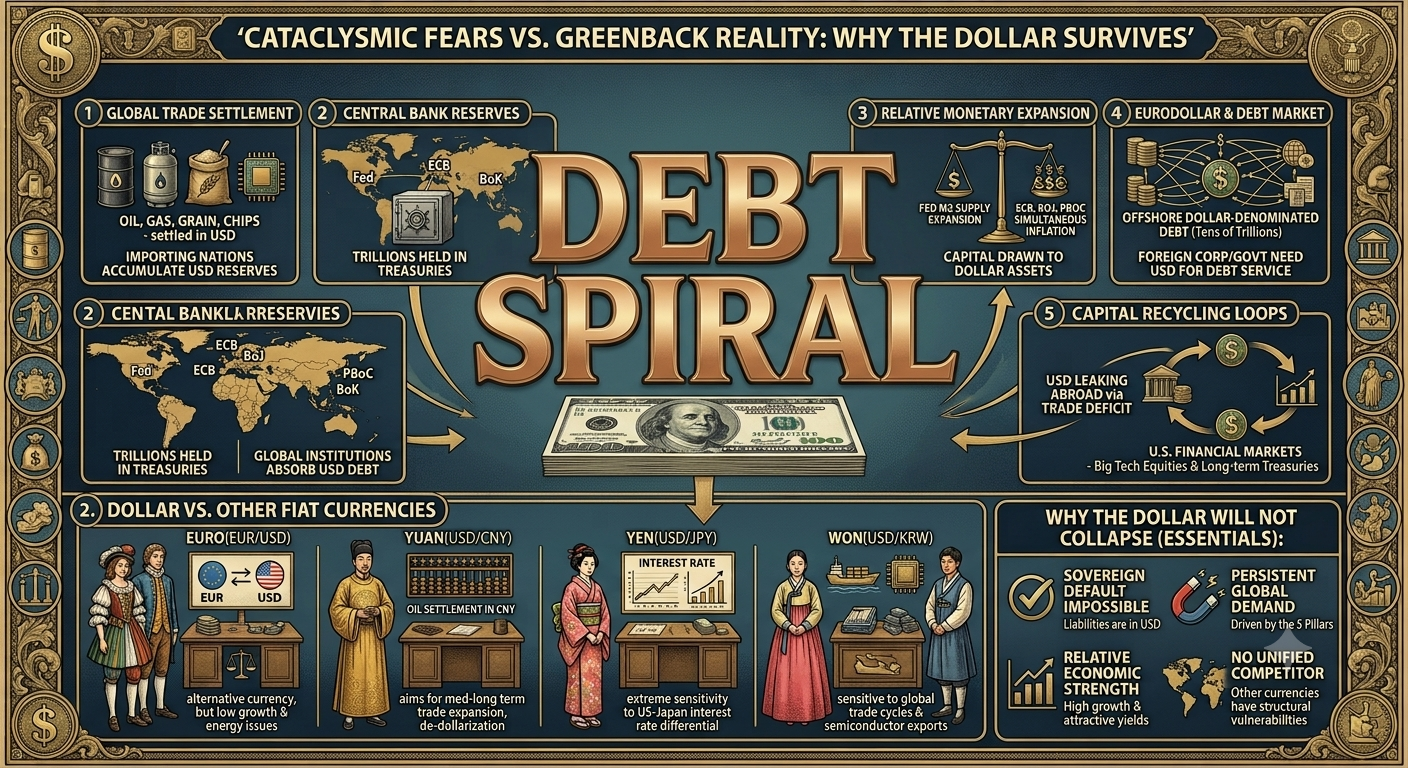
The U.S. is not bound by the same fiscal gravity as other nations. Despite vast dollar supply increases, powerful global mechanics create a massive, structural appetite that absorbs this liquidity:
- Global Commodity and Trade Settlement: Core commodities—including crude oil, natural gas, grain, and microchips—are settled almost exclusively in greenbacks. Import-dependent nations must continuously accumulate and hold dollar reserves to maintain basic trade operations.
- Central Bank Foreign Exchange Reserves: To protect domestic currencies during volatility, central banks across Asia, Europe, and Latin America hold trillions in U.S. Treasuries. When Washington issues debt, global institutions absorb it, absorbing excess supply before it triggers currency shocks.
- Relative Global Monetary Expansion: Currency values are inherently relative. While the Federal Reserve expands the M2 supply, the European Central Bank, Bank of Japan, and People’s Bank of China simultaneously inflate their money supplies. Because the U.S. consistently maintains higher economic growth rates and attractive yields, capital remains drawn to dollar assets.
- The Eurodollar Market and Dollar Debt Obligations: Beyond American borders lies a tens-of-trillions offshore market for dollar-denominated financial instruments. Foreign corporations and governments holding dollar debt must constantly source dollars to service interest, creating a perpetual structural bid under the currency.
- Capital Recycling Loops: Dollars leaking abroad through the massive U.S. trade deficit do not remain idle. Foreign capital regularly flows back into premier American financial markets—primarily high-growth technology equities (Big Tech) and long-term Treasuries—reinforcing the value of the underlying currency.
2. Foreign Currency Analysis: Euro, Yuan, Yen and Won Dynamics
Major fiat alternatives possess structural vulnerabilities that prevent them from displacing the dollar as the premier global reserve unit:
2. Trends in Dollar Exchange Rates Against Major Currencies (EUR, CNY, JPY, KRW)
- Euro (EUR/USD): Tends to strengthen as an alternative currency when US debt risks come into focus. However, due to Europe’s own low economic growth and structural energy challenges, upward pressure remains confined within a range-bound channel.
- Chinese Yuan (USD/CNY): Aims to expand its share of international trade settlements over the medium-to-long term, driven by China’s de-dollarization policy and efforts to settle commodity transactions in Yuan.
- Japanese Yen (USD/JPY): Extremely sensitive to the US-Japan interest rate differential. Rapid strengthening of the Yen (weakening of the Dollar) occurs whenever the Federal Reserve cuts interest rates to ease the US government’s interest burden.
- Korean Won (USD/KRW): Highly sensitive to global trade cycles, semiconductor exports, and foreign capital flows. While US monetary easing generally exerts downward pressure on the exchange rate, persistent interest rate differentials and domestic economic growth dynamics limit rapid appreciation, keeping it influenced by regional economic conditions (particularly China).
- Overall Market Stability: Despite massive US Treasury bond issuances and the expanded global supply of US dollars, exchange rates against major currencies have remained remarkably stable overall, experiencing only minor fluctuations rather than extreme volatility.
3. The Sovereign Debt Spiral: Mechanism and Structural Risks
When national debt crosses critical thresholds, it triggers a self-reinforcing feedback loop that threatens broader economic stability:
This dynamic manifests across three distinct economic phenomena:
- The Debt Spiral: Deficit funding requires massive Treasury auctions. Excess supply lowers bond prices and pushes up yields, which directly increases borrowing costs for future debt issuance, worsening fiscal conditions.
- Structural Fiscal Ponzi Dynamics: When tax receipts can no longer cover mandatory spending alongside debt service, a sovereign must issue new obligations strictly to pay existing debt holders—a classic refinancing reliance.
- The Crowding-Out Effect: As net interest expense eclipses core budget items like defense and infrastructure spending, productive government investment gets crowded out, weakening long-term productivity potential.
4. Alternative Assets: Real Capabilities and Practical Limits
- Gold & Digital Assets: Physical gold remains the classic anti-fiat reserve, while Bitcoin operates as a digital alternative. However, neither asset yields ongoing cash flow. Additionally, elevated price volatility and regulatory frameworks prevent them from replacing transactional global banking rails.
- Commercial & Residential Real Estate: Real assets provide strong structural protection against inflation over long timeframes. While illiquidity, local property taxes, and mortgage borrowing costs pose operational constraints, prime real estate in supply-constrained metropolitan markets continues to attract institutional capital.
5. Four Extreme Scenarios Required to Unseat the Dollar
For a complete breakdown of U.S. dollar hegemony to occur, four extreme conditions would need to materialize simultaneously:
- A Fully Unified Competitor Currency: Complete financial market opening in China, full fiscal integration across the Eurozone, or a universally accepted Central Bank Digital Currency (CBDC) system.
- Dismantling of U.S. Naval and Military Power: Total loss of maritime trade route security and the complete dissolution of dollar-based bilateral defense contracts.
- Extreme Hyper-Inflationary Bond Strikes: Severe central bank debt monetization that forces international investors to reject Treasuries entirely.
- Institutional and Systemic Collapse: Severe internal political breakdown resulting in the total suspension of rule-of-law and private property rights.
Conclusion: Key Takeaways
- Bankruptcy Is Off the Table, Inflation Is Not: The United States will not experience a nominal sovereign default because its liabilities are denominated in dollars. Instead, the real cost of debt expansion is managed through steady currency debasement.
- The Problem Is Purchasing Power Decay: Your true financial risk is not a sudden collapse of the financial system, but the loss of real purchasing power caused by ongoing monetary expansion.
- Strategic Asset Allocation Is Essential: Protecting wealth over long horizons requires moving away from uninvested cash or low-yielding paper assets toward scarce, cash-flowing productive assets—including top-tier U.S. equities, prime real estate, and strategic hard asset hedges.
※ This post is provided strictly for informational purposes and does not constitute a recommendation or solicitation to buy or sell any specific financial instruments or securities. The analysis and opinions expressed herein are based on information available at the time of writing, but no guarantee is made regarding their accuracy, completeness, or timeliness. All investment decisions and risk exposures are solely the responsibility of the individual investor.
※ Some images and technical descriptions in this post were created in collaboration with Google Gemini AI, and were finalized after direct creation, review, revision, and editing by the author.