
Looking at the Canadian real estate market alongside fluctuating interest rates can easily make anyone feel anxious. It triggers that intense FOMO (Fear of Missing Out), pushing you to ask: “Should I stretch my budget to the absolute limit and get a mortgage right now?” In recent years, the Canadian housing market has experienced dramatic booms and busts, leaving many home buyers confused and overwhelmed.
However, when you actually step inside a local Canadian bank to get pre-approved, you immediately run into a puzzling paradox. Compared to South Korea or many other countries, Canada’s mortgage underwriting system is exceptionally strict and complex. It often feels like the ultimate catch-22: “They won’t lend you money unless you can prove you don’t actually desperately need it.”
In this comprehensive guide, we will break down the true inner workings of the Canadian mortgage market, why qualifying for a loan has become so tough lately, the key differences between various lenders, tailored solutions for unique financial situations, and the pros and cons of the Canadian financial system.
1. The Real Reason Behind Canada’s Strict Lending Regulations
While modern consumers are accustomed to instant gratification—where a credit card can instantly grant tens of thousands of dollars in credit—Canadian financial regulators care about only one thing: an unbreakable safety net.
A mortgage is undeniably the most powerful leverage tool for achieving homeownership. In a booming market, it allows buyers to build substantial wealth with a relatively small initial capital investment.
However, the Office of the Superintendent of Financial Institutions (OSFI) views mortgages differently. For OSFI, mortgage lending is not about “how quickly can we issue loans?” It is about “will the entire national financial system survive if interest rates skyrocket or an economic crisis hits?”
Canadian banks are not being overly difficult just to frustrate applicants. Rather, regulators remember the catastrophic fallout of the 2008 U.S. Subprime Mortgage Crisis. Canada’s conservative approach is designed to eliminate systemic vulnerability before it starts.
2. Anatomy of Terms: 3 Key Regulations Raising the Mortgage Bar
📌 The 3 Major Gatekeepers of Canadian Mortgages
- Stress Test: Can you handle payments if interest rates rise by an extra 2 percentage points?
- GDS / TDS Ratios: Is your debt relative to your income within a safe threshold?
- LTV (Loan-to-Value): Is your loan size safe relative to the home’s appraisal value?
① The Mortgage Stress Test
Under Canadian regulation, lenders must test your financial capability at a rate higher than your actual contract rate. You must qualify at either your contract interest rate plus 2%, or the qualifying benchmark rate set by regulators—whichever is higher. Even if you secure a mortgage rate of 5% in reality, the bank evaluates whether your budget can survive a 7% interest rate environment.
② GDS and TDS Ratios (Debt Service Ratios)
- Gross Debt Service (GDS): Your housing costs—including principal, interest, property taxes, and heating fees—must not exceed 39% of your gross monthly income.
- Total Debt Service (TDS): Your total debt obligations—housing costs plus car loans, credit card balances, and personal lines of credit—must not exceed 44% of your gross monthly income.
③ LTV (Loan-to-Value Ratio)
This measures your total loan amount against the home’s appraised value. In Canada, if your down payment is less than 20%, your loan is classified as a high-ratio mortgage. In this case, you are legally required to purchase mortgage default insurance from providers like the Canada Mortgage and Housing Corporation (CMHC).
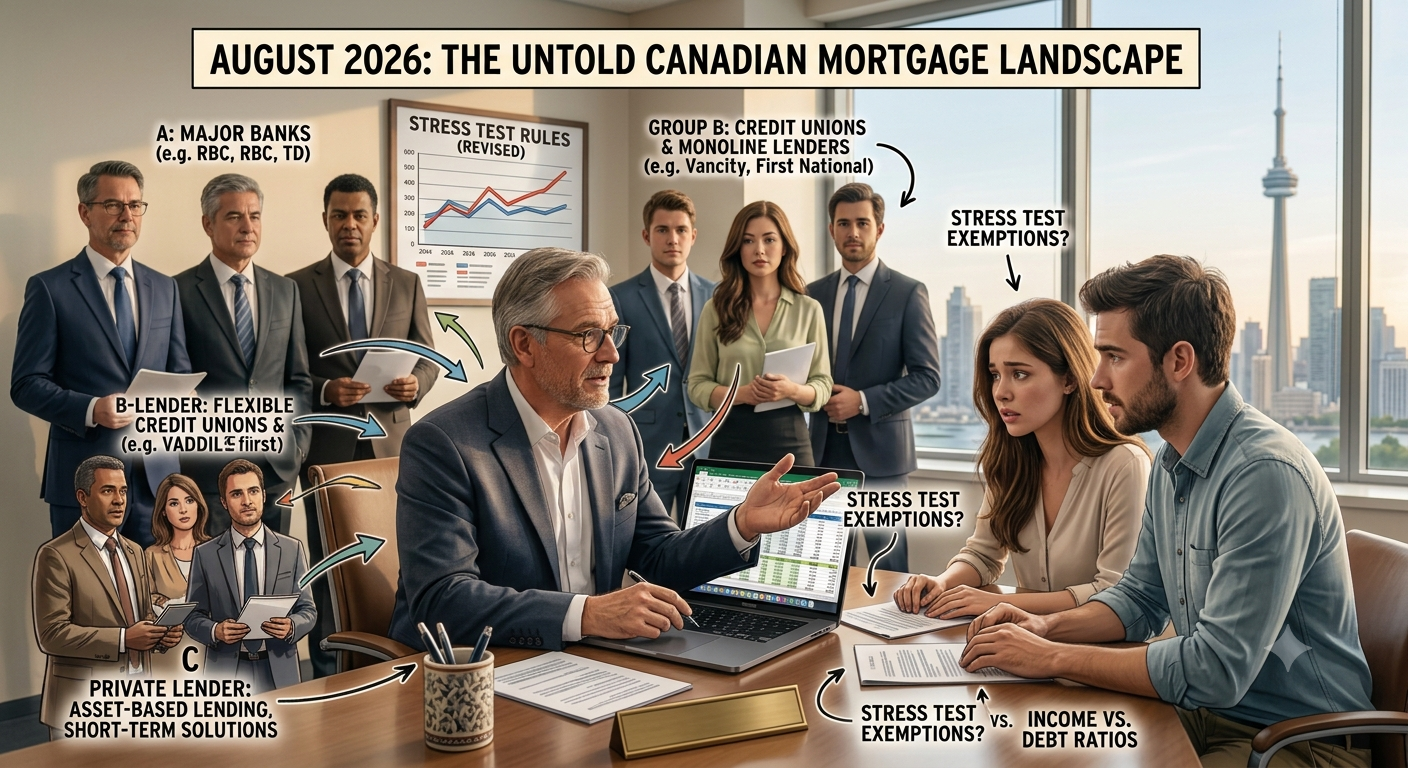
3. Comparing Financial Institutions: A-Lenders vs. B-Lenders vs. Private Lenders
Think of the Canadian mortgage market as a multi-lane toll highway with strict security checkpoints:
3. Comparing Financial Institutions: A-Lenders vs. B-Lenders vs. Private Lenders
Think of the Canadian mortgage market as a multi-lane toll highway with strict security checkpoints:
- A-Lenders (Major Banks like RBC, TD, BMO, Scotiabank, CIBC): Think of them as strict highway patrol officers. If your documentation, tax records, or credit score deviate even slightly from standard guidelines, you will be turned away. However, if you pass, you get the cheapest toll rate (the lowest interest rates).
- B-Lenders (Alternative Lenders like Equitable Bank): Think of them as flexible patrol officers. If your income verification is slightly non-traditional or you are self-employed with complex tax returns, they will look at the bigger picture. In exchange for this flexibility, you pay a slightly higher interest rate plus processing fees.
- Private Lenders (Mortgage Investment Corporations / Private Individuals): This is a express lane with a steep price tag. Private lenders do not worry about your job or credit score; they only care about the equity in the property. In exchange, they charge very high interest rates alongside 1% to 2% upfront lender fees.
4. Summary Table: Pros and Cons of the Canadian Banking System
| Feature | Pros | Cons |
| System Stability | Strict rules mean extremely low risk of bank failures during financial crises. | High barriers to entry for self-employed individuals, newcomers, and freelancers. |
| Stress Test | Prevents mass borrower defaults and foreclosures when interest rates rise. | Significantly reduces total borrowing capacity, even for capable buyers. |
| Credit Framework | Rigorous tracking prevents toxic, unmanageable subprime debt. | Documentation-heavy, rigid, and often slow processing times. |
| Lending Alternatives | Options exist beyond major banks (B-Lenders, Private Lenders). | Secondary and tertiary lenders come with rapidly escalating fees and rates. |
5. Strategic Solutions for Special Scenarios
Scenario 1: Low Documented Income, High Net Worth Assets
- The Situation: You retired or sold property abroad, holding $1,000,000 in liquid assets, but your ongoing taxable monthly income is low.
- The Problem: Major A-Lenders will decline the mortgage application because your low regular income breaches the GDS/TDS debt ratio limits.
- The Solution: Utilize Asset-Based Programs or High Net Worth Programs. These specialized options allow borrowers to qualify based on liquid financial assets or by putting down a larger down payment (35% to 50%). You can start with a flexible B-Lender program and transition back to an A-Lender later as your financial records establish a track record.
Scenario 2: Returning to Canada from Overseas
- The Situation: You are moving back to Canada after living and working abroad for several years.
- The Problem: You lack recent Canadian employment verification and local Notice of Assessment (NOA) tax documents, causing traditional bank algorithms to flag your file.
- The Solution:
- Foreign Income Programs: Work with specialized lenders that accept apostilled and translated international tax documents, foreign income statements, and bank records.
- Confirmed Job Offer: Provide a firm Canadian job offer letter that explicitly waives any probationary period.
- Rebuild Credit Swiftly: Canadian credit history degrades over time. Secure a Canadian credit card immediately upon arrival to build your credit score quickly.
6. Critical Warning: Mortgage Flexibility and Prepayment Penalties
Focusing solely on the advertised interest rate can lead to massive financial shocks if you need to break your mortgage contract early or transfer it when relocating.
🔍 Fixed vs. Variable Rate Breaking Penalties
Breaking a Variable Rate Mortgage usually incurs a manageable fee equal to three months of interest. Breaking a Fixed Rate Mortgage, however, triggers an Interest Rate Differential (IRD) calculation. The IRD penalty compares current market rates to your original contract rate, which can cause penalty fees to skyrocket into tens of thousands of dollars.
| Comparison | Variable Rate Mortgage | Fixed Rate Mortgage |
| Penalty Calculation | 3 Months of Interest | 3 Months Interest OR Interest Rate Differential (IRD) — whichever is higher |
| Penalty on $500k Loan | Approx. $3,000 – $4,000 | Approx. $15,000 – $30,000+ |
| Financial Impact | Low penalty risk if breaking early | Extremely severe penalty risk if sold or broken early |
7. Actionable Strategies for Mortgage Success
To successfully navigate Canada’s strict mortgage landscape, keep these three key strategies in mind:
- Get Pre-Approved with a Rate Hold: Before viewing homes, obtain a mortgage pre-approval. This locks in your interest rate for 90 to 120 days, protecting your buying power against sudden rate hikes.
- Include a Financing Condition: Always include a “Subject to Financing” clause in your purchase offer. If your loan gets denied due to stress test changes or a low property appraisal, this condition protects your initial deposit.
- Work with an Experienced Mortgage Broker: Visiting a single retail bank branch limits your options. An independent mortgage broker has access to A-Lenders, B-Lenders, credit unions, and private options, allowing them to structure a solution tailored to your specific situation.
Conclusion: Key Takeaways
Canada’s mortgage system is built on a conservative foundation: it prioritizes macro-financial stability over individual convenience. While the approval process can feel rigid, understanding debt ratios, selecting the right lender category, and preparing for prepayment terms will ensure a smooth, safe home-buying journey.
AI Disclosure: This post was written, reviewed, and edited by the author in collaboration with Google Gemini AI. All featured images, and visual materials were generated using Google Gemini AI to enhance technical clarity, readability, and overall visual presentation.