
The first rule of an investment is don’t lose money. And the second rule is don’t forget the first rule.”
When the stock market heats up and stories circulate about people making double- or triple-digit returns in a short period, a overwhelming sense of FOMO (Fear of Missing Out) naturally creeps in. It becomes dangerously easy to fixate on flashy technical charts and trending meme stocks.
Yet, throughout decades of market panics, economic recessions, and speculative bubbles, one man has consistently maintained his position among the world’s wealthiest individuals: Warren Buffett. His approach to value investing is fundamentally different. It relies not on high-frequency trading tricks or complex technical indicators, but on a remarkably straightforward philosophy: accurately evaluating a business’s intrinsic value and having the discipline to wait.
In this comprehensive guide, we will break down Buffett’s core investment strategy, examine the principles that maximize his win rate, and explain how individual investors can apply these real-world practices to build a resilient, high-performing portfolio.
1. The Core Mindset: How Buffett Views the Stock Market
Where most retail traders view stocks as mere ticker symbols—paper tokens to be flipped quickly to the next buyer for a fast profit—Buffett views every stock as a fractional ownership stake in an actual operating business.
Instead of reacting emotionally to daily market swings or endless news cycles, he asks a fundamental question: “If I were to buy this entire business and the stock market closed for the next ten years, would I feel confident in its ability to generate consistent cash flow?”
While market price fluctuates wildly in the short term driven by human emotion and speculative noise, the intrinsic value of a solid enterprise eventually wins out over time. This foundational belief forms the absolute bedrock of value investing.
2. Anatomy of Value Investing: The Three Pillars
| Pillar | Core Concept | Strategic Question |
|---|---|---|
| 1. Intrinsic Value & Margin of Safety | Purchasing assets at a significant discount below their calculated fair value. | Are you buying a $1.00 bill for 50 cents? |
| 2. Compounding Engine & High ROE | Targeting companies with high Return on Equity that reinvest capital efficiently. | Does the business grow its value automatically without constant capital injections? |
| 3. Cash Allocation & Patience | Holding cash reserves until high-probability, deeply discounted opportunities arise. | Can you remain inactive while waiting for a true mispricing? |
① Intrinsic Value and the Margin of Safety
Intrinsic value represents the total discounted cash a business will generate over its remaining life. Buffett insists on acquiring businesses only when their stock price trades at a 20% to 30% discount relative to this estimated value. This discount creates a “Margin of Safety,” protecting capital if valuation assumptions prove slightly optimistic.
② Compounding Engines and High ROE
Buffett favors businesses that maintain a consistently high Return on Equity (ROE)—ideally above 15%. Companies with strong economic moats don’t waste capital; they reinvest earnings efficiently, turning their compounding structure into a self-propelling financial snowball.
③ Cash Reserves and Discipline
No company is worth buying if the price is inflated. When asset prices are stretched, Berkshire Hathaway holds vast cash reserves. Buffett waits patiently—sometimes for years—until market panics allow him to purchase elite equities at bargain prices.
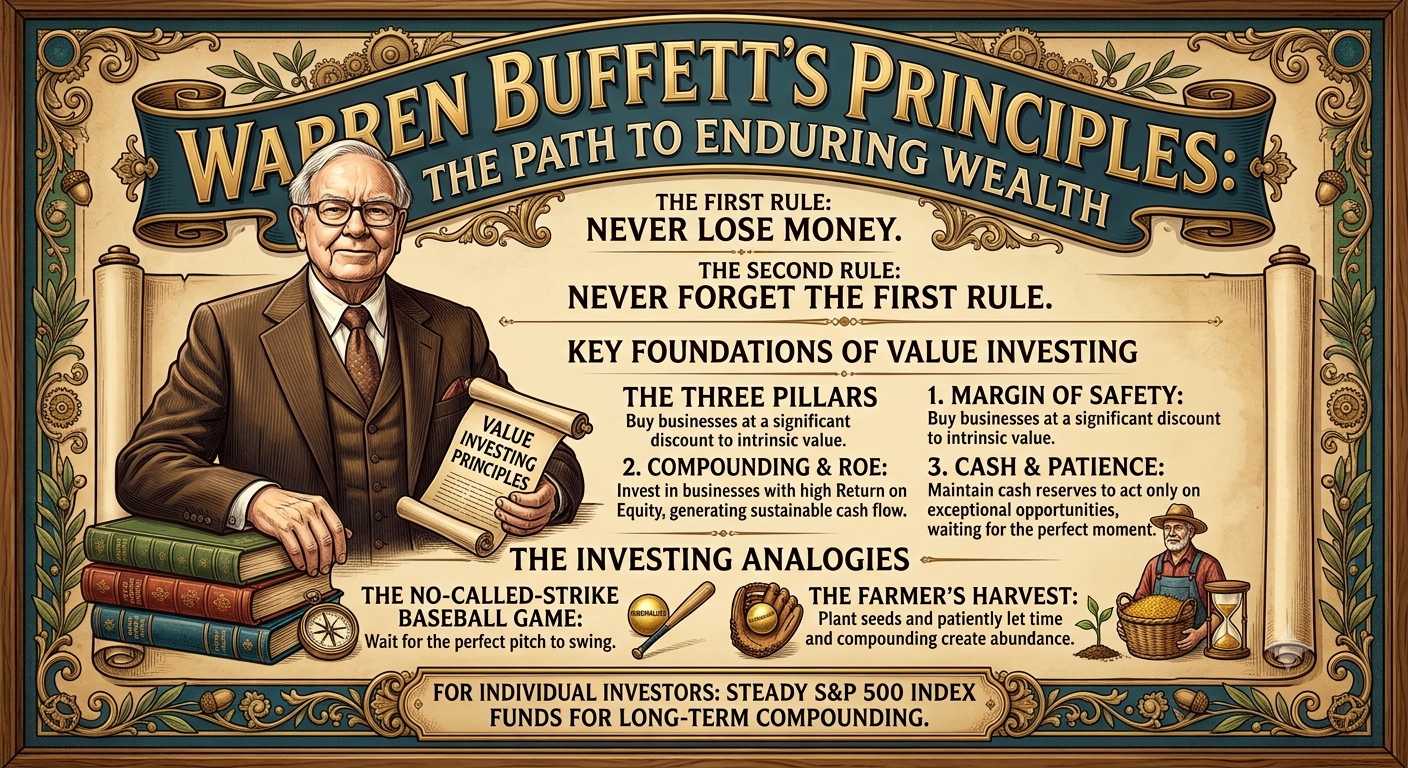
3. Real-World Metaphors: Baseball Batter vs. Farming
To make these principles memorable, consider two straightforward comparisons:
- The Batter with No Called Strikes: In professional baseball, taking pitch after pitch leads to a strikeout. In investing, there are no called strikes. Hundreds of overvalued or mediocre investment options can fly past you without penalty. You are under no pressure to swing until a clear pitch enters your specific sweet spot—a high-quality company trading at a deep discount.
- Agriculture Over Constant Digging: Successful farming requires planting resilient crops in rich soil and allowing sunshine, rain, and time to produce a harvest. Checking stock prices every five minutes is like digging up seeds daily to see if they are growing; it damages the long-term process. Real wealth creation requires patience.
4. Case Studies: Coca-Cola & Financial Crisis Liquidity
Coca-Cola & Occidental Petroleum: Predictable Cash Flow
When Buffett began accumulating shares of The Coca-Cola Company in 1988, he wasn’t speculating on short-term price movements. He recognized a world-class brand with global pricing power and predictable cash flow. Over time, the cumulative dividends paid to Berkshire Hathaway exceeded his initial investment cost, turning Coca-Cola into an income-generating asset.
The Value Compounding Loop:
Strong Brand Power → Consistent Cash Flow → Growing Dividend Payouts → Complete Principal Recovery → Infinite Realized Yield
The 2008 Financial Crisis: Contrarian Execution
During the 2008 global financial panic, credit markets froze and institutions collapsed. While market sentiment was dominated by fear, Buffett deployed Berkshire’s massive cash reserves. He provided capital to blue-chip institutions like Goldman Sachs and Bank of America on highly favorable terms, generating billions in risk-adjusted profits during the recovery.
5. Identifying the Trap: Value vs. Value Traps
A common mistake among retail investors is assuming a stock is cheap simply because its price dropped 50% from an all-time high. A steep decline does not automatically guarantee a Margin of Safety. If a company’s underlying fundamentals or competitive advantages deteriorate, a low stock price can easily be a precursor to further losses.
HTML
| Metric / Trait | Genuine Value Stock (Buffett Model) | Value Trap (Dangerous Mirage) |
|---|---|---|
| Price Action | Down 40% due to broader macro panic | Down 40% due to business model obsolescence |
| Intrinsic Business Health | ROIC & Free Cash Flow remain strong | Drying revenues, margin compression, high debt |
| Long-Term Trajectory | Recovers and reaches new high valuations | Stagnates or faces permanent capital impairment |
6. Comparison: Value Investor vs. Average Trader
| Dimension | Buffett Value Investor | Speculative Market Trader |
|---|---|---|
| Primary Focus | Cash flow generation and competitive moat | Short-term momentum, chart patterns, headlines |
| Buying Trigger | Price is below estimated intrinsic value | Surging volume or breakout price moves |
| Holding Period | Multi-year to indefinite (“Forever”) | Days, weeks, or a few months |
| Market View | A counterparty (“Mr. Market”) offering prices | An entity to predict constantly |
7. How Individual Investors Can Apply This Strategy
You don’t need to run a multi-billion-dollar conglomerate to apply these principles. Here is how retail investors can integrate Buffett’s framework into everyday portfolio management:
- Leverage “Mr. Market’s” Emotional Swings: Treat the market as an emotional counterparty rather than an authority. When panic selling depresses prices, look for quality businesses selling at a discount. When euphoria drives valuations to extreme levels, exercise restraint.
- Adopt the Passive Buffett Route (S&P 500 Indexing): For investors without the time or accounting background to analyze balance sheets, Buffett explicitly recommends low-cost S&P 500 index funds. This approach lets you participate in the long-term compounding growth of America’s leading corporations without single-stock risk.
- Maintain Cash Allocations: Fully invested portfolios leave no maneuverability during market dislocations. Keeping 10% to 20% of your portfolio in cash equivalents ensures you have capital ready when attractive opportunities emerge.
8. Conclusion: Key Takeaways
Value investing is simple in concept, but demanding in practice. It requires emotional discipline, independent thinking, and long-term perspective. To successfully build wealth using Warren Buffett’s framework, keep these core lessons top of mind:
- Prioritize Capital Preservation: Protecting your downside is the fastest way to compound wealth over time.
- Focus on Business Fundamentals: Evaluate companies based on free cash flows, competitive advantages, and return on equity rather than short-term price movements.
- Avoid the Value Trap: Low valuations mean little if a company’s underlying earnings engine is permanently broken.
- Maintain Patience and Discipline: The best investment decisions often involve doing nothing until a favorable opportunity presents itself.
- Utilize Indexing when Unsure: Broad market index funds offer an efficient, low-stress way to harness long-term compounding for busy professionals.
By shifting your focus from daily price fluctuations to long-term business value, you can build a resilient portfolio designed to weather market volatility and compound wealth over time.
AI Disclosure: This post was written, reviewed, and edited by the author in collaboration with Google Gemini AI. All featured images, and visual materials were generated using Google Gemini AI to enhance technical clarity, readability, and overall visual presentation.