
For the longest time, coding has been a high, formidable wall, protecting a fortress accessible only to experts. For outsiders, learning to code was notoriously difficult, requiring months to master complex syntax, and even generating small results consumed massive amounts of time. However, we have entered the era of “Vibe Coding,” where months spent pouring over rigid grammar are compressed into natural conversations and collaboration with AI.
We are witnessing a shift from the solitary work of a master craftsman, meticulously laying bricks one by one, to the “art of conducting,” where pure inspiration is instantly transformed into reality. Instead of getting bogged down by minor typos and wasting precious time on debugging, you can now execute your ideas immediately by standing on the shoulders of giants—Artificial Intelligence. Coding has now transcended the barrier of specialized expertise to become a “universal tool,” enabling anyone to realize their imagination.
1. The Paradigm Shift: Communicating through ‘Intent’ Instead of Syntax
In the past, developers were “faithful scribes,” forced to adapt themselves to the rigid linguistic rules—the syntax—that computers could understand. As of 2026, however, we are living in the age of Vibe Coding, creating results simply by conveying our “feelings” (the vibe) and fundamental “intent” to an AI.
Why call it “Vibe Coding”? Here, “vibe” does not just mean a general mood or atmosphere; it signifies a high-level intuitive alignment and connection between the developer and the AI.
Previously, humans had to adapt to the computer’s language. Now, AI can accurately read the “texture” (vibe) of a human idea—our abstract intention—and handle the technical implementation. Think of it as how skilled jazz musicians synchronize their frequencies just by exchanging glances to perform a brilliant improvisation. It is a new method where a developer’s human sense combines with AI’s intelligence. Coding is evolving from the strict realm of “logic” to the intuitive realm of “sense.”
2. Understanding through Everyday Analogies
To truly grasp this shift, let’s look at how this compares to traditional methods using analogies relevant to our daily lives.
1) Traditional Coding = The ‘Precision Watchmaker’
- The Approach: A watchmaker puts on a magnifying glass and meticulously assembles thousands of tiny gears—the lines of code—one by one.
- The Characteristics: While this allows for perfect control, if just one gear is slightly misaligned, the entire watch stops. It is an arduous process that takes years to master.
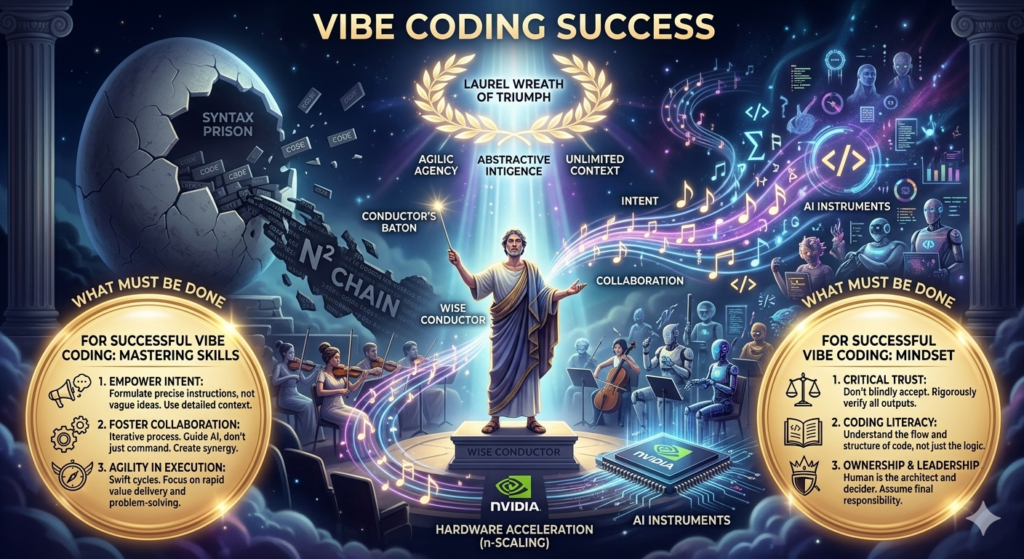
2) Vibe Coding = The ‘Orchestra Conductor’
- The Approach: The conductor waves a baton to direct the overall interpretation, tempo, and atmosphere (the vibe) of the musical piece. The actual performance is handled by the orchestra—the AI. Rather than writing every line of code personally, the developer utilizes the AI orchestra to produce the desired result.
- The Characteristics: In this paradigm, business intuition—understanding “what kind of value to create”—and communication skills become vastly more important than merely studying programming syntax. Consequently, the ability to define what to build and which problem to solve becomes much more critical than the ability to perfectly know every rule of a programming language.
3. How is ‘Vibe Coding’ Technologically Possible?
“Vibe Coding” is not just a catchy buzzword; it is a fundamental new approach to development made possible by the recent, explosive advancements in Large Language Models (LLMs). Models like GPT-4 can understand natural language descriptions provided by humans and translate that intent directly into functional computer code.
- Natural Language Understanding: Even if a developer describes their goal somewhat vaguely, saying, “Make me an app with this kind of look and feel,” the AI analyzes the context. It infers necessary functionalities and creates the required code structure.
- Rapid Reasoning and Collaboration: Modern AI models go beyond simply generating code; they understand the developer’s intent and can actively suggest edits and improvements. As a result, developers spend less time manually writing code and more time collaborating with AI to design the overall program architecture.
4. How to Succeed: The Art of Communication and Mindset
While intuition is fast, it has limits regarding precision. Vibe coding is incredibly powerful, but the sharper the tool, the more the user’s mindset determines success or failure.
1) The Limits of Vibe Coding: AI Cannot Read Your Mind Perfectly
- Absence of Verification: Code generated by AI may look perfect on the surface, but it can contain fatal “hallucinations”—errors in logic or facts—inside.
- Lack of Detail: Human design and verification remain essential for complex business rules or security-critical applications, such as financial systems.
- The Dependency Trap: If you rely solely on AI without understanding underlying programming principles, you lose the ability to solve problems independently when things inevitably go wrong.
2) The Best Approach: Communication Skills for a ‘Good Vibe’
- Specify Your Intent: Instead of asking for something “vaguely cool,” you must clearly define the purpose, the target audience, and the expected outcomes. The AI’s performance increases exponentially with the clarity of your prompt.
- Iterative Process: Do not expect a perfect result on the first try. Adopt a collaborative attitude, treating the AI as a partner that you talk to, refining the results step-by-step.
- Provide Context: The “vibe” aligns much faster when you provide the AI with sufficient background information regarding the environment in which the code will be used.
3) The Human Mindset: The Conductor Must Be Able to Read the Score
- Critical Trust: Trust AI output, but maintain healthy skepticism, always asking, “Why did it produce this result?”
- Coding Literacy: Even if you do not code manually, you must not give up the ability to “read” code, understanding its flow and structure.
- The Conductor Mentality: Define yourself as the “designer” and “decision-maker,” not a mere “task worker.” The AI is your hands and feet; you are the intuition that sets the direction.
4) The Formula for Success: Escaping Logic Chains and Syntax Weight
The core of modern development is no longer about building massive, complex blocks of code manually; it is about “Agentic” capability—efficiently directing AI agents to do the work.
- Abstraction Intelligence: The ability to summarize complex problems into simple, clear intentions.
- Hardware Acceleration: Next-generation chips, such as NVIDIA’s Rubin architecture, will process the intuitive “vibes” we share with AI faster and more accurately than ever before.
5. At a Glance! Side-by-Side Comparison
| Category | Pro-Code | Low-Code | No-Code |
| Target Audience | Professional Developers | LOB staff with IT knowledge | General Planners, Entrepreneurs |
| Degree of Freedom | Unlimited (Highest) | High (Customizable) | Average (Template-based) |
| Development Speed | Slow (Focus on precision) | Fast | Very Fast |
| Core Value | System Optimization | Business Efficiency & Automation | Rapid Idea Validation |
Conclusion: Key Takeaways
The advent of Vibe Coding represents a democratization of technology. By shifting the focus from rigid syntax to creative intent, AI has lowered the barrier to entry for software creation to an unprecedented level. However, this does not render human developers obsolete. Instead, it elevates their role from technical mechanics to high-level architects and conductors. To succeed in this new landscape, one must cultivate coding literacy—the ability to read and understand code—while honing the ability to communicate clearly and define problems effectively. Ultimately, AI handles the execution, but the human intuition required to define what is worth building remains irreplaceable.
※ Images and some descriptions in this posting were produced in collaboration with Google Gemini AI, and the author personally created, reviewed, revised, and edited the content for final completion.