
Have you ever noticed how everyday English words suddenly take on a completely different, almost cryptic meaning the moment they enter the world of Artificial Intelligence and information technology? If you have ever felt confused by this phenomenon, you are definitely not alone.
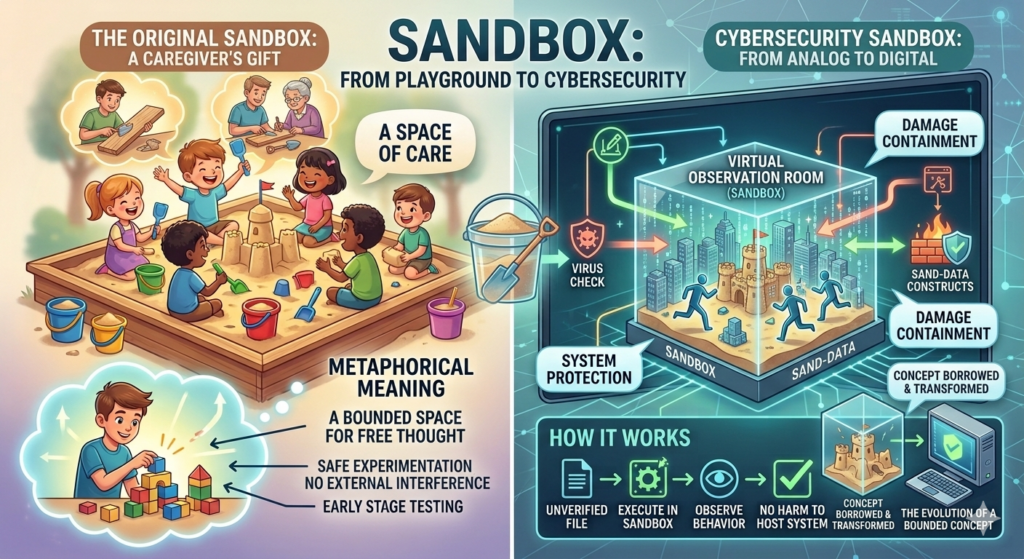
Our main protagonist today is a term that sounds like a fun weekend project but forms a core pillar of modern computer architecture: “Sandbox.” Do you remember playing in a neighborhood playground as a child, sitting inside a large wooden frame filled with soft, fine sand? Within that perimeter, you could build massive sandcastles and smash them down, or make mistakes while digging tunnels, and absolutely nothing bad would happen. To us, a sandbox was a magical space where we could exercise our imagination and fail repeatedly in total safety.
As technology has evolved, the term has transitioned into the worlds of software development, corporate finance, and public policy. Yet, its core essence remains completely unchanged. A sandbox is still an indispensable environment that protects users from external dangers while allowing them to experiment with new ideas in a highly secure, isolated digital lab. Today, we will uncover how this childhood playground concept grew into one of the tech sector’s most trusted protective frameworks.
1. In Everyday Life: Analogue Spaces for Safe Exploration
In the physical world, a “sandbox” is simply a shallow container or designated depression filled with sand, commonly found in suburban backyards and public parks across North America.
Architecturally, it functions as a deliberate buffer zone designed for early childhood development. If a toddler slips while climbing or drops a heavy object inside the sand, the impact is absorbed softly, preventing injuries. In everyday conversation, saying “let the kids play in the sandbox” carries an unwritten social promise: it means this specific zone has been cleared of sharp rocks and dangerous hazards, allowing children to make a mess and explore their creative boundaries without constant parental intervention. It represents the ultimate analogue manifestation of protective care.
2. In the IT World: The Isolated Digital Proving Ground
When we shift our focus to computer network engineering and cybersecurity, a sandbox transforms from a physical wooden box of sand into a sophisticated virtual containment facility.
To put it simply: In the IT world, a sandbox is an isolated, virtual environment that allows untrusted programs, experimental source code, or suspicious files to execute safely without risking the security of the host operating system.
Modern corporate networks face a constant barrage of security threats. If a software engineer wants to test a newly coded web application, or a cybersecurity analyst needs to open an unverified email attachment, executing those files directly on a live corporate server is incredibly dangerous. If the file contains hidden malware or a critical code defect, it could crash the host system or compromise proprietary enterprise data.
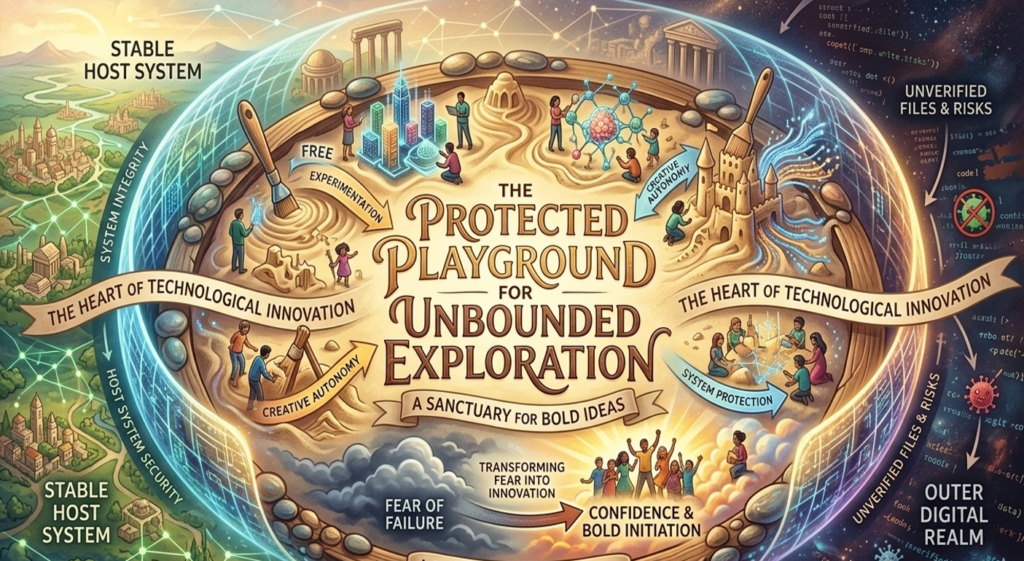
By utilizing a digital sandbox, developers can run these high-risk assets inside a sealed virtual container. If the software malfunctions, corrupts files, or unleashes a virus, the destruction is contained entirely within the digital walls of that specific sandbox. The real computer operating outside the box remains completely untouched. This removes the fear of system failure and replaces it with the confidence to run bold, innovative technical experiments.
3. The Origin Story: Replicating Playground Safety in Computer Science
The terminology was explicitly adopted by early software engineers who were searching for a clear metaphor to explain digital isolation.
When commercial computing platforms began scaling up, a rogue software bug could completely wipe out an enterprise mainframe. Tech teams needed a structural strategy to separate unverified code from core operational data. Looking at how backyards were organized, engineers realized that a sandbox provided the perfect conceptual blueprint: a defined space where a child can play freely without tracking dirt into the rest of the house.
Computer scientists looked at this paradigm and established a universal design pattern: “We will build a computational play area. Any program entering this perimeter will be blocked from accessing memory sectors, network drives, or hardware devices outside the frame.”
This innovation introduced two vital technical concepts:
- Sandbox: The isolated target environment where execution occurs safely away from the host system.
- Sandboxing: The programmatic security practice of automatically routing unverified files or background processes into these closed containers for automated analysis.
Far from being a cold, bureaucratic IT policy, sandboxing is a thoughtfully designed safety net. It serves as a protected playground for unbounded exploration, turning the terrifying threat of system failure into a structured, educational opportunity for technical teams.

4. Cleared Up: Sandbox vs. Virtual Machine vs. Testbed
In industry discussions, professionals frequently confuse sandboxes with related virtualization concepts. Let’s map out their precise structural differences:
| Category | Technical Definition | Practical Analogy |
|---|---|---|
| Sandbox | A highly restricted, application-level isolation environment focused on blocking a specific program from communicating outward. | A secure, transparent isolation room inside a laboratory where scientists inspect a volatile chemical compound. |
| Virtual Machine | A complete, software-based emulation of an entire physical computer system, running its own independent operating system. | Building an exact, fully functional replica of an entire laboratory building on an adjacent piece of land. |
| Testbed (테스트베드) | A holistic platform or live testing ground where new technologies are deployed at scale to evaluate performance under real-world conditions. | A high-speed automotive test track where an experimental vehicle is driven over real asphalt to check its tire durability. |
5. High-Stakes Applications of Sandbox Architecture
The utility of sandbox environments has expanded far beyond basic file inspection, becoming a standard operating framework across multiple sectors:
- Regulatory Sandbox: A progressive policy framework adopted by governments worldwide. When a startup develops a highly disruptive product—such as an automated AI health diagnosis tool—existing laws might block its launch. A regulatory sandbox grants the firm a temporary exemption from certain legal constraints, letting them test their service on real consumers under close regulatory supervision to see if the rules need updating.
- Cloud Sandbox: A dynamic security service that interceptively routes suspicious file downloads or unverified web links through a remote cloud server. The file is opened and executed in the cloud sandbox first, and is only delivered to the employee’s computer once the system verifies it does not exhibit malicious behavior.
- Financial Sandbox: A specialized environment managed by financial authorities. It allows fintech innovators and digital banking startups to test novel asset management algorithms or payment processing networks with a limited group of real-world customers, ensuring institutional stability is maintained.
6. Industry Leaders Utilizing Core Sandboxing Technologies
Every major technology conglomerate integrates sandboxing mechanics into their consumer facing products to safeguard user data:
- Google (Chrome Browser): Google revolutionized web security by transforming every individual browser tab into an isolated sandbox. If you visit a compromised website that crashes or runs malicious scripts, the damage is restricted exclusively to that single tab. The rest of your browser tabs and your computer’s core operating system continue running smoothly.
- Microsoft (Windows Sandbox): For enterprise users handling unverified programs, Microsoft provides an integrated, lightweight desktop environment called Windows Sandbox. It generates a pristine, temporary version of Windows to run suspicious applications. The moment you close the sandbox window, the entire environment and all its files are permanently deleted, leaving zero footprint on your machine.
- Financial Services Commission (Public Regulators): Government entities utilize public regulatory sandboxes to foster local tech ecosystems. By allowing early-stage companies to test innovative ideas without facing immediate compliance penalties, they ensure economic modernization occurs safely.
- Roblox & Minecraft: In the gaming and digital media sectors, these platforms are referred to as “sandbox games.” They provide users with open-ended virtual environments equipped with raw building blocks, giving players the freedom to engineer custom assets and interactive experiences from scratch.
Conclusion: Key Takeaways for Today’s Tech-Driven Landscape
Embracing the logic of sandbox architecture helps organizations drive continuous technological innovation while maintaining rock-solid infrastructure security.
- Security Replaces Fear: By separating execution from impact, sandboxes eliminate the fear of accidental system failure, empowering developers to test radical new code iterations with total peace of mind.
- The Bridge to Public Innovation: Regulatory sandboxes prove that consumer protection laws do not have to stifle economic growth. They provide a safe space where public policy can adapt alongside fast-moving software trends.
- A Corner Stone of Modern Operations: Whether you are securing enterprise networks from cyber threats or launching a new venture, building an isolated environment for testing is the ultimate insurance policy for corporate stability.
AI Disclosure: Created in collaboration with Google Gemini. All core content was authored, reviewed, and edited by the author.