
Have you ever noticed how everyday English words suddenly take on a completely different, almost cryptic meaning the moment they enter the world of Artificial Intelligence and information technology? If you have ever felt confused by this phenomenon, you are definitely not alone.
Our main protagonist today is a term that sounds incredibly intense and fiery, yet serves as the quiet, foundational bodyguard of your operating system: “Firewall.” If you have spent any time navigating a personal computer, you have likely encountered sudden, imposing pop-up warnings stating “Firewall has blocked some features of this app” or “Please check your network firewall settings.” Hearing the word “firewall” might make you wonder if your hardware is at risk of catching fire. In reality, a firewall is a critical digital gatekeeper designed to shield your system from external threats. Today, we will dissect exactly what a firewall is, uncover its physical world origins, and examine how it creates a highly secure boundary for your private data.
1. In Everyday Life: Physical Barriers Against Spreading Disasters
Long before it became an indispensable cornerstone of enterprise cybersecurity architecture, a “firewall” was entirely structural and mechanical.
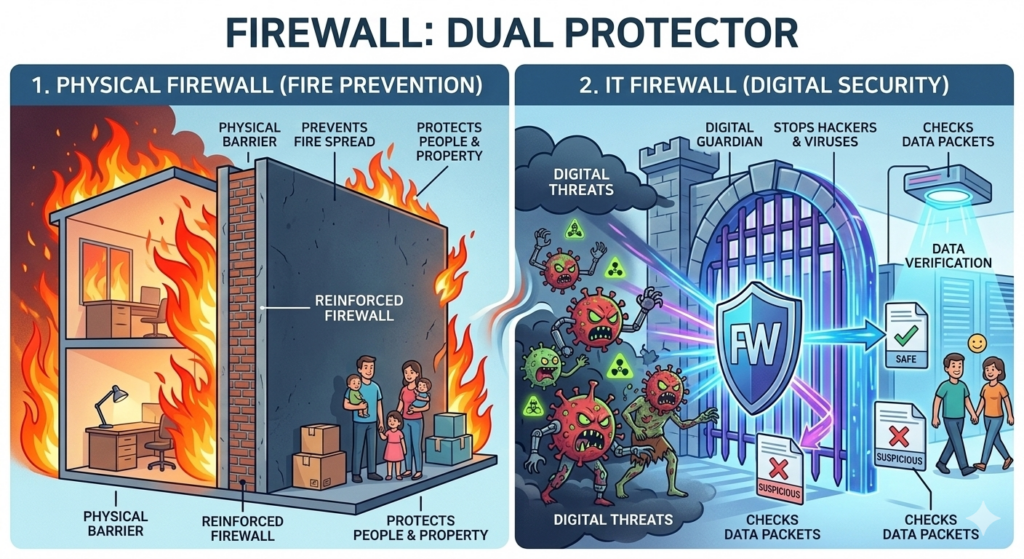
In automotive engineering and commercial architecture, a firewall is a thick, highly reinforced, and solid wall constructed out of specialized heat-resistant materials. Its purpose is life-saving: if a catastrophic fire breaks out inside an automobile engine or a specific wing of a building, this heavy structural barrier completely isolates the hazard. It seals the flames away, preventing the fire from spreading to adjacent rooms or the passenger cabin. In the physical world, a firewall represents a robust, literal shield engineered to protect human life and property from an ongoing disaster.

2. In the IT World: The Digital Castle Gatehouse
When we step into the domain of computer networking, information systems, and Artificial Intelligence, the focus shifts from blocking physical heat to filtering malicious code.
To put it simply: In the IT world, a firewall is a specialized network security system that monitors and controls incoming and outgoing network traffic based on predetermined security rules.
Think of your personal computer, smartphone, or corporate server infrastructure as a private, high-value home filled with sensitive personal records and financial assets. The open internet, while incredibly useful, is full of malicious software, opportunistic hackers, and automated network scanners.
An IT firewall acts as a digital castle gatehouse situated at the single point of entry to your network. It inspects every single unit of incoming and outgoing data, cross-referencing them against an explicit checklist. If the data looks clean and authorized, the gatehouse declares, “You are an approved visitor, welcome inside!” If the data exhibits suspicious patterns or originates from an unverified source, the gatehouse immediately commands, “Access denied; turn back.” Without this active perimeter checkpoint, malicious entities could infiltrate your background systems without your knowledge.
3. The Origin Story: Stationing Sentries on the Digital Frontier
To understand why network architects adopted this concept, it helps to imagine how security worked on historical frontiers.
Imagine a massive, fortified stone city surrounded by an uncertain wilderness. To protect the citizens inside from hostile forces or traveling merchants carrying contagious diseases, the city rulers built a singular, heavily guarded main gate. Sentries were stationed at this gate 24/7. They did not wait for a threat to enter the public square; they intercepted every traveler at the perimeter, demanding identification papers, inspecting cargo, and checking for signs of hidden weaponry before allowing anyone to step foot inside the walls.
Incoming Data Packet: "Requesting entry to access port 80."
Firewall Sentry (Inspecting Packet Headers): "Your origin IP address is unverified, and your payload structure looks altered. Entry denied!"
Early computer engineers looked at this classic defense paradigm and replicated it in software code to handle the expanding networks of the global internet. The internet provides incredible access to information, but it also exposes machines to continuous vulnerabilities. A firewall acts as that unyielding stone wall, preventing external bad actors from exploiting your operating system.
- Firewall: The defensive digital shield that establishes an automated inspection perimeter between a trusted internal network and an untrusted external network.
- Trusted Network: The safe zone located entirely behind the firewall—essentially your private home network or secure corporate intranet where your devices communicate without fear of outside interference.
This perimeter protection operates around the clock. By standing watch continuously, a firewall ensures that harmful external disruptions are stopped long before they can breach your system’s core.
4. Cleared Up: Firewall vs. Antivirus vs. Password
In casual tech conversations, users frequently treat all cybersecurity tools as if they do the exact same job. However, to maintain a truly resilient system, you must understand how these tools complement each other through entirely different operational roles:
| Category | Technical Definition | Practical Analogy |
| Firewall | A perimeter-level security system that filters network traffic at the gateway to prevent unauthorized entry. | A strict security guard standing at the front door of a building, turning away sketchy individuals before they step inside. |
| Antivirus | A system-level software application that scans internal storage to locate, isolate, and delete malicious code that has already executed. | An automated interior cleaning drone that continuously sweeps the hallways to find and neutralize any dirt or pests that slipped through the vents. |
| Password | An authentication credential designed to verify the identity of a specific user requesting system access. | A specialized, high-security physical key that fits into an internal vault lock, proving you are the actual owner of the property. |
5. Standard Operations and Traffic Rules of Firewall Architecture
Firewalls do not guess who to trust; they execute precise computational actions based on specific network protocols and directional rules:
- Block (차단): The explicit defensive action where a firewall rejects an incoming or outgoing data packet, completely cutting off communication with a suspicious external server to prevent a potential network breach.
- Allow / Permit (허용): The process where a firewall validates a data stream as safe, giving it a green light to pass seamlessly through an open network port so your applications can function normally.
- Inbound Rules (인바운드 규칙): A set of strict security parameters that governs external traffic trying to enter your internal network. It dictates exactly which external services or remote servers are permitted to send data into your computer, acting as a filter for outside visitors.
6. Industry Leaders Providing Core Network Firewalls
The massive scale of modern global cyber threats requires robust, enterprise-grade infrastructure. The firewall ecosystem is anchored by several major technology providers:
- Microsoft (Windows Defender Firewall): The most widely deployed consumer firewall on earth. Baked directly into the Windows operating system, it runs silently in the background from the moment you turn on your PC, providing automated out-of-the-box perimeter protection for everyday users.
- Cisco Systems: A powerhouse in global enterprise infrastructure. Cisco engineers massive, specialized hardware firewall appliances that act as ironclad, unyielding fortresses for multinational corporations, universities, and massive financial institutions handling high-frequency data.
- AhnLab: A highly prominent cybersecurity institution in South Korea. AhnLab develops sophisticated, tailored firewall and endpoint security solutions optimized for complex corporate networks and public sector data centers, setting a regional benchmark for threat intelligence.
Conclusion: Key Takeaways for Today’s Tech-Driven Landscape
Developing a clear perspective on firewall mechanics allows you to better navigate the security frameworks required to protect digital assets in an interconnected world.
- Perimeter Defense is Mandatory: A firewall is your primary line of defense. Relying on an internal antivirus tool without an active firewall is like hiring an internal cleaning crew while leaving your front door wide open to the public street.
- Architecture Matters: Cybersecurity requires a multi-layered strategy. True operational safety is achieved when you combine a perimeter firewall to block inbound external traffic, an antivirus to sweep internal files, and strong passwords to guard access credentials.
- Enabling Confident Operations: Far from being a restrictive bottleneck that just throws up annoying warning signs, an optimized firewall provides the structural peace of mind necessary for businesses to scale their cloud systems and exchange global data securely.
AI Disclosure: Created in collaboration with Google Gemini. All core content was authored, reviewed, and edited by the author.