
Have you ever heard two tech terms that seem simple enough when discussed separately, but become completely muddled the moment they are used together? If so, you are definitely not alone. Many people frequently mix up certain technical “pairs” because they are so deeply interconnected that it is almost impossible to mention one without the other.
Today, we are going to look at the ultimate digital duo: Domain and Web Hosting. These two components form the bedrock of everything we do on the internet, whether you are launching a personal blog, building an e-commerce store, or setting up an AI-driven business ecosystem. By the time you finish reading this guide, the exact relationship between these two inseparable concepts will be perfectly clear.
1. The Real Estate Metaphor: Understanding the Core Concepts
To navigate the digital landscape easily, it helps to step out of the abstract world of computer servers and look at a practical, real-world comparison that everyone understands: residential real estate.
1) The Domain = Your Street Address
Imagine you want to invite your friends over for a housewarming party. To help them find you, you give them a specific piece of information: “My house is located at 123 Prosperity Lane.” That explicit directional text on the street sign or your front door mail slot is your address.
In the digital ecosystem, a domain name operates exactly like that street address. When someone types an intuitive web identifier like finpropai.com into a browser bar, they are interacting with a user-friendly digital nameplate.
In reality, computers do not naturally understand human alphabetic text like finpropai.com. Machine networks communicate using complex, numerical strings known as IP addresses—for example, 123.45.67.89. You can think of an IP address as the precise, raw latitude and longitude GPS coordinates of a plot of land. Because it would be incredibly tedious for humans to memorize long strings of random numbers just to visit a favorite website, the domain name system was invented to map memorable words onto those hidden numerical coordinates.
2) Web Hosting = Your Physical House and Land
Now, let’s look at the second part of the equation. Having a designated street address is wonderful, but an address alone does not shelter you from the rain. To actually live on that property, you need a physical structure—a concrete foundation, framing, walls, and rooms where you can store your furniture, clothes, and personal belongings.
Web hosting represents that actual physical building and the land it sits on. When you build a website, you create real digital assets: high-resolution images, text files, database scripts, and video elements. These assets cannot just float around in thin air; they must be stored on a highly powerful, specialized computer known as a server.
When you buy a subscription from a web hosting provider, you are essentially renting a dedicated room or a piece of storage space inside an internet-connected apartment building. Unlike a standard home computer that you turn off when you go to sleep, these enterprise-grade hosting servers are kept powered on, cooled, and monitored 24 hours a day, 365 days a year. This continuous uptime ensures that no matter what time zone your visitors live in, your digital home is always open and ready to welcome them.
2. The “What If” Scenarios: Why You Absolutely Need Both
To truly cement how this pairing operates, let’s explore what happens to your digital presence if you attempt to launch a website using only one of these components.
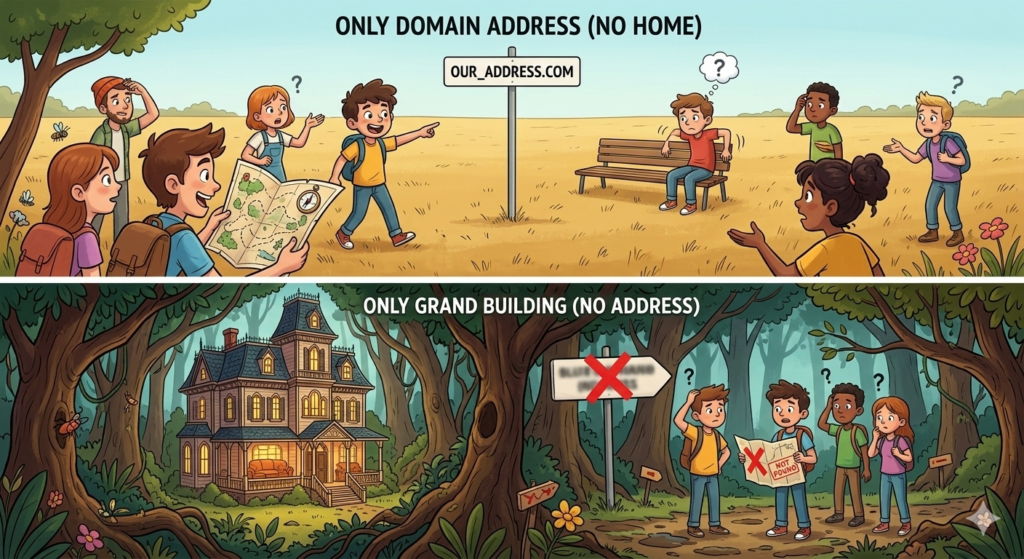
Scenario A: You Only Purchase a Domain Name
- The Reality: You have successfully registered your custom address nameplate (
your-address.com), but when eager customers type that URL into their browser, they are met with a completely blank screen or a generic parking page. - The Missing Link: This is the equivalent of buying a beautiful, customized street address sign and sticking it into an empty patch of grass in the middle of an open, undeveloped field. There is no front door to open, no living room to sit in, and no content for your guests to view. You have a location identifier, but you haven’t built the house yet.
Scenario B: You Only Lease Web Hosting Space
- The Reality: You have spent weeks designing a gorgeous website, filling it with premium graphics, optimized content, and functional layouts on a remote server. However, your daily traffic analytics show exactly zero visitors.
- The Missing Link: This is the equivalent of building a spectacular, multi-million dollar luxury mansion with stunning interior design, but hidden deep inside an uncharted forest with absolutely no access roads, no street signs, and no mapped address. The building exists and is fully operational, but because nobody knows how to locate it, your friends and customers are left wandering through the digital wilderness, completely unable to find your front door.
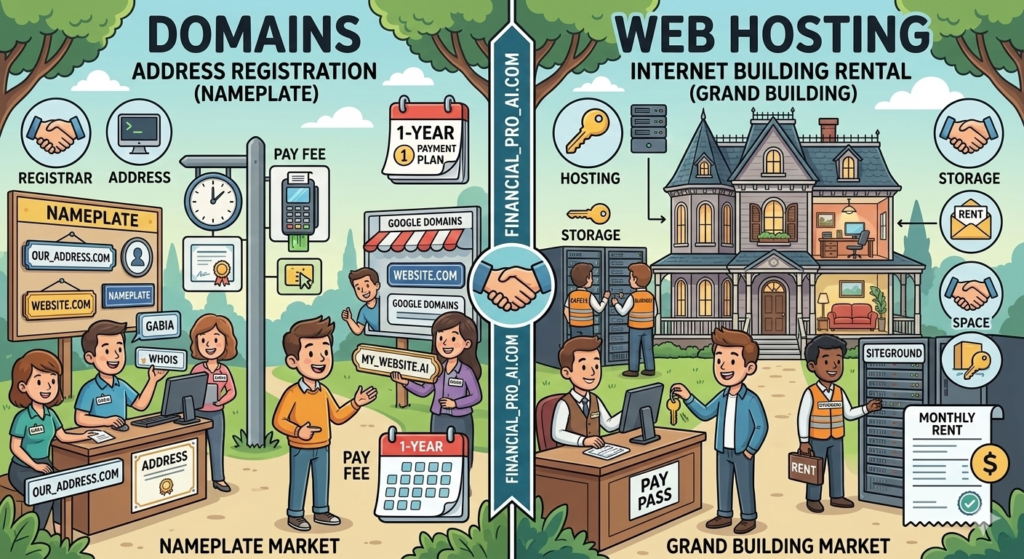
As these scenarios demonstrate, the components are completely dependent on each other. A successful online presence requires a seamless marriage between a clear navigation point and a robust storage infrastructure.
3. Building Your Digital Footprint: The Step-by-Step Architecture
When you decide to launch a new digital initiative—whether it’s an online financial consulting portal, a real estate directory, or a personal portfolio—the engineering process mimics building a brick-and-mortar storefront from scratch.
First, you formulate a high-level vision: “I want to open a highly sophisticated digital cafe to share insights and interact with global clients.”
To execute that vision, your development workflow must follow a dual-track integration plan. First, you secure your identity by registering an optimized domain name so your audience has a clear path to follow. Simultaneously, you secure your operational foundation by renting server capacity from a hosting provider to store your digital assets.
This interactive blueprint forms the heart of the modern internet ecosystem. By combining identity with infrastructure, you transform abstract lines of software code into an accessible, interactive destination.
4. Side-by-Side Comparison: Head-to-Head Analysis
To help you easily distinguish between these foundational tools during your next corporate IT alignment or development sprint, let’s review their core operational boundaries:
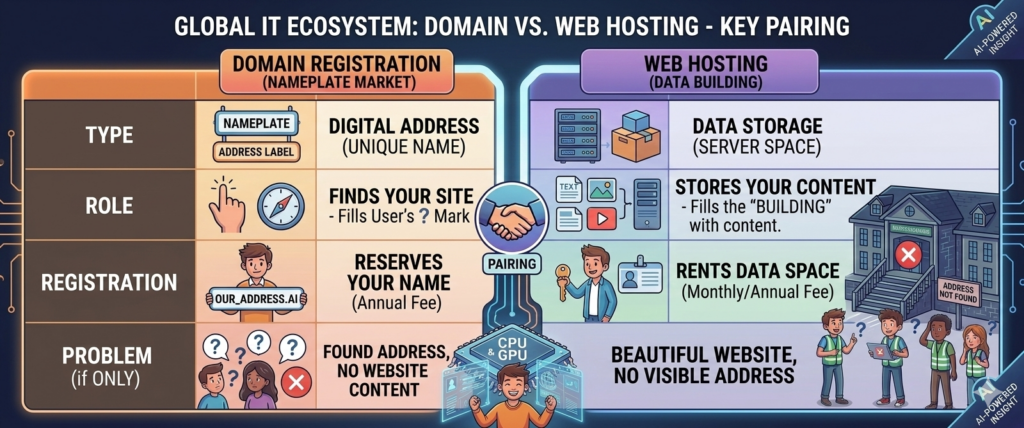
| Category | Domain Name | Web Hosting |
|---|---|---|
| Core Operational Role | Acts as an intuitive directional guide (“Come to this location”). | Functions as a secure physical vault (“Store your digital assets here”). |
| Real-World Property Analogy | The registered street address and the nameplate on the mailbox. | The physical house structure, the land foundation, and the rooms. |
| Standard Billing Cycle | Annual licensing fee to maintain exclusive rights to the name. | Monthly or annual lease payments based on server space utilization. |
| Primary Asset Managed | The alphanumeric branding name and domain extension (.com, .ca, .org). | The actual live files, database content, images, and page code. |
5. Industry Infrastructure Providers: Who Manages the Ecosystem?
When you are ready to transition from conceptual theory to live deployment, you will interact with two specialized categories of technology vendors:
1) Domain Name Registrars
These specialized entities are authorized to allocate and manage unique web addresses, ensuring that no two companies on earth can claim ownership of the exact same URL at the same time.
- North American & Global Leaders: Platforms like GoDaddy and Google Domains (now integrated into major cloud registry suites) provide streamlined portals to search for, secure, and manage DNS settings for global brands.
- Regional Providers: Domestic registrars such as Gabia or Whois cater heavily to regional localized extensions, providing localized customer support and registry maintenance.
2) Web Hosting Providers
These infrastructure conglomerates function as your digital landlords. They own massive, climate-controlled data centers packed with high-speed server racks, leasing out slices of their processing power and storage to individual businesses.
- Global Enterprise & Managed Hosting: Companies like Bluehost, SiteGround, and Hostinger manage millions of websites worldwide, offering highly optimized environments for content management systems and scalable web applications.
- Regional Infrastructure Leaders: Providers such as Cafe24 offer specialized, high-bandwidth server localizations optimized for regional web traffic and specific local e-commerce integrations.
6. One-Sentence Summary
While a network firewall acts as the secure, protective front gate of your digital property, your domain is the street address that guides visitors to the door, and web hosting is the physical house containing everything inside.
Conclusion: Key Takeaways for Today’s Digital Strategy
Mastering the relationship between infrastructure assets is vital for executing a scalable web or investment strategy.
- Recognize the Interdependence: Never treat identity and infrastructure as competing options. A domain without hosting is hollow, and hosting without a domain is invisible. Every successful digital launch requires both.
- Optimize for Security and Growth: When designing your system, ensure that your perimeter tools (like firewalls) protect your hosting environment, while your domain cleanly routes inbound client traffic.
- Invest in Quality Foundations: Choosing reputable domain registrars and robust hosting platforms prevents costly downtime, speeds up page load times for international users, and provides an ironclad baseline for your brand’s digital presence.
AI Disclosure: Created in collaboration with Google Gemini. All core content was authored, reviewed, and edited by the author.