
Have you ever heard two tech terms that seem simple enough when discussed separately, but become completely muddled the moment they are used together? If so, you are definitely not alone. Many people frequently mix up certain technical “pairs” because they are so deeply interconnected that it is almost impossible to mention one without the other.
Today, we are going to look at the ultimate digital duo: Frontend and Backend. These two components form the inseparable foundation of everything we experience on the internet. To build a functional digital product, they must operate in perfect unison—much like a glamorous actor performing under the spotlight on stage, and the invisible stagehands operating the complex mechanical machinery behind the curtains. By the time you finish reading this guide, you will understand exactly why these two concepts share the word “End” and how they work together to build our modern web ecosystem.
1. The Restaurant Metaphor: Understanding the Core Concepts
To easily navigate these web development concepts, let’s step away from lines of source code and explore a familiar, real-world comparison: dining out at a restaurant.
1) The Frontend = The Dining Room and Menu
Imagine walking into a high-end restaurant. You are immediately greeted by beautiful interior design, comfortable seating, elegant lighting, a polished menu, and the warm smile of a server. Everything you can physically touch, look at, or interact with falls into this space.
In the digital world, the frontend is the website interface that appears directly on your screen. It encompasses the layout, typography, colorful buttons, sliders, images, and submission forms. When you hover your mouse over a link and it changes color, or when you type a query into a search bar, you are interacting with the frontend. The primary value of frontend engineering is aesthetic beauty, intuitive layout, and seamless user experience.
2) The Backend = The Kitchen and Storage Supply Room
Now, consider what happens after you place your order with the server. You do not see the raw ingredients being chopped, the chefs operating the high-powered grills, or the inventory manager tracking supplies in the walk-in freezer. Yet, without this unseen operational zone, your order could never be fulfilled.
The backend is the digital kitchen of the internet. It operates entirely behind the scenes, away from the user’s view. When you type your username and password into a website, the frontend passes that information to the backend. The backend runs calculations, checks an internal storage vault called a database to verify your identity, and securely signals back whether you should be allowed in. When you publish a blog post, it is the backend engine that processes the text and commands the system to store it safely in the data warehouse.

2. The “What If” Scenarios: Why You Absolutely Need Both
To truly understand how this pairing operates, let’s explore what happens to a web platform if you attempt to launch it using only one of these components.
Scenario A: You Only Have a Frontend (All Dining Room, No Kitchen)
- The Reality: The website features an award-winning design, gorgeous animations, and beautifully styled buttons. However, the moment a user clicks a “Purchase Now” button or tries to log in, nothing happens.
- The Result: This is the equivalent of a restaurant with a spectacular dining room but no kitchen or chefs. A customer can look at the beautiful menu and make a choice, but no food will ever arrive. The website becomes an empty shell—visually stunning but completely broken under the hood.
Scenario B: You Only Have a Backend (All Kitchen, No Dining Room)
- The Reality: You have built a highly secure database, a lightning-fast data processing engine, and world-class security protocols capable of managing millions of operations per second.
- The Result: This is the equivalent of having a world-class chef and a kitchen fully stocked with premium ingredients, but no dining room, no tables, and no menu. The food is ready, but customers have no way to step inside or place an order. Without a frontend user interface, your powerful system is just a raw machine block that ordinary human beings cannot interact with.
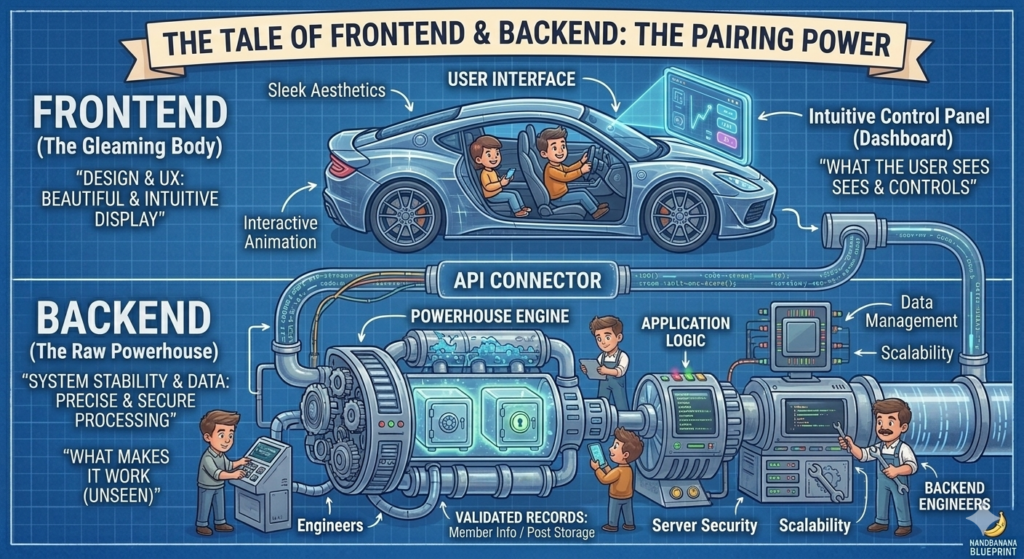
THE BLUEPRINT OF DIGITAL ARCHITECTURE
What the driver sees, touches, and rides
The hidden turbine and gear systems
As these automotive and culinary blueprints show, true software innovation requires a complete bridge between the external presentation layer and the internal logic engine.
3. The Origin of the Terms: Why Do We Say “End”?
While “Front” and “Back” are intuitive directional terms, appending the word “End” can sometimes feel linguistically awkward to newcomers. In computer science and network architecture, “End” does not mean a termination or final stop. Instead, it refers to an endpoint or the extreme boundaries of a communication channel.
Think of an automated vending machine. The physical keypad, the coin slot, and the digital display screen form the front-end endpoint—the exact boundary where the human operator makes physical contact with the machine. Conversely, the internal electronic motors, product dispensers, and inventory sensors form the back-end endpoint—the boundary deep inside the machine where the physical labor is executed. The two ends hold hands across the network to complete a singular task.
4. Side-by-Side Comparison: Head-to-Head Analysis
To help you clearly distinguish between these two foundational disciplines during your next development cycle, let’s review their core operational boundaries:
| Category | Frontend | Backend |
|---|---|---|
| Core Operational Role | Presenting data beautifully and making interfaces easy to navigate. | Processing data accurately and protecting server architecture securely. |
| Real-World Metaphor | The restaurant dining room, or an actor performing on a stage. | The restaurant kitchen, or a stagehand managing props behind the curtains. |
| Primary Core Value | Visual design, responsive layout, and user experience. | System stability, database optimization, and cloud security. |
| Primary Management Targets | Visual screens, interactive buttons, and web animations. | User profiles, database storage, server logic, and API protocols. |
5. The Professional Roles: Who Builds the Modern Web?
In the technology sector, software engineers specialize in navigating these different structural layers, using distinct toolsets to accomplish their goals:
1) Frontend Developers
These professionals function as the digital architects and interior designers of the internet. They translate abstract concepts into visible, interactive realities that humans can easily navigate.
- Core Toolset: They master core languages like HTML (the structural skeleton of a webpage), CSS (the stylistic clothing and layout design), and JavaScript (the muscles that create dynamic movement and behavior).
2) Backend Developers
These specialists act as structural engineers and logistical warehouse managers. They build the underlying logic systems that keep applications running smoothly, securely, and efficiently.
- Core Toolset: They build robust infrastructure using powerful programming languages like Python, Java, or Ruby, and design organized database systems like SQL or MongoDB to catalog massive streams of enterprise data.
3) Full-Stack Developers
These versatile professionals are the ultimate multi-taskers of the programming world. They possess the specialized skills required to manage both the front-facing user experience and the back-end server architecture. A full-stack engineer can single-handedly take a product from a conceptual design sketch all the way to a fully deployed cloud application.
6. One-Sentence Summary
In the modern technological landscape, the frontend allows users to experience technology intuitively, while the backend works behind the scenes to realize that technology securely.
Conclusion: Key Takeaways for Today’s Tech-Driven Landscape
Understanding how frontend and backend development intersect is essential for launching successful software products and navigating corporate digital transformation.
- Prioritize Balanced Architecture: Never sacrifice backend security for a flashy frontend design, and never neglect frontend user experience for raw backend power. True digital excellence requires both ends to be strong.
- Streamline Cross-Functional Collaboration: Successful tech projects rely on seamless communication between frontend designers and backend engineers. When the presentation layer and data layer are perfectly aligned, application performance improves drastically.
- Adapt to the AI Era: As automated tools simplify basic coding tasks, the human role shifts toward higher-level system design. Understanding how these two structural endpoints connect gives professionals the framework needed to direct AI tools effectively and build scalable systems.
AI Disclosure: Created in collaboration with Google Gemini. All core content was authored, reviewed, and edited by the author.