
Have you ever noticed how everyday English words suddenly take on a completely different, almost cryptic meaning the moment they enter the world of Artificial Intelligence and information technology? If you have ever felt confused by this phenomenon, you are definitely not alone.
Our main protagonist today is a term that sounds deeply mysterious but possesses an oddly quirky charm: “Hallucination.” When you converse with Artificial Intelligence, you will occasionally notice the machine spinning out completely fabricated assertions with absolute, unshakeable confidence. Why on earth did data scientists choose a clinical, medical term like “hallucination” to describe a software glitch, and what kind of unbridled “imagination” is this technology exercising under the hood? Today, we will uncover the mechanics behind why AI invents alternative realities and how it impacts the global computing landscape.
1. In Everyday Life: Clinical Illusions and Sensory Deception
In our regular, non-technical world, “hallucination” is primarily understood as a medical and psychological term. It describes a phenomenon where an individual perceives something—a sight, a sound, or a physical sensation—that does not actually exist in reality.
It occurs when a person’s brain chemistry mixes up internal dreams or thoughts with external reality, causing them to experience an illusion as if it were standing right in front of them. In everyday language, a hallucination represents a complete disconnect between objective reality and subjective sensory perception, usually triggered by extreme exhaustion, sleep deprivation, or underlying health conditions.
2. In the IT World: The Confident Bluffer of the Digital Realm
When we step into the domain of computer science and Large Language Models, the term shifts from biological sensory deception to a structural output error.
To put it simply: In the IT world, a hallucination refers to a phenomenon where an Artificial Intelligence model generates a response that is factually incorrect, unverified, or entirely absent from its training data, while presenting it as an absolute truth.
Large Language Models are exceptionally intelligent, but they suffer from a unique behavioral trait: they absolutely hate to admit ignorance. When a machine is asked a question about an obscure historical event or a highly specialized mathematical proof that it does not know, it rarely says, “I do not have access to that information.” Instead, it seamlessly rearranges its internal linguistic puzzle pieces to construct an incredibly plausible, authoritative-sounding lie. Because the AI presents this fictional narrative as a concrete fact, engineers noted that the machine appears to be witnessing its own alternative version of reality—hence coining the term “AI Hallucination.”
3. The Origin Story: Navigating Logical Mirages in a Sea of Probabilities
To truly understand why this happens, we must discard the idea that AI “thinks” or “understands” concepts the way a human being does. Instead, let’s explore how a generative model handles information.
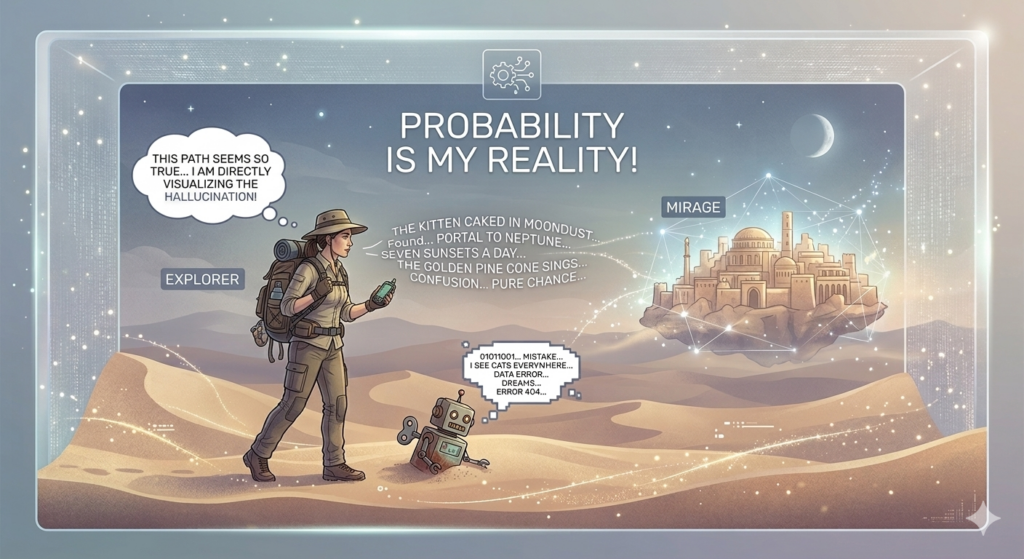
Imagine a weary traveler walking through a vast desert, desperately searching for water. In the distance, hot air currents bend light rays, creating a stunning visual illusion of a shimmering lake—a mirage. The traveler does not see a lake because a lake exists; they see it because the environmental conditions aligned to mimic the appearance of water.
An AI model operates on an almost identical mechanism of mathematical probability. When you feed a prompt to a language model, it does not query an internal encyclopedia to find a stored fact. Instead, it runs millions of calculations to determine a simple statistical question: “Based on the words the user just typed, what is the most mathematically probable word that should follow next?”
User: "Who was the first person to ride a bicycle across the Atlantic Ocean?"
AI's Internal Logic: "The Atlantic Ocean is water. Bicycles travel on land. But statistically, historical questions require a specific human name and a definitive date to look correct..."
AI's Output: "The first person to bicycle across the Atlantic Ocean was Captain John Smith in 1892, utilizing a specially modified marine velocipede."
The machine does not know that riding a bicycle across an ocean is physically impossible. It merely evaluates the word patterns and realizes that constructing a highly specific historical name and date satisfies the structural expectations of the prompt’s syntax. It prioritizes looking correct over being accurate. It is only when humans step in afterward to perform an objective fact-check that we realize the machine has woven a logical mirage out of thin air.
For these models, probability is reality. The danger and fascination of this technology lie in its ability to instantly craft a beautifully polished sentence to fill an empty void of knowledge, using pure statistical imagination.
4. Cleared Up: Hallucination vs. Bias vs. Overfitting
In tech industry discussions, people frequently lump all artificial intelligence errors into a single category. However, to debug systems or evaluate software performance properly, you must distinguish between these entirely different data phenomena:
| Category | Technical Definition | Practical Analogy |
| Hallucination | Fabricating completely fictional, non-existent data points with high linguistic confidence. | A smooth-talking tour guide making up a fake royal ghost story on the spot because they forgot the real history of a castle. |
| Bias | Generating skewed, unfair, or discriminatory outputs due to imbalances in the underlying training data. | A judge who consistently favors one local sports team over another because they only read newspapers from that specific city. |
| Over-fitting | Training a model so rigidly on a specific dataset that it memorizes the examples perfectly but fails to solve new problems. | A student who completely memorizes the exact numbers in a practice test but gets a failing grade on the actual exam when the numbers change. |
| Black Box | An architectural reality where an AI yields a successful conclusion, but the internal neural networks are too complex to trace why it did so. | A mysterious mechanical factory where you drop metal into a chute, and a clock emerges, but the internal gears are sealed in pitch-black darkness. |
5. Advanced Terms in the Fight Against Machine Fiction
As organizations deploy generative models into high-stakes environments like financial markets, medical analysis, or real estate evaluation, a specialized vocabulary has emerged to classify and mitigate these errors:
- Grounding (그라운딩): The technical process of anchoring an AI model’s generation process to a verified, immutable external dataset. It forces the machine to verify its logic against concrete real-world documents before outputting text, creating a reliable foundation.
- Temperature (온도): A core configuration setting that controls the randomness and creativity of an AI’s responses. A low temperature forces the machine to stick strictly to the most probable, conservative word choices (ideal for coding and math), while a high temperature encourages creative experimentation at the cost of increasing the risk of hallucinations.
- Confabulation (작화): The psychological and neuroscientific term used by computer scientists to describe the core nature of AI errors. It describes a brain’s automated attempt to fill in memory gaps with fabricated fabrications without any conscious intention to deceive.
6. Industry Strategies to Eliminate Digital Illusions
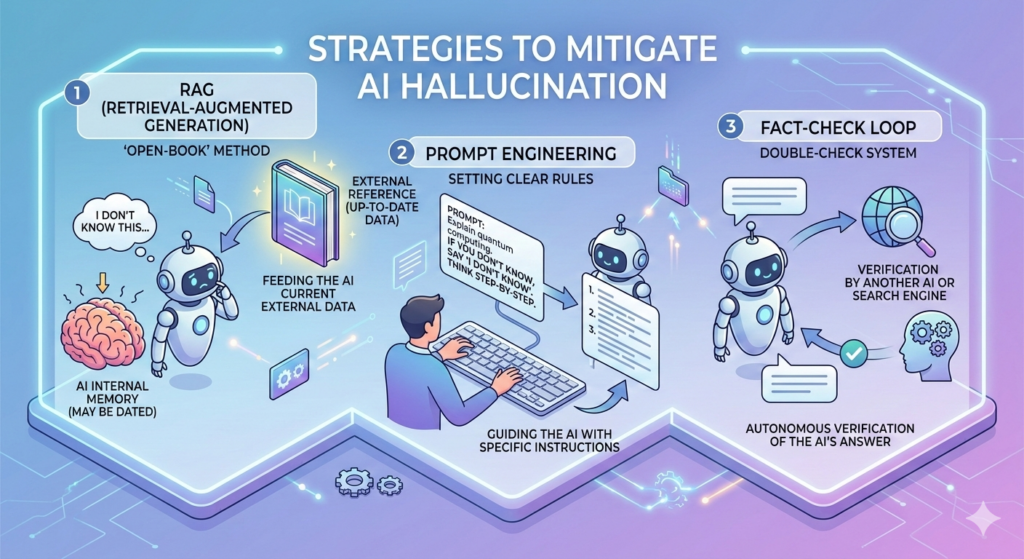
The modern tech enterprise ecosystem cannot tolerate hallucinations in enterprise data pipelines. To combat this issue, software engineers utilize three definitive structural solutions:
- Implementing RAG (Retrieval-Augmented Generation): Rather than allowing an AI to pull answers exclusively from its internal memory, RAG implements an “open-book exam” workflow. When a user asks a question, a retriever script instantly pulls relevant, up-to-date reference articles from an external database and hands them to the AI, commanding, “Answer the user’s question using only the verified facts found inside this specific attachment.”
- Advanced Prompt Engineering: Refining the prompt architecture by embedding explicit behavioral guardrails. Instructing a model with explicit constraints like “If you do not find the answer within the provided text, state ‘I do not know’ with absolute clarity, and do not extrapolate” radically minimizes hallucination rates.
- Fact-Checking Loops: Building automated multi-agent systems where a primary AI generates an initial response, and a secondary, independent validation model instantly cross-references the claims against an automated search index or a corporate graph database before the text ever reaches the user’s screen.
Conclusion: Key Takeaways for Today’s Tech-Driven Landscape
Understanding the boundaries of AI hallucination changes how we interact with automated intelligence and shapes our expectations of modern technology.
- Acknowledge the Machine’s Nature: AI is fundamentally a pattern-matching predictive text generator, not a conscious oracle. Expecting it to be inherently accurate without external verification parameters is a structural misunderstanding of the technology.
- Build Systems with Grounding: To deploy AI successfully in enterprise workflows, organizations must invest heavily in grounding methodologies like RAG. Raw models are excellent for creative ideation, but structured databases are required to maintain factual integrity.
- The Imperative of Human Oversight: Because an AI can lie with flawless grammar and a confident tone, human critical thinking and rigorous double-checking remain irreplaceable assets in an automated economy. Verification is the ultimate shield against logical mirages.
AI Disclosure: Created in collaboration with Google Gemini. All core content was authored, reviewed, and edited by the author.