
Have you ever noticed how everyday English words suddenly take on a completely different, almost cryptic meaning the moment they enter the world of Artificial Intelligence and information technology? If you have ever felt confused by this phenomenon, you are definitely not alone.
One of the most foundational—yet widely misunderstood—terms in this new era of technology is the word “Prompt.” When you navigate the world of Artificial Intelligence, a prompt serves as the golden key that extracts the precise answers you need from a massive digital library of global knowledge. It looks like a simple line of text, but it is actually the spark that ignites AI intelligence. Today, we are going to dive deep into the world of computer science and theater history to uncover exactly what a prompt is, where the term historically comes from, and how it transforms text into a powerful tool.
1. In Everyday Life: Speed and Immediate Responses
Before it became an essential term for Generative AI, the word “prompt” was used in standard English primarily as an adjective or a verb related to speed and timing.
In everyday conversation, you hear it in phrases like “prompt treatment” at a hospital when an injury requires immediate care, or “prompt arrival” when someone is praised for showing up exactly on time. As a verb, to prompt someone means to incite, move, or stimulate them into immediate action. In the physical world, a prompt represents a clear signal or catalyst that causes an instantaneous reaction without any unnecessary delay.
2. In the IT World: The Compass for Artificial Intelligence
When we transition into the digital landscape of Large Language Models and Artificial Intelligence, the focus shifts from real-world punctuality to guiding the cognitive boundaries of a machine.
To put it simply: In the IT world, a prompt is the initial question, instruction, or set of contextual guidelines given to an AI model to initiate its thought process and direct its behavior.
Think of a prompt as a map for a highly intelligent but completely blind genius. Modern AI models possess a staggering amount of data, but without a clear framework, they can easily drift off in the wrong direction or generate unhelpful hallucinations. Everything you type into an AI input box—whether it is a simple question, a massive data sheet, or a highly detailed corporate style guide—is part of the prompt. It is the bridge between human intent and machine computation.
3. The Origin Story: The Hidden Whisperer in the Theater Wings
How did computer scientists land on this specific word to describe machine instructions? The answer lies in classical theater history rather than traditional mathematics.
Decades ago, long before digital screens existed, stage plays relied entirely on human memory. When an actor stood under the spotlight and suddenly forgot their next line due to stage fright, the entire production faced an immediate crisis. To prevent an awkward silence, theater companies stationed a specific crew member just off-stage, hidden in the wings or a small box at the front of the stage. This person held the complete script and would quietly whisper the first few words of the forgotten line to the struggling actor. This hidden assistant was called the “Prompter.”
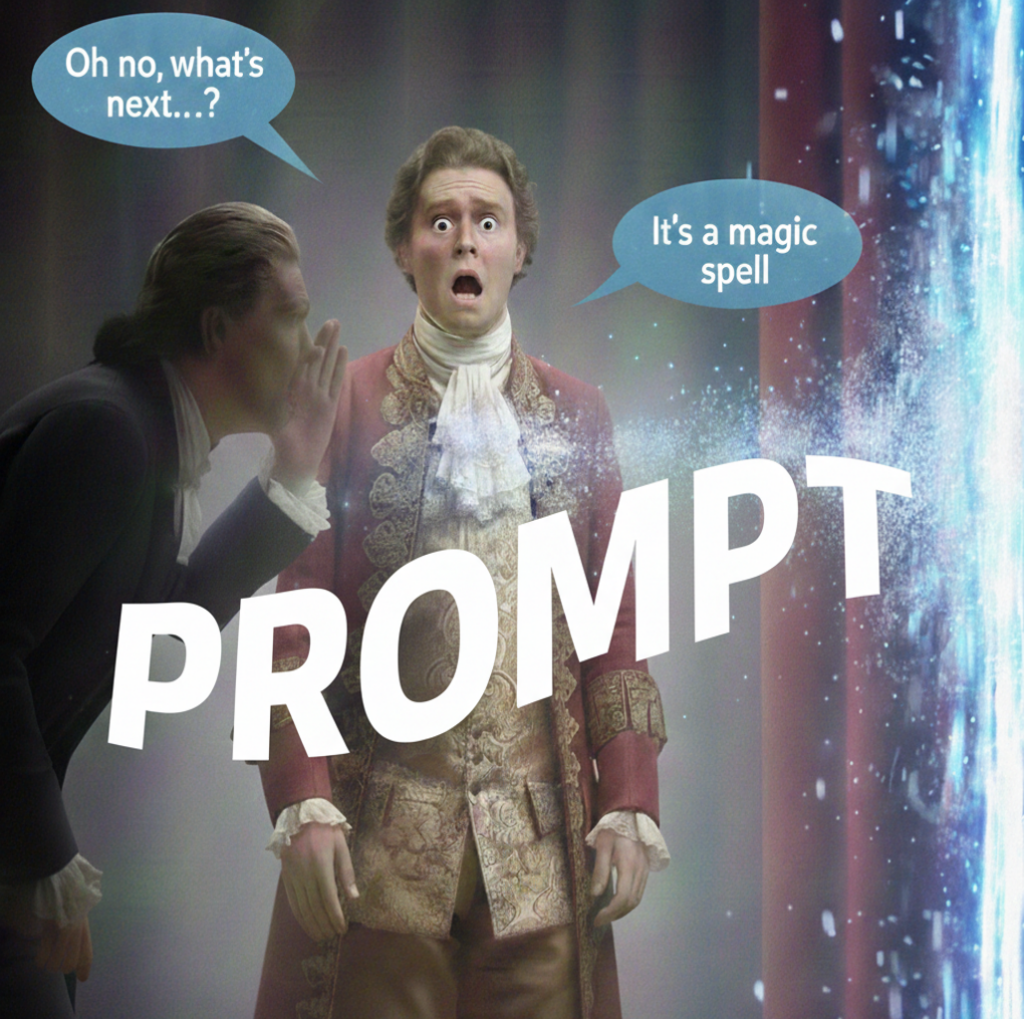
The actor, catching that tiny off-stage cue, would instantly remember the rest of their monologue and continue the performance flawlessly.
Actor: "To be, or not to be... uh... what was next?"
Prompter (Whispering from the wings): "That is the question..."
Actor: "That is the question!"
Artificial Intelligence operates in almost the exact same way. The AI model has a massive reservoir of linguistic patterns, but it stands on a digital stage waiting for a cue. Your input acts as the modern prompter, whispering the initial context from the wings so the AI knows exactly what line of thought to pursue.
- Prompt: The human-to-machine command interface that serves as a binding protocol to translate human intent into computational execution.
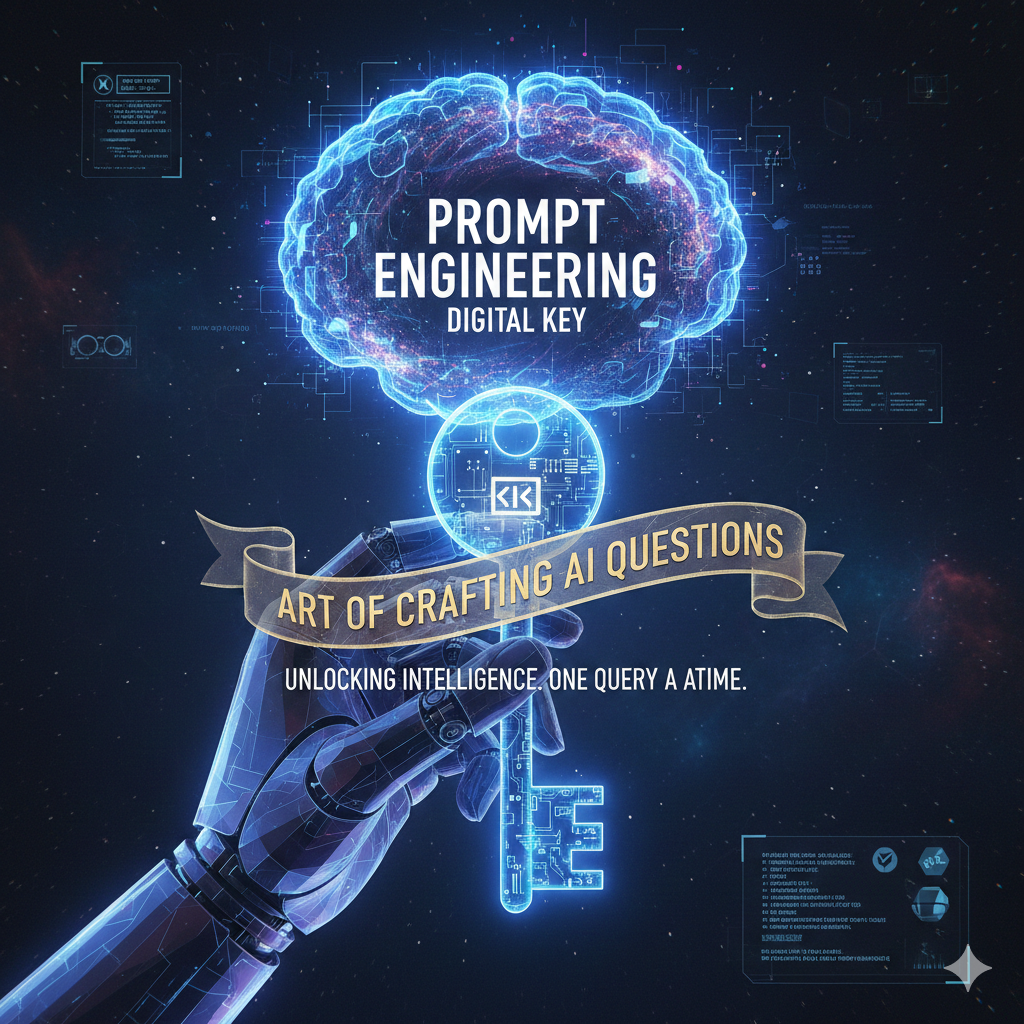
- Prompt Engineering: The technical practice and art of meticulously structuring AI questions, rules, and contexts to extract the highest-quality outputs from a language model.
4. Cleared Up: Prompt vs. Query vs. Input
In technology discussions, people frequently confuse prompts with older data concepts like queries or raw inputs. Let’s establish clear architectural boundaries so you can differentiate them like an industry expert:
| Category | Technical Definition | Practical Analogy |
| Prompt | A rich, context-driven instruction that sets roles, constraints, and operational guidelines for an AI. | Handing a professional writer a detailed creative brief that establishes the tone, audience, and narrative persona. |
| Query | A rigid, literal request designed to pull specific data points from a structured database. | Typing a keyword into a library catalog system to see if a specific book is currently sitting on the shelf. |
| Input | The raw material, variables, or data assets fed into a computer system for generic processing. | Dropping unrefined lumber or raw steel into a factory machine to be processed into uniform parts. |
5. Advanced Methodologies in Prompt Architecture
As you develop corporate AI workflows or refine your automation tools, you will encounter specialized prompting techniques designed to boost machine reasoning:
- Zero-Shot Prompting: Demanding a complex output from the AI immediately without providing any previous structural examples. It relies entirely on the model’s pre-trained global knowledge.
- Few-Shot Prompting: Providing a highly detailed blueprint by inserting a few clear examples of inputs and desired outputs within the prompt before asking the final question. This guides the machine’s structural format.
- Persona Prompting: The strategic technique of assigning an explicit identity, profession, or worldview to the AI—such as commanding it to act as a Veteran Financial Analyst or a Corporate Legal Scholar. This acts as a specialized digital mask, instantly shifting the vocabulary, risk assessment parameters, and tone of the machine’s response.
6. The AI Frontiers: Who Builds the Prompt Engines?
The modern infrastructure powering these prompt-driven ecosystems is led by a few major technology enterprises that set the standard for high-context data processing:
- OpenAI (ChatGPT): The undisputed pioneer that ignited the global AI revolution. OpenAI popularized conversational prompt interfaces, showing the public how simple text could orchestrate complex programming, writing, and logical analysis.
- Google (Gemini): A global infrastructure titan capable of handling massive multi-modal prompts. Gemini excels at ingestion, allowing users to drop long videos, massive code repositories, or complex spreadsheets directly into the prompt window alongside text instructions.
- Anthropic (Claude): Renowned for its natural, nuanced communication style. Anthropic engineered its models to excel at processing dense, highly complex academic prompts and long-form manuscript documentation with precise adherence to strict formatting constraints.
- Midjourney: The gold standard for generative visual arts. Midjourney utilizes highly descriptive, stylistically dense prompts to translate human textual concepts into hyper-realistic, studio-quality digital illustrations and graphics.
Conclusion: Key Takeaways for Today’s Tech-Driven Landscape
Mastering the mechanics of prompt design changes how you view human-computer interaction in an automated world.
- Shifting from Coding to Communication: In the AI era, natural language has become the ultimate programming language. The ability to articulate clear, logical boundaries in a prompt replaces the need for manual syntax writing.
- Context is Power: An AI is only as smart as the framework you provide. Spending time refining your prompt architecture prevents system errors and drastically cuts down on project revision times.
- The Definitive Career Asset: As businesses integrate large language models into daily operations, prompt engineering remains a vital skill. Learning to craft precise, role-driven questions is the ultimate armor for navigating the modern workplace.
AI Disclosure: Created in collaboration with Google Gemini. All core content was authored, reviewed, and edited by the author.