
Any executive who has managed a corporate finance team or held responsibility for an organization’s treasury has likely asked a common question: “When we are already buried under income statements and balance sheets, do we really need to build a complex cash flow statement every month? Can’t we just simplify this process?” Reconciling a formal cash flow statement requires auditing ledger accounts line by line and re-adjusting accrual-based entries into actual cash inflows and outflows. This process demands a significant amount of labor, time, and operational cost. Because of this administrative burden, many business leaders are tempted by the convenience of a simplified cash flow model.
However, is simplifying cash flow data practically viable for corporate governance, and how does the cost-benefit dynamic actually play out? By exploring the relationships between four core financial indicators, this guide uncovers the operational realities of cash flow shortcuts.
1. The Core Metrics: Tracking the Conversion of Paper Profits into Cash
Before analyzing whether simplification is viable, management must understand the corporate ecosystem that drives cash movement. The interaction between these metrics shows how paper commitments on an accounting ledger convert into hard currency in a bank account.
The Baseline: Net Income as an Accrual Commitment
Net income serves as the final grade on an income statement. Calculated under the accrual principle, it represents a formal accounting declaration of what the enterprise earned during a specific period. However, this figure includes non-cash paper expenses and capital tied up in daily operations. To determine true liquidity, financial teams must adjust this baseline using two primary variables.
The First Adjustment: Reversing Non-Cash Depreciation
Depreciation represents the gradual decline in the book value of fixed assets over time, such as machinery or facilities purchased in prior fiscal periods. While depreciation is deducted as an expense when calculating net income, no actual cash leaves the company’s bank account during that specific month. Therefore, to determine true cash positions, analysts must add depreciation back to net income.
The Second Adjustment: Accounting for Working Capital Taps
Working capital represents a highly dynamic variable in corporate finance, primarily driven by accounts receivable and inventory. Even when a company records strong sales and high net margins, its cash remains trapped if clients delay payments or unsold products accumulate in warehouses. Consequently, any net increase in working capital must be subtracted from net income to evaluate actual cash flow.
The Core Cash Flow Equation
Ultimately, Cash Flow from Operating Activities is determined by the interaction of these three core variables:
The desire for simplification usually stems from a simple question: “If depreciation is our largest non-cash expense, can’t we just add it back to net income to get a quick, reliable view of our cash position without auditing every account?”
2. The Simplification Trap: Weighing Administrative Savings Against Corporate Risk
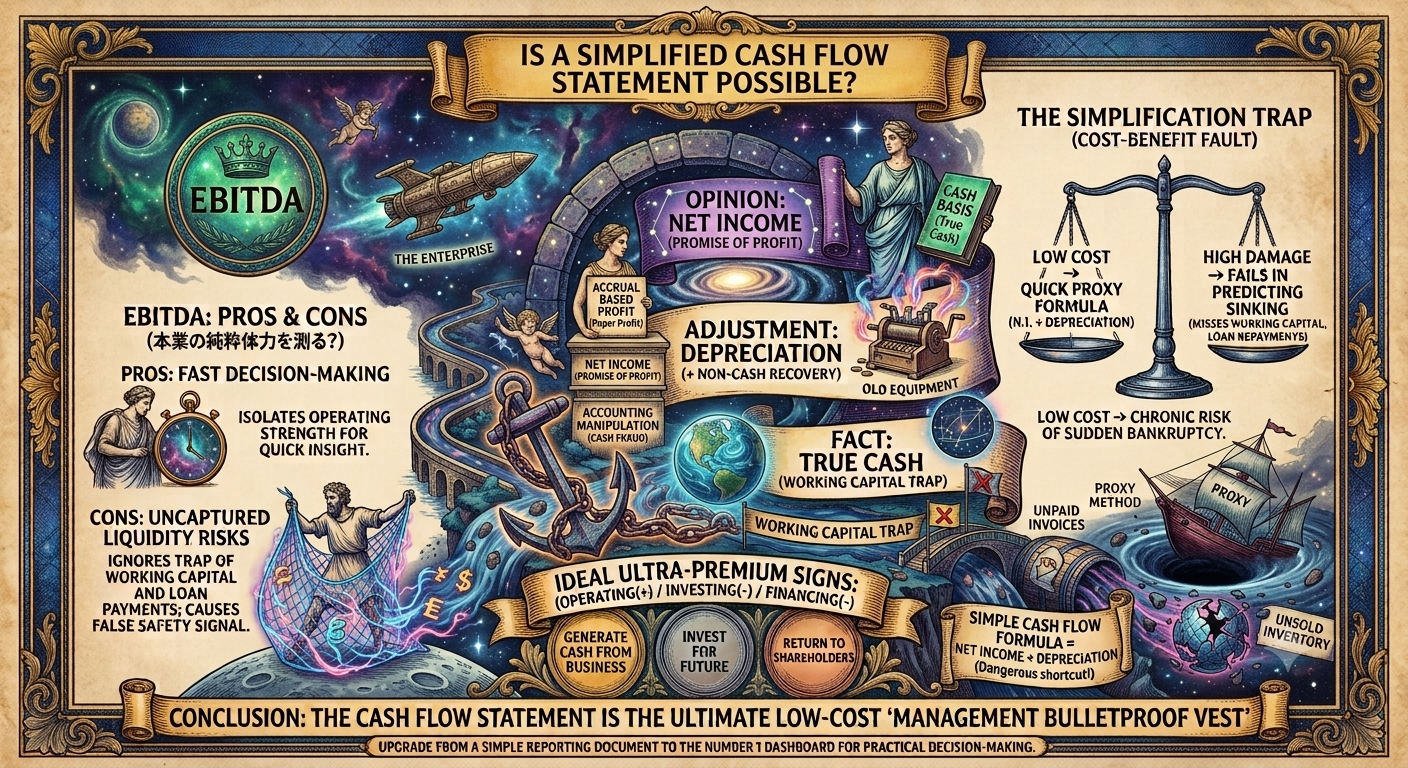
Using a simplified proxy—where management merely adds depreciation back to net income—offers the clear benefit of low administrative cost. Financial analysts can calculate this proxy figure in seconds using basic line items from the income statement.
However, the trade-off for this shortcut is severe financial blind spots that can quietly lead a company toward insolvency. This shortcut treats changes in working capital as non-existent factors.
For example, a company might aggressively push products to distributors on generous credit terms to inflate its reported revenues and net income. On paper, the business appears highly profitable. In reality, zero cash has entered the bank. If that company relies on a simplified cash flow formula, it will miss the fact that its liquidity is trapped in unpaid invoices.
This can lead to a sudden liquidity crisis where the firm cannot cover upcoming payroll or vendor obligations, risking a profitable bankruptcy. Furthermore, simplified calculations completely omit cash outflows for major capital expenditures or debt principal repayments, providing an artificial sense of financial security.
Strategic Conclusion: Trading a complete view of corporate liquidity for minor administrative time savings is an incredibly risky bargain. It exposes an enterprise to sudden liquidity shortages by ignoring working capital traps.
3. Practical Alternatives: The Pros and Cons of EBITDA
In corporate finance, the most common alternative to a full cash flow statement is EBITDA (Earnings Before Interest, Taxes, Depreciation, and Amortization).
EBITDA backs out depreciation, amortization, interest costs, and tax variables to isolate core operating performance. This allows management to evaluate the baseline cash-generating power of a business model, independent of its capital structure or local tax environments.
| Strategic Advantages (Pros) | Systemic Risks (Cons) |
| Isolates Core Operating Capacity: Eliminates external financing variables, interest structures, and tax jurisdictions to provide a clear view of the baseline business model’s cash generation power. | Omits Working Capital Traps: Like simpler add-back formulas, EBITDA fails to track cash tied up in slow-paying clients, delayed receivables, or aging warehouse inventory. |
| Accelerates Executive Decision-Making: Can be calculated in seconds directly from standard income statements, demanding minimal time or labor from corporate accounting teams. | Creates Risks of Financial Blind Spots: A company can report a highly attractive EBITDA while its actual cash flow plunges into negative territory due to growing operational shortfalls. |
4. Operational Solutions: Balancing Financial Speed with Rigorous Controls
To bridge the gap between finance teams managing complex reporting and executives requiring rapid data for decision-making, organizations can implement three structured operational approaches.
A. Deploying a Dual-Track Governance Dashboard
- Weekly and Monthly Sprints: For day-to-day operations where speed is critical, management can monitor shorthand metrics like EBITDA paired with operational indicators like Days Sales Outstanding (DSO) and Inventory Turnover Ratios. Tracking working capital efficiency alongside EBITDA helps mitigate the risks of simplified cash models.
- Quarterly and Annual Audits: During formal closing periods, financial teams must run full accounting reconciliations to build a formal cash flow statement. This comprehensive review verifies earnings quality and validates the assumptions used in monthly shortcuts.
B. Automating Cash Trackers Within Enterprise Resource Planning Systems
The primary cost of cash flow reporting comes from manual data entry and retroactive spreadsheet calculations. By investing in modern ERP modules that automatically map transactions to cash-basis codes at the point of invoice entry, companies can reduce reporting friction. While this requires an upfront capital investment, it delivers permanent benefits by providing leadership with real-time liquidity tracking and lower labor costs.
C. Mandating Free Cash Flow Metrics for Capital Budgeting
When evaluating new projects, facility expansions, or corporate acquisitions, corporate leaders should never rely on simplified proxies or standard income statements. Organizations must implement a formal process that projects incremental cash flows year by year while adjusting for sunk costs, ensuring that capital allocation decisions protect long-term financial health.
Conclusion: Key Takeaways
- Avoid Simplified Proxies: Simplified cash flow formulas offer low administrative costs but introduce severe corporate risks by ignoring critical adjustments like working capital fluctuations.
- Acknowledge EBITDA Limitations: Use EBITDA to evaluate baseline business model strength, but never treat it as a substitute for true cash flow, as it misses changes in collections and inventory.
- Implement Dual-Track Dashboards: Balance operational speed with financial safety by tracking EBITDA alongside DSO and inventory metrics for monthly reviews, backed by full cash flow statements each quarter.
- Automate Financial Infrastructure: Transition away from manual tracking by using automated ERP modules to capture cash movements in real time, reducing administrative costs while strengthening financial oversight.
AI Disclosure: The cost-benefit analyses, corporate finance frameworks, and liquidity risk strategies detailed in this guide were developed through a collaborative partnership with Google Gemini AI. The final manuscript was reviewed, adapted to standard North American treasury management terminology, and approved by the blog administrator.