
In the past, the accounting cycle was often viewed as a purely mechanical routine—a monotonous chore of collecting paper receipts, manually ledgering entries, and closing out the books at year-end. Today, however, the modern accounting cycle for financial reporting is fundamentally different. It operates as an intricate visualization process: filtering out valuable business signals from a massive sea of corporate data to construct transparent, actionable financial statements.
When navigating daily surges of cost records and transaction vouchers, modern businesses face a choice. They can drift aimlessly like a vessel tossed about by the waves, or they can step up as a skilled captain equipped with the precision clockwork and compass of a well-designed accounting cycle. Whether managing complex operations like healthcare administration or steering standard corporate enterprises, what matters most is acquiring the strategic insight required to refine raw data into an impeccable financial reporting system.
1. Understanding through an Everyday Analogy
The accounting cycle for financial reporting is remarkably similar to producing and screening a feature-length documentary film.
Imagine a film crew capturing every live event on set using video cameras (journalizing). That raw footage is then organized, tagged, and filed by scene, actor, or genre in an editing suite (posting). After careful cuts, color grading, and final adjustments, the finished film is projected onto the big screen for the public (financial statement preparation and reporting). In the same way, the accounting cycle synthesizes a full fiscal year of business activity into a unified, coherent story for the world to see.
Core Stages and Etymology Breakdown
- Journalizing (
Journalizing/Journal): Originating from the French word journal (daily record or diary), journalizing serves as the foundational groundwork for financial reporting. It involves analyzing every business transaction and splitting it into two balancing rooms—Debit (left side) and Credit (right side)—according to its economic nature, recording life’s daily business activities as they happen. - Posting (
Posting/General Ledger): Derived from placing or assigning items to designated stations. Posting takes entries recorded chronologically in the journal and transfers them directly to their specific home accounts in the general ledger. Much like a logistics courier sorting packages into designated delivery zones, posting moves data into distinct rooms such as the “Cash Room,” “Buildings Room,” or “Revenue Room.” - Closing (
Closing/Adjustments): Closing goes far beyond simply shutting the doors for the year. It signifies settling and bringing closure to the financial accounts for a specific period. It is a highly sophisticated refinement process in which unrecorded accrued expenses or prepaid revenues are precisely adjusted to extract an accurate, reportable financial score. - Financial Statements (
Financial Statements): Financial statements represent the ultimate destination of financial reporting. They form the comprehensive report card and health diagnostic document of a business, created through the synthesis of every bookkeeping and accounting entry.
2. Industry Deep Dive: Comparing Business Models
Different industries apply the accounting cycle to reflect their core operational models.
Manufacturing & Healthcare (Physical Resource-Centric Reporting)
- Examples: General Motors, Mayo Clinic
- Key Characteristics: These organizations manage substantial tangible inventories and physical assets—ranging from automotive parts and pharmaceutical supplies to capital-intensive equipment like MRI machines. Consequently, the accounting cycle places immense weight on complex cost accounting and depreciation adjustments. Even a minor variance in physical inventory can ripple through final financial reports, making conservative and precise month-end closes indispensable.
Technology & Entertainment (Intangible Asset-Centric Reporting)
- Examples: Microsoft, Netflix
- Key Characteristics: Rather than vast manufacturing facilities, these businesses center around software developer payroll, AI algorithm research, and intellectual property (IP) portfolios. Here, the critical judgment during the closing adjustment phase revolves around deciding which expenditures qualify as capital assets (e.g., capitalized development costs) versus immediate operating expenses on financial statements.
3. Demystifying the Cycle: First Half vs. Second Half
Rather than viewing the accounting cycle as one monolithic block, it is far more insightful to split it into two distinct halves: the Transaction Recording First Half and the Closing & Financial Reporting Second Half.
| Comparison Point | Daily Transaction Phase (First Half) | Period-End Closing & Reporting Phase (Second Half) |
| In Simple Terms | Documenting daily operational events as they happen | Aggregating annual data to build final financial reports |
| Core Function | Identifying transactions, recording journal entries, posting to ledgers | Preparing unadjusted trial balances, making adjusting entries, finalizing statements |
| Primary Actor | Automated accounting software and frontline staff | Professional accountants, controllers, and Chief Financial Officers (CFOs) |
| Key Objective | Accurate data capture without errors or omissions | Transforming raw data into reliable financial information for decision-makers |
| Timing & Frequency | Continuous, real-time occurrence as transactions take place | Concentrated at designated intervals (quarter-end, year-end) |
| Everyday Analogy | Saving receipt stubs and recording daily expenses in a logbook | Balancing your bank statement against monthly spending at month-end |
| The AI Era Evolution | Fully automated via AI and Optical Character Recognition (OCR) | Strategic interpretation and oversight of AI-generated closing data by human experts |
4. The Evolution of the Accounting Cycle: From Paper Ledgers to Real-Time Reporting
- The Classical Era (Manual Paper Ledgers): Accountants once painstakingly wrote debit and credit entries using fountain pens across massive physical leather-bound ledgers. A single transcription error during posting meant burning the midnight oil to locate the discrepancy and balance the ledger—a process heavily reliant on manual labor.
- The Modern Era (Computerized Accounting & ERP Systems): The advent of software changed everything. Once a practitioner entered a journal entry, the system automatically executed posting and trial balance generation. Error rates dropped drastically, while reporting turnaround times accelerated.
- The Contemporary & Future Era (AI-Powered Real-Time Reporting): Today, artificial intelligence reads optical image receipts and processing systems can ingest healthcare or sales data, recognizing transactions and generating ledger posts automatically without human intervention. The accounting cycle is shifting away from a once-a-year closing door toward a continuous, real-time financial reporting dashboard. Humans now focus on analyzing financial statements and communicating strategic insights to investors.
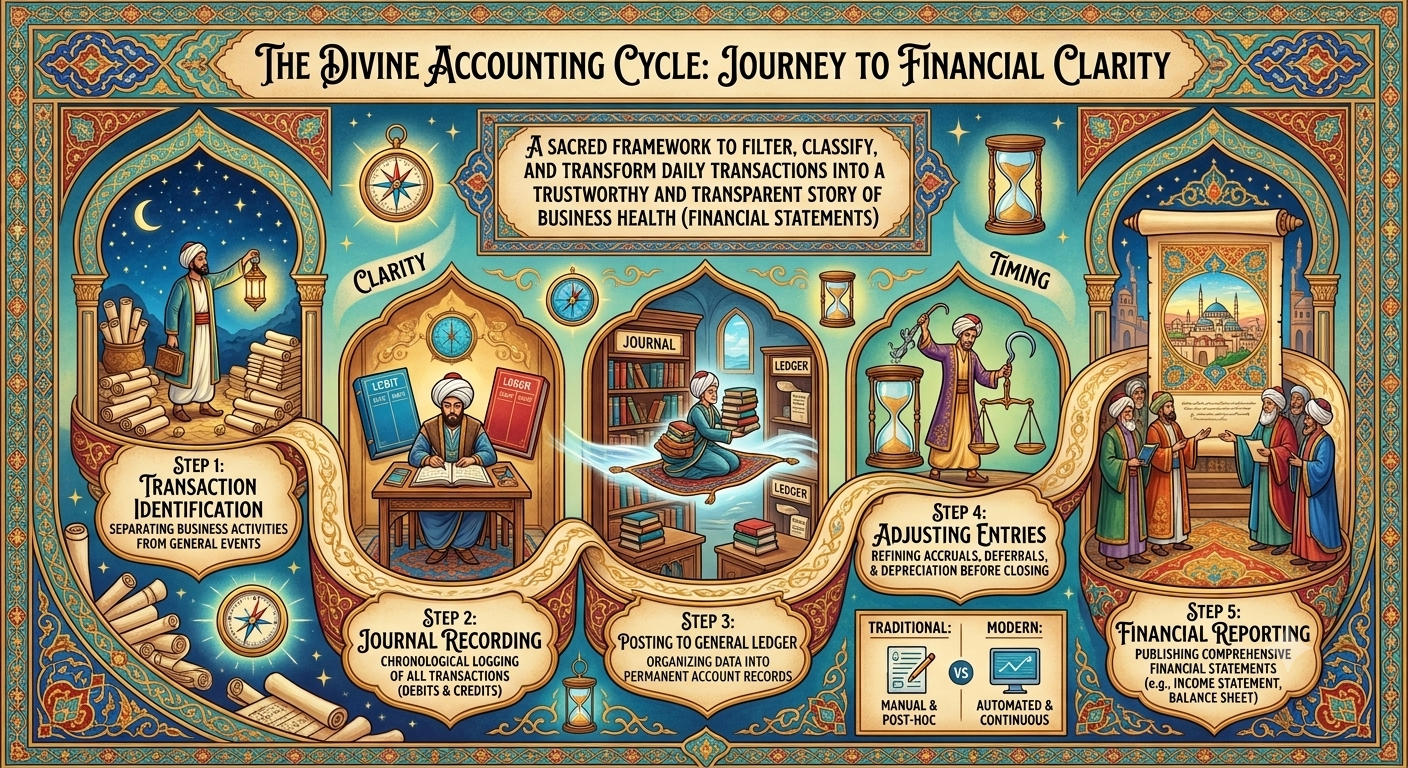
5. The 5 Core Stages of the Accounting Cycle
- Transaction Identification: The initial filtering stage. A factory fire damaging physical inventory qualifies as an accounting transaction, whereas signing an employment contract with a talented candidate does not immediately trigger a financial entry because no money or asset has exchanged hands.
- Journalizing: Recording identified transactions using double-entry bookkeeping, balancing cause and effect between Debit (left) and Credit (right) entries.
- Posting to General Ledger: Transferring organized entries from chronological journal logs to dedicated account categories like Cash, Revenue, or Operating Expense.
- Adjusting Entries (Closing Adjustments): Stripping away distortions to ensure reporting integrity. This step accounts for accrued interest expenses not yet paid out or records depreciation on aging machinery.
- Financial Statement Preparation & Reporting: Compiling final numbers into standardized reporting packages—such as the Balance Sheet and Income Statement—and presenting them to external stakeholders, investors, and regulatory bodies.
6. Key Advantages vs. Limitations in Financial Reporting
Advantages
- Self-Balancing Reliability: The structured, repetitive cycle incorporates built-in checks and balances to catch mathematical and procedural errors.
- Misrepresentation Control: Systematic journalizing and posting ensure that every recorded financial outcome links directly to a verifiable cause.
- Stakeholder Transparency: Regular closing periods supply investors and financial institutions with dependable, standardized performance metrics.
- Digital Integration: Standardized rules make the accounting cycle ideal for automation through AI-driven continuous accounting platforms.
Limitations
- Procedural Rigidity: Structured accounting routines can sometimes struggle to capture rapidly evolving business models instantly.
- Risk of Delayed Adjustments: Potential risks exist if closing adjustments are intentionally delayed or subjected to earnings management techniques.
- Historical Nature: Because reports reflect past periods, financial statements do not always showcase emerging real-time operational risks instantly.
- Setup Costs: Transitioning to advanced ERP architectures requires upfront investment, and bad source data can still distort output quality.
7. The Core Definition and Value of Modern Financial Reporting
At its heart, the modern accounting cycle for financial reporting can be defined as follows:
A dynamic, systemic framework that captures a company’s daily economic events, categorizes and summarizes them according to established standards, adjusts period-end financial balances with precision, and communicates meaningful financial and non-financial information to external stakeholders in near real-time.
1) Self-Balancing Verification
The accounting cycle derives its power from double-entry bookkeeping. Because total debits must equal total credits, any discrepancy instantly triggers warnings during trial balance checks. It acts as an automated self-correcting engine that builds market trust.
2) Universal Business Language
Financial statements generated by this cycle serve as a standardized global language. Regardless of geography or sector, investors and institutions rely on these unified metrics to allocate capital efficiently.
3) Promoting Transparent Capital Allocation
By guaranteeing accurate, audited disclosure, the accounting cycle reduces market uncertainty, facilitating the flow of capital toward well-managed, sustainable enterprises.
8. Emerging Trends in Modern Financial Reporting
- Continuous Reporting: Thanks to integrated ERP systems and AI models, companies are moving away from traditional quarter-end waiting periods in favor of daily automated trial balances and real-time management dashboards.
- ESG & Non-Financial Integration: Modern financial reporting increasingly integrates non-financial metrics—such as carbon footprint data, human capital governance, and sustainability indicators—directly alongside traditional balance sheets.
Conclusion: Key Takeaways
- Core Essence: The accounting cycle for financial reporting is not just routine record-keeping. It is a systematic process that transforms raw operational data into trustworthy financial statements via Journalizing, Posting, Adjusting, and Reporting.
- Built-in Systemic Integrity: Powered by double-entry bookkeeping principles, the cycle features automated self-balancing checks that catch inaccuracies before financial reports reach the public.
- Strategic Evolution: As AI automates manual transactional recording, the cycle transitions toward continuous reporting. Accounting professionals now focus on interpreting strategic metrics, managing risk, and telling the broader story behind the numbers.
* AI Disclosure: Created in collaboration with Google Gemini. All core content was authored, reviewed, and edited by the author.