
Every administrative effort surrounding bad debt allowances and bad debt write-offs originates from a single, fundamental accounting query: “At what precise point in time should we record sales revenue and bad debt expenses to render the most honest and accurate picture of a corporation’s financial health?”
Welcome to the foundational bedrock of accrual accounting: the Revenue Recognition Principle and the Matching Principle. These two concepts govern how top-line growth and operating costs interact on the income statement, transforming raw cash transactions into actionable corporate metrics.
1. Everyday Analogies: The Essence of Revenue and Expense Recognition
To grasp these accounting pillars, consider a simplified restaurant scenario:
Imagine a local diner receiving a corporate catering order for 10 meal combos. The kitchen prepares the meals and delivers them safely to the client’s office, handing over a $200 invoice payable in 30 days.
- Revenue Recognition (When do we record earnings?): Even though zero cash has entered the cash register today, the diner fulfilled its core obligation by delivering the food. Under accrual accounting principles, the diner records $200 in sales revenue today. The right to receive payment has been earned through complete performance, giving rise to an account receivable.
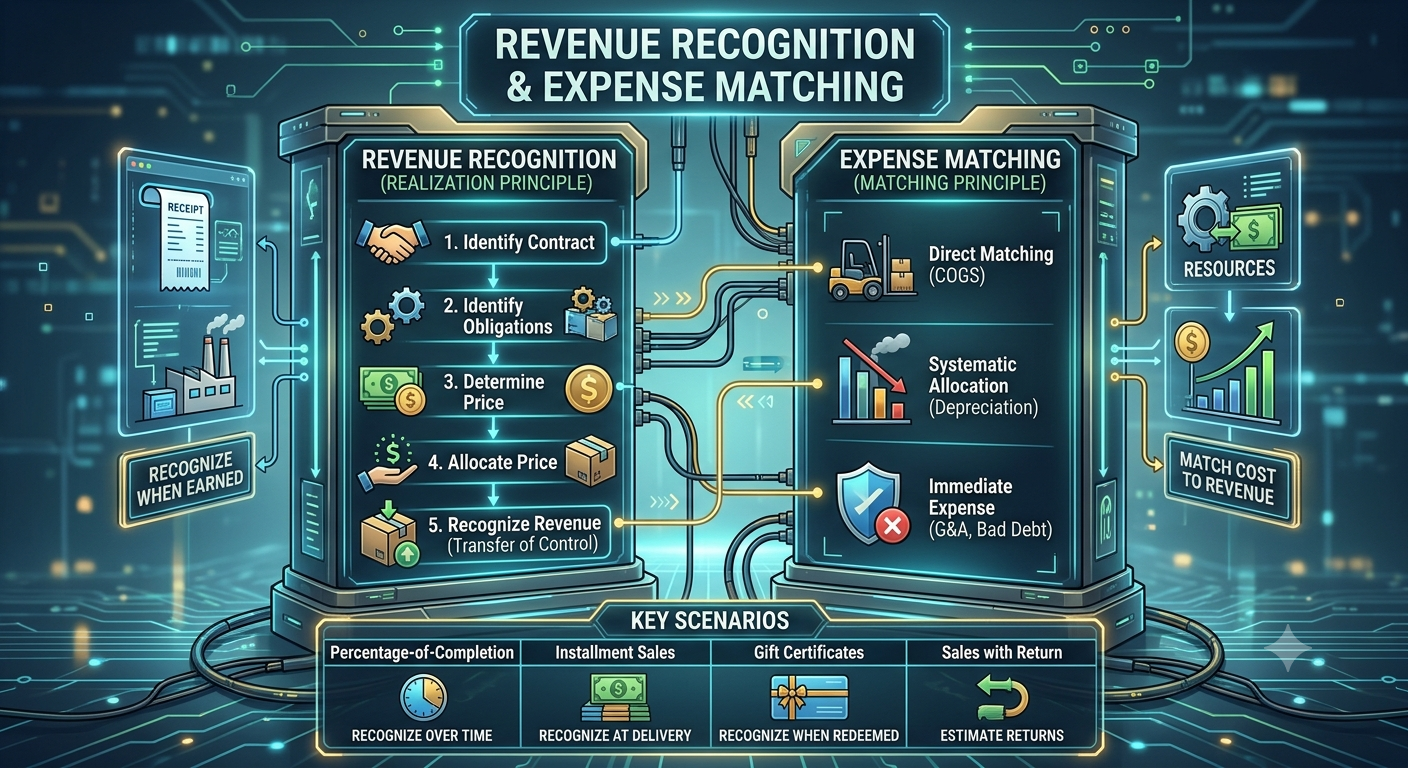
- Expense Recognition (When do we record costs?): The diner purchased raw ingredients (chicken, oil, spices) worth $70 earlier in the week. That $70 is not recognized as an operating expense on the day of purchase; instead, it sits in inventory. It is recognized as Cost of Goods Sold (COGS) on the exact day the corresponding $200 revenue is recorded. This systematic pairing of revenues with associated costs is known as the Matching Principle.
2. The Universal 5-Step Model for Revenue Recognition
Under modern frameworks—specifically IFRS 15 and ASC 606 under US GAAP—regulatory bodies established a standardized 5-step model to prevent premature revenue recognition and aggressive earnings management.
Step 1: Identify the Contract with a Customer
An enforceable agreement (written, oral, or implied by customary business practices) must exist, establishing legal rights, payment terms, and commercial substance.
Step 2: Identify Distinct Performance Obligations
The contract must be broken down into explicit promises to transfer distinct goods or services (e.g., selling hardware versus providing ongoing technical support).
Step 3: Determine the Transaction Price
Management must calculate the net consideration expected in exchange for goods or services, accounting for variable elements such as volume rebates, early-payment discounts, and potential return allowances.
Step 4: Allocate the Transaction Price
If a transaction bundled hardware and a two-year service subscription, the total contract value must be allocated across each distinct performance obligation based on their standalone selling prices.
Step 5: Recognize Revenue Upon Transfer of Control
Revenue is booked only when control of the asset or service transfers to the customer—either over time (e.g., subscription services) or at a point in time (e.g., physical delivery).
3. Specialized Revenue Recognition Scenarios in Practice
Modern commerce introduces complex transactional structures that test the boundaries of point-in-time recognition:
- Percentage-of-Completion (Long-Term Construction and Defense): Waiting three years until a high-rise building is fully constructed to record revenue creates severely distorted annual financial reporting. Instead, firms recognize revenue incrementally based on the percentage of completion, typically measured by total costs incurred relative to estimated total project costs.
- Installment Sales: When heavy machinery is sold under a 36-month payment plan, revenue is recognized in full upon delivery and transfer of control. Uncollected balances are booked as accounts receivable, which then trigger bad debt estimation models.
- Gift Cards and Unearned Revenue: Receiving cash from a gift card sale does not constitute earned revenue. The cash influx is offset by a liability account known as unearned (or deferred) revenue. Revenue is recognized only when the customer redeems the gift card for actual merchandise.
- Sales with a Right of Return: E-commerce models offering money-back guarantees cannot recognize 100% of gross sales immediately if significant returns are anticipated. Revenue is recognized net of estimated return reserves based on historical statistical estimates.
4. The Dual Matrix: Revenue vs. Expense Recognition
Revenue and expenses represent two sides of the same financial ledger. Accounting standards link these metrics to reflect a firm’s true operating margin:
5. Strategic Considerations for Executives and Investors
I. Investors: Watch for Revenue Policy Shifts and Accounts Receivable Bulges
A classic red flag in corporate reporting involves booking future revenue prematurely to inflate short-term earnings. Investors should examine sudden policy switches—such as moving from delivery-based recognition to percentage-of-completion—or situations where revenue surges while cash flow from operations declines alongside ballooning accounts receivable. Firms may push channel-stuffing practices to artificially boost top-line numbers, only to write off those balances as bad debt in subsequent reporting periods.
II. Managers: Balancing Conservatism and Tax Exposure
Chief Financial Officers must maintain prudence in timing revenue recognition. Recognizing revenue aggressively inflates paper profits but creates immediate tax liabilities on uncollected receivables, straining cash flow. For platform and SaaS enterprises, distinguishing between gross revenue reporting (acting as a principal) and net revenue reporting (acting as an agent) dramatically alters reported revenue scale. Preemptively reviewing these structures with external auditors helps mitigate compliance and reporting risks.
Conclusion: Key Takeaways
- Realization & Control: Revenue is recorded when performance obligations are satisfied and control passes to the customer, not merely when cash changes hands.
- The Matching Mandate: Expenses must be systematically paired with the specific revenues they helped generate within the same reporting period.
- Prudent Corporate Governance: Maintaining conservative revenue recognition policies protects corporate cash flows from premature tax burdens and preserves long-term financial integrity.
AI Disclosure: This article was drafted, translated, and refined in collaboration with Google Gemini AI technology. Technical structure and accounting principles were curated and validated under expert human oversight.