
Greetings! In our previous post, we explored discounting accounts receivable and notes receivable to accelerate corporate liquidity. Today, we turn our focus to the darkest corner of the balance sheet: default on commercial credit, commonly referred to as bad debt.
A corporation can easily record millions in revenue on its income statement while facing insolvency because cash never reaches its bank accounts—a crisis known as profitable bankruptcy. To prevent such disasters, financial accounting and corporate management rely on a systematic framework to manage uncollectible receivables. This comprehensive guide covers everything from establishing an allowance for doubtful accounts to determining the precise timing of write-offs and recording unexpected bad debt recoveries.
1. Everyday Analogies: Understanding the Core Life Cycle of Bad Debt
To understand how accounting handles defaulted credit, consider a simple personal lending scenario:
Imagine you lend $100 to each of 10 close acquaintances, totaling $1,000. In corporate finance, this corresponds to issuing trade credit, creating accounts receivable.
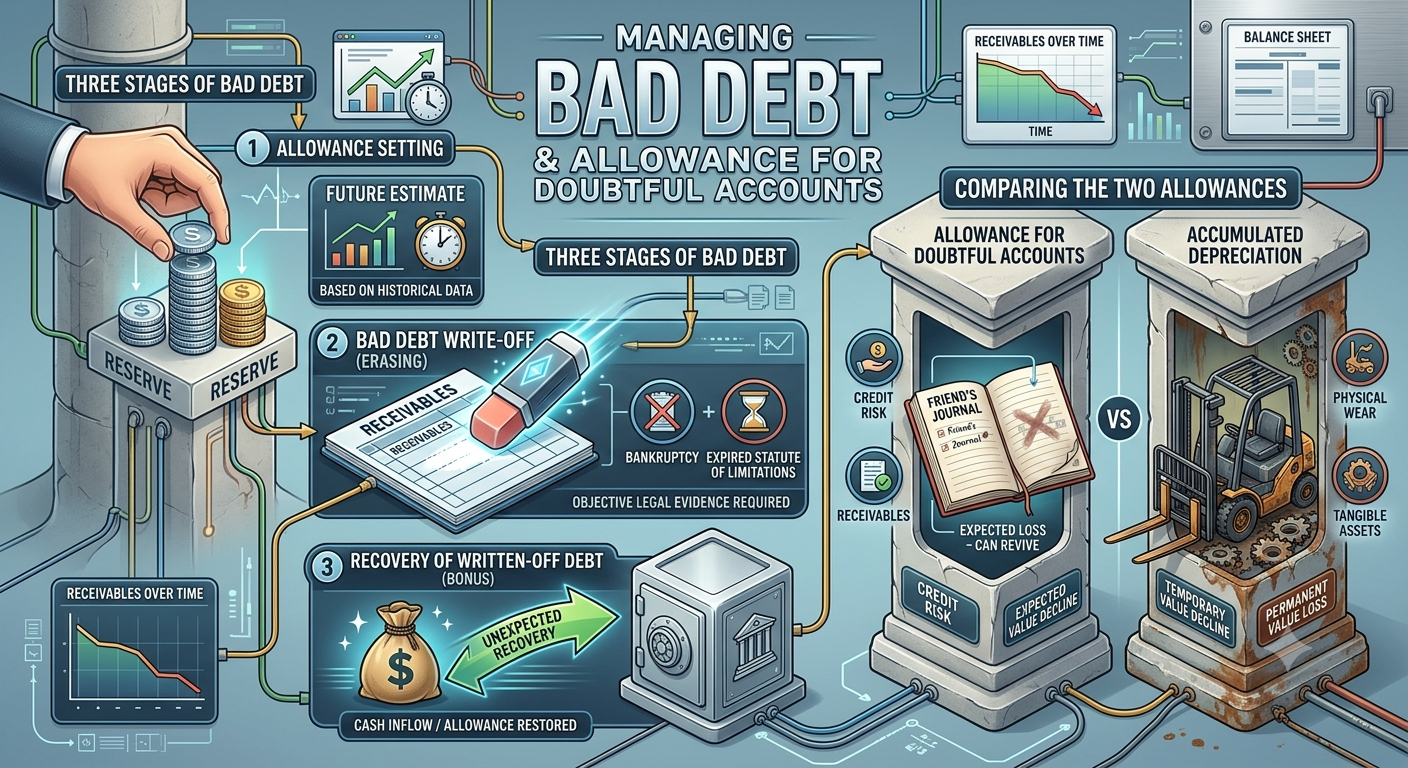
- Allowance for Doubtful Accounts (Mental Preparation): Upon lending the money, you reason, “Based on past experience, at least one person might run into financial trouble and fail to pay me back. I should prepare mentally for a $100 loss.” By anticipating this uncollectible amount, you apply a realistic filter to your asset expectations. In accounting, this reserve is known as the Allowance for Doubtful Accounts.
- Bad Debt Write-Off (Removing from the Ledger): Months later, one acquaintance cuts off all communication and files for personal bankruptcy. Hope of recovery vanishes completely. You grab a permanent marker and cross that person’s name and $100 balance off your personal record. Confirming that the money is permanently lost and removing the asset from your balance sheet is called a Write-off.
- Recovery of Written-Off Debt (The Miraculous Comeback): Three years later, that person turns their life around, calls you back, and hands you $100 in cash to clear their conscience! Because you wrote off this balance years ago, receiving actual cash creates an unexpected windfall. Corporate books record this event as a Recovery of Bad Debt, replenishing the corporate cash pool.
2. Determining the Timing: Subjective Estimates vs. Objective Proof
A recurring debate between executive leadership and financial auditors centers on the timing of bad debt recognition: Should write-offs be governed by management’s subjective judgment or strict objective benchmarks?
Financial accounting standards balance these needs: Establishing allowances permits reasonable subjective estimates, whereas removing a receivable through a write-off demands verifiable objective evidence.
Stage 1: Setting the Allowance (Subjective & Forward-Looking)
Management predicts what percentage of current receivables will default over the coming year. CFOs evaluate historical loss rates, customer credit risk profiles, and macroeconomic conditions to calculate an estimate. While this process involves managerial judgment, executives must provide auditors with statistically sound methodologies under standards such as the Current Expected Credit Losses (CECL) model under US GAAP.
Stage 2: Executing the Write-Off (Strictly Objective)
Removing a receivable entirely from the balance sheet cannot rest solely on executive discretion. If subjective write-offs were permitted, companies might artificially erase healthy receivables to inflate bad debt expenses and reduce corporate income tax liabilities. Consequently, tax authorities and accounting regulators permit write-offs only when objective, legally verifiable trigger events occur:
- Expiration of Legal Rights: Expiration of the statute of limitations governing commercial claims or negotiable instruments.
- Debtor Inability to Pay: Formal court discharge of bankruptcy, execution of liquidation orders, or official confirmation that the debtor possesses no attachable assets.
- Objective Time Elapsed: Bounced checks or defaulted trade notes remaining uncollected for more than six months without collateral backing.
3. Allowance for Doubtful Accounts vs. Accumulated Depreciation
Financial statements feature two prominent contra-asset accounts that reduce reported asset values: Allowance for Doubtful Accounts and Accumulated Depreciation. While both sit beneath their respective primary asset accounts on the balance sheet, they operate under distinct financial concepts:
Everyday Comparison
- Allowance for Doubtful Accounts: You lend $100 to a friend and set aside $20 mentally because you suspect they might default. If your friend pays, that $20 value fully recovers.
- Accumulated Depreciation: You purchase a smartphone for $1,000. You log $200 in value loss each year due to battery degradation and hardware wear. Regardless of handling, modern technological advancement causes its functional market value to decline over time.
4. Accounting Entries Across the Bad Debt Life Cycle
To understand how uncollectible accounts move through corporate books, consider a three-stage journalizing process:
Stage 1: Estimating Bad Debt at Period-End
- Scenario: At year-end, a firm holds $1,000,000 in outstanding accounts receivable and estimates that 2% ($20,000) will prove uncollectible.
- Journal Entry:(Debit) Bad Debt Expense $20,000(Credit) Allowance for Doubtful Accounts $20,000
- Financial Impact: Operating expenses increase, reducing net income for the current period. Concurrently, the contra-asset account increases, lowering the net realizable value of accounts receivable.
Stage 2: Confirming an Actual Write-Off
- Scenario: A client officially declares bankruptcy, confirming that a $15,000 receivable cannot be collected.
- Journal Entry:(Debit) Allowance for Doubtful Accounts $15,000(Credit) Accounts Receivable $15,000
- Financial Impact: Because the loss was anticipated in Stage 1, writing off the asset against the existing allowance produces zero impact on net income in the period the write-off occurs.
Stage 3: Recovering Previously Written-Off Debt
- Scenario: Three years later, the bankrupt client settles its prior debt, remitting $15,000 via direct bank wire.
- Journal Entry:(Debit) Cash (or Bank Account) $15,000(Credit) Allowance for Doubtful Accounts $15,000
- Financial Impact: Real cash assets increase, and the depleted allowance account is restored. During year-end adjustments, excess allowances are credited back as a reversal of bad debt expense or non-operating income, enhancing corporate profitability.
5. Strategic Insights for CFOs and Investors
I. Investors: Allowance Ratios as Indicators of Reporting Integrity
When executive teams face pressure to inflate short-term operating profits, reducing bad debt allowance percentages offers an easy temptation. If accounts receivable surge year-over-year while the allowance percentage drops without operational justification, investors should exercise caution. Such moves artificially suppress current expenses to mask deteriorating asset quality. Investors should inspect accounts receivable aging schedules in financial statement footnotes to verify whether overdue balances are accumulating.
II. Corporate Executives: Managing Credit Risk and Capital Allocation
Bad debt management serves as a vital diagnostic tool:
- Bad Debt Allowances Signal Credit Risk: A sudden spike in required allowances indicates rising credit risk across your customer base. CFOs must tighten customer credit limits and coordinate with sales leadership to prevent unvetted credit expansion.
- Accumulated Depreciation Signals CAPEX Timing: When accumulated depreciation approaches 80% to 90% of the historical cost of tangible assets, production equipment is approaching the end of its useful life. Financial executives must anticipate upcoming capital expenditures and secure necessary financing ahead of time.
- Documenting Legitimate Write-Offs: When write-offs occur, finance teams must archive bankruptcy filings, court distribution schedules, and official notices to substantiate tax deductions during corporate tax audits.
Conclusion: Key Takeaways
- Two-Step Defense: Corporate finance uses period-end estimations to record expenses and objective legal benchmarks to execute asset write-offs.
- Preserving Income Stability: Pre-funding uncollectible receivables through allowance accounts shields net income from sudden shocks when actual defaults occur.
- Balance Sheet Vigilance: Monitoring receivable aging schedules and allowance percentages provides essential visibility into underlying corporate liquidity and reporting honesty.
AI Disclosure: This article was created, translated, and edited in collaboration with Google Gemini AI technology. Technical accounting structures and principles were verified and finalized under expert human supervision.