
In the past, artificial intelligence was like a stubborn student: once it finished its initial studies, it had to relearn everything from scratch just to incorporate new information. Today, however, AI has evolved into a far more flexible learner. If it encounters something it doesn’t know, it can look it up in a virtual library or receive intense, specialized tutoring to become an expert in a specific field.
At the heart of this transformation are two critical technologies: RAG (Retrieval-Augmented Generation), which allows the AI to reference external information in real-time, and Fine-tuning, which deeply trains the AI itself for a specific purpose. Think of the difference between a student taking a “textbook” or encyclopedia into an exam to find answers (RAG) and a student who memorizes the entire exam scope to become a localized “expert” (Fine-tuning). We now live in an era where we must wisely select the optimal study method for our specific goals, rather than simply relying on general AI intelligence.
1. Textbook Study vs. Specialized Tutoring: Different Methods for Different Goals
When we ask an AI about the latest news or a company’s internal confidential documents, the AI prepares its answer using one of two methods. As of 2026, many enterprises and developers are strategically deploying these two technologies in the right places to create more accurate and relevant AI services.
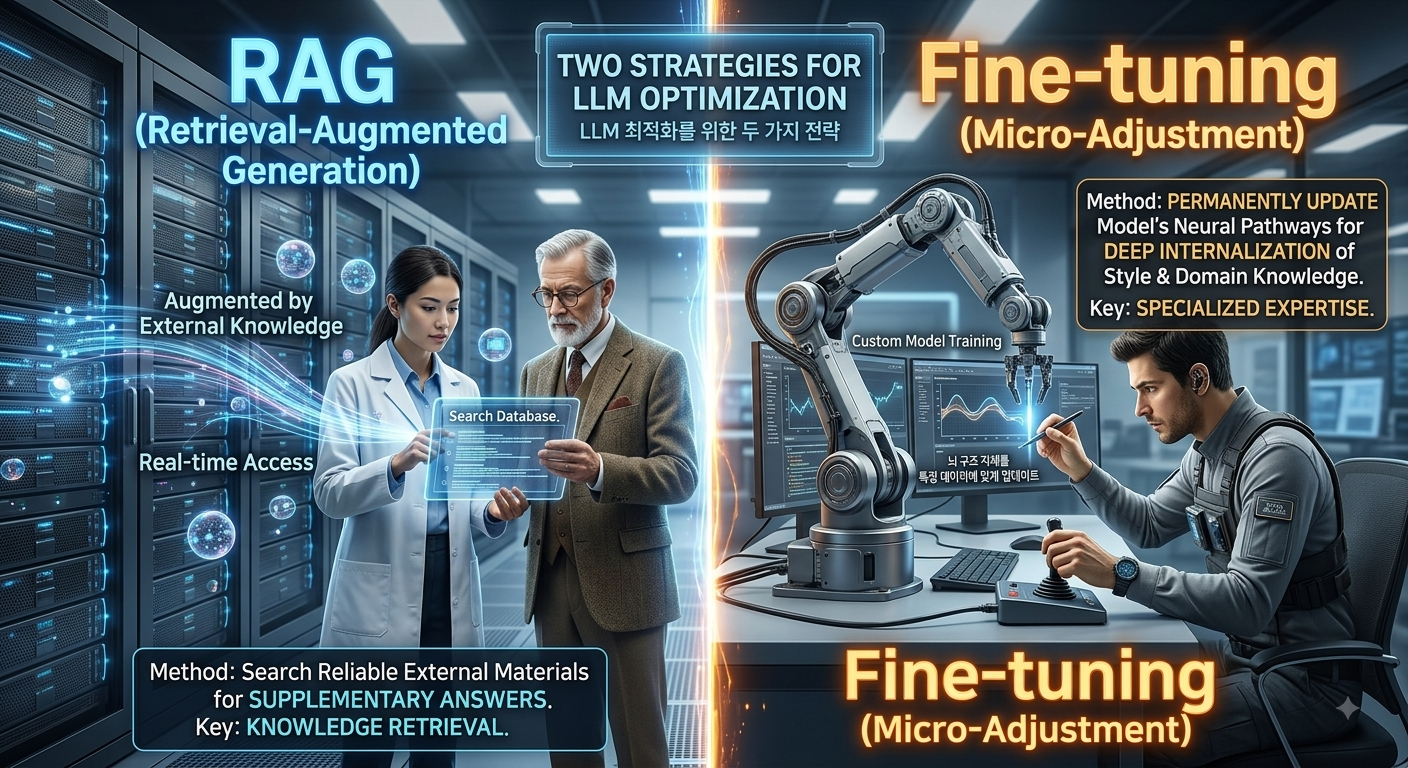
Why is it crucial to distinguish between RAG and Fine-tuning? RAG is a method where, when the AI doesn’t know something, it supplementarily references reliable external materials via retrieval before generating an answer.
Conversely, Fine-tuning is a method that updates the AI’s internal brain structure itself to match specific data, fully internalizing a particular tone, style, or domain-specific expertise. To use a cooking analogy, RAG is like receiving a custom order for a new dish and opening a “recipe book” to cook it step-by-step, while Fine-tuning is like repeatedly practicing only that one specific dish for months to become a “master” of that exact culinary style.
2. Understanding through Everyday Analogies
1) Unpacking the Terms: RAG vs. Fine-tuning
Let’s break down the definitions to clearly grasp these concepts.
- RAG (Retrieval-Augmented Generation):
- Retrieval: The act of searching for and finding necessary information.
- Augmented: Meaning original capability has been enhanced by the found information.
- Generation: Refers to creating the final answer.
- Overall Meaning: A process where, upon receiving a question, relevant documents are first retrieved, and then utilized as a reference to generate the response. Think of it as an “open-book exam.”
- Fine-tuning:
- Fine: Meaning precise and highly detailed.
- Tuning: The act of adjusting a machine or instrument optimally.
- Overall Meaning: A “specialist training” method that refines an already smart, general AI model into a more sophisticated expert using data from a specific domain (e.g., legal or medical).
2) RAG = ‘A Genius Aided by a Librarian’
- The Approach: A genius model with strong core reasoning but lacking recent knowledge utilizes a handy “recent magazine” or “encyclopedia” (external database) to answer.
- The Characteristics: You can instantly write down yesterday’s news or a secret family story on a piece of paper (provide it as data), and the AI will answer correctly. A major advantage is that the answer has clear ground-truth justification.
3) Fine-tuning = ‘A Specialist with Specialized Education’
- The Approach: This is akin to a college student with rich general knowledge who then focuses intensely on “accounting” for a year to become a dedicated accounting AI expert.
- The Characteristics: This AI doesn’t need to look things up; its domain-specific “tone” and “knowledge” are ingrained. This is highly advantageous when you need the AI to perfectly mimic a specific company’s brand voice or a seasoned customer service agent.
3. “Real-Time Information is Vital; Which Method Should I Use?”
This is the most crucial criterion for selection! If we want to deal with rapidly changing data like daily stock market fluctuations or real-time real estate listings, the answer is clear.
- RAG (Knowledge Retrieval Style): If information changes continuously, you must use RAG. Fine-tuning takes a long time to learn new data; by the time the specialized tutoring is finished, that information has already become “old news.”
- Fine-tuning (Re-training Style): Use this when “how you say it” is more important than “the content” itself. For example, to make the AI use a specific brand image’s “gentle tone,” specialized tutoring (Fine-tuning) is necessary.
4. What Happens If You Lacked One Method?
To truly appreciate their value, let’s imagine a situation where only one exists.
- If You Only Have RAG and No Fine-tuning: You will have an AI that knows many facts but is awkward in its “tone and style.” It can answer questions based on the encyclopedia, but it will face limits in naturally utilizing professional legal terminology or mimicking the calm tone of a medical doctor.
- If You Only Have Fine-tuning and No RAG: You get an AI with a specialized tone but outdated “latest knowledge.” It perfectly executes professional accounting jargon, but dangerously explains old laws as if they are current if asked about yesterday’s legal amendments.
5. Deployment Strategies: ‘Smart Selection Criteria’
When utilizing AI for North American business operations, content creation, or financial strategy, keep the following criteria in mind.
- If Freshness is Crucial, Use RAG: To post the latest IT trends, RAG is vastly superior because it can rapidly ingest the latest news from reliable technical textbooks and blogs.
- If a Unique Style is Crucial, Use Fine-tuning: To emphasize a unique writing style, corporate-specific sentiment, or deep expertise, you must train the general model on your specific internal data.
- The Hybrid Approach is King: Today, the most preferred method is a hybrid strategy: fine-tuning the general tone and structure of the model, and then populating its specific knowledge base using RAG.
6. At a Glance! Side-by-Side Comparison
| Category | RAG (Retrieval-Augmented Generation) | Fine-tuning (Micro-Adjustment) |
| Core Principle | Searching & retrieving external knowledge in real-time | Permanently updating internal neural pathways with custom data |
| Everyday Analogy | Open-book exam (Genius with a library card) | Intense, specialized tutoring (Executive master chef) |
| Knowledge Freshness | Instant access to real-time & dynamic data | Static knowledge tied to the training cutoff date |
| Tone & Style | Limited (Relies heavily on prompt engineering) | Exceptional (Deeply internalizes brand voice & jargon) |
| Key Advantage | Fast reflection of new facts; low hallucination risk | High domain specialization; streamlined operational prompts |
| Key Disadvantage | Requires complex database setup & retrieval architecture | High computational cost; expensive & slow to update |
| Primary Use Cases | Latest news search, internal document Q&A, FAQs | Custom support agents, specialized code/legal/medical bots |
7. Key Underlying Technologies and Corporations
- Pinecone, LangChain: These are critical foundational tools for storing and connecting data when implementing RAG systems.
- OpenAI, Hugging Face: Platforms that allow you to take existing models and easily fine-tune them with your own specific datasets.
Conclusion: Key Takeaways
The choice between RAG and Fine-tuning is ultimately a strategic decision centered on information freshness versus ingrained expertise. If your corporate AI needs to remain agile and reference up-to-the-minute market data, RAG is the essential knowledge retrieval architecture.
If you are building a specific brand identity or a deep domain expert, fine-tuning provides the specialized tutoring needed to perfect its voice. The most effective corporate strategies will move beyond a single-method approach and instead build hybrid models, leveraging the foundational structure of fine-tuning for brand alignment and the agile knowledge access of RAG for real-world accuracy.
※ Images and some descriptions in this posting were produced in collaboration with Google Gemini AI, and the author personally created, reviewed, revised, and edited the content for final completion.