
The architecture of modern computing is undergoing a seismic shift. If traditional processors were once built to follow step-by-step instructions like a rigid digital accountant, today’s AI-driven silicon operates much more like a synthetic human brain. To process billions of parameters and make instantaneous decisions, artificial intelligence demands specialized silicon that can handle overwhelming mathematical workloads.
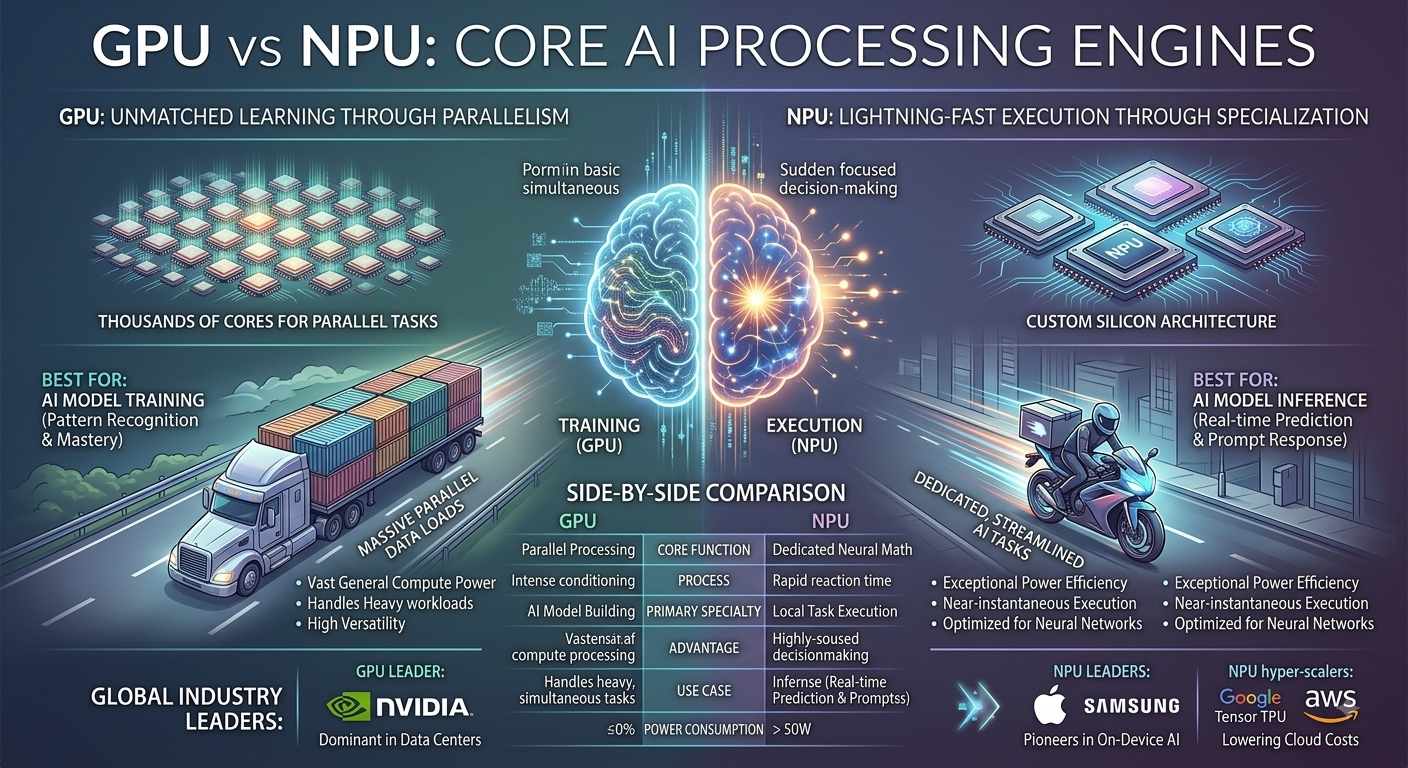
At the heart of this hardware evolution are two distinct compute powerhouses: the Graphics Processing Unit (GPU) and the Neural Processing Unit (NPU). While both are essential to the broader AI ecosystem, they serve entirely different masters within the hardware matrix. Think of a GPU as a heavy-duty semi-truck built to haul massive, complex loads across vast distances, whereas an NPU is an agile delivery motorcycle designed to zip through city streets quickly on a set, repeated route. Today, we will break down how these two processing engines differ and why both are crucial for the future of artificial intelligence.
1. Training Engine vs. Inference Engine: The Dynamic Duo of AI
To understand these processors, we must first look at the two distinct operational stages of any AI model:
- Training (Learning Stage): Feeding massive datasets into a model so it can recognize patterns, build associations, and master concepts.
- Inference (Execution Stage): Utilizing that trained knowledge to answer prompts, translate languages, or generate images in real time.
Why do we need two separate processors for these tasks?
While GPUs were originally designed to render complex 3D graphics for video games, engineers discovered that their ability to perform thousands of simple calculations simultaneously makes them ideal for the massive compute requirements of AI training.
Conversely, the NPU is a custom-tailored processor optimized exclusively for AI calculations. It excels at inference—delivering near-instantaneous responses while consuming minimal battery power, making it the ideal engine for consumer mobile devices like smartphones and laptops.
Using a sports analogy, a GPU is like the intense, exhaustive off-season conditioning program where an athlete builds endurance and learns complex strategies. An NPU, on the other hand, is the lightning-fast reaction time the player displays on the field during a live championship game, executing pre-learned plays instantly without hesitation.
2. Understanding through Relatable Everyday Analogies
1) Unpacking the Terminology
- GPU (Graphics Processing Unit):
- Graphics: Refers to rendering images, visual effects, and video frames.
- Processing Unit: The hardware responsible for running calculations and moving data.
- Core Concept: A versatile computational powerhouse consisting of thousands of small processing cores working in parallel to process massive amounts of data simultaneously. Prominent market examples include the NVIDIA H100, H200, and consumer GPUs like the RTX 4090.
- NPU (Neural Processing Unit):
- Neural: Refers to architecture inspired by the neural pathways of the human brain.
- Processing Unit: The dedicated silicon chip executing AI algorithms.
- Core Concept: A specialized AI assistant designed specifically to run neural networks as efficiently and rapidly as possible. Examples include the Neural Engine found in Apple’s A-series and M-series chips or the dedicated NPUs integrated into Snapdragon processors.
2) GPU = ‘A Team of One Thousand Elementary Students’
- The Approach: Instead of tackling one extraordinarily complex calculus problem sequentially, this team solves one thousand basic addition problems all at the exact same moment.
- Key Strength: It excels at massive parallel workload processing, which is required when rendering 3D graphics or training multi-billion parameter AI models.
3) NPU = ‘A Highly Trained Executive Chef’
- The Approach: A specialized chef focuses exclusively on perfecting a single signature dish using the most efficient, streamlined technique possible.
- Key Strength: While it lacks general-purpose flexibility, it produces immediate AI outputs while consuming significantly less energy than a GPU.
3. On-Device AI: Is There an NPU Inside Your Smartphone?
If you own a recent flagship smartphone, you are likely utilizing an NPU every single day without realizing it.
- On-Device AI Capabilities: Features like instant photo background removal, real-time voice translation during phone calls, and local text summarization run directly on your device without needing an active internet connection. These workloads are handled almost entirely by the NPU.
- Unmatched Power Efficiency: Running complex generative AI tasks solely on a mobile GPU would drain a smartphone battery within minutes and cause the hardware to overheat. The NPU solves this bottleneck by providing dedicated compute power at a fraction of the wattage, making local AI feasible for everyday handheld devices.
4. Side-by-Side Comparison: GPU vs. NPU
The architecture of modern computing is undergoing a seismic shift. If traditional processors were once built to follow step-by-step instructions like a rigid digital accountant, today’s AI-driven silicon operates much more like a synthetic human brain. To process billions of parameters and make instantaneous decisions, artificial intelligence demands specialized silicon that can handle overwhelming mathematical workloads.
At the heart of this hardware evolution are two distinct compute powerhouses: the Graphics Processing Unit (GPU) and the Neural Processing Unit (NPU). While both are essential to the broader AI ecosystem, they serve entirely different masters within the hardware matrix. Think of a GPU as a heavy-duty semi-truck built to haul massive, complex loads across vast distances, whereas an NPU is an agile delivery motorcycle designed to zip through city streets quickly on a set, repeated route. Today, we will break down how these two processing engines differ and why both are crucial for the future of artificial intelligence.
1. Training Engine vs. Inference Engine: The Dynamic Duo of AI
To understand these processors, we must first look at the two distinct operational stages of any AI model:
- Training (Learning Stage): Feeding massive datasets into a model so it can recognize patterns, build associations, and master concepts.
- Inference (Execution Stage): Utilizing that trained knowledge to answer prompts, translate languages, or generate images in real time.
Why do we need two separate processors for these tasks?
While GPUs were originally designed to render complex 3D graphics for video games, engineers discovered that their ability to perform thousands of simple calculations simultaneously makes them ideal for the massive compute requirements of AI training.
Conversely, the NPU is a custom-tailored processor optimized exclusively for AI calculations. It excels at inference—delivering near-instantaneous responses while consuming minimal battery power, making it the ideal engine for consumer mobile devices like smartphones and laptops.
Using a sports analogy, a GPU is like the intense, exhaustive off-season conditioning program where an athlete builds endurance and learns complex strategies. An NPU, on the other hand, is the lightning-fast reaction time the player displays on the field during a live championship game, executing pre-learned plays instantly without hesitation.
2. Understanding through Relatable Everyday Analogies
1) Unpacking the Terminology
- GPU (Graphics Processing Unit):
- Graphics: Refers to rendering images, visual effects, and video frames.
- Processing Unit: The hardware responsible for running calculations and moving data.
- Core Concept: A versatile computational powerhouse consisting of thousands of small processing cores working in parallel to process massive amounts of data simultaneously. Prominent market examples include the NVIDIA H100, H200, and consumer GPUs like the RTX 4090.
- NPU (Neural Processing Unit):
- Neural: Refers to architecture inspired by the neural pathways of the human brain.
- Processing Unit: The dedicated silicon chip executing AI algorithms.
- Core Concept: A specialized AI assistant designed specifically to run neural networks as efficiently and rapidly as possible. Examples include the Neural Engine found in Apple’s A-series and M-series chips or the dedicated NPUs integrated into Snapdragon processors.
2) GPU = ‘A Team of One Thousand Elementary Students’
- The Approach: Instead of tackling one extraordinarily complex calculus problem sequentially, this team solves one thousand basic addition problems all at the exact same moment.
- Key Strength: It excels at massive parallel workload processing, which is required when rendering 3D graphics or training multi-billion parameter AI models.
3) NPU = ‘A Highly Trained Executive Chef’
- The Approach: A specialized chef focuses exclusively on perfecting a single signature dish using the most efficient, streamlined technique possible.
- Key Strength: While it lacks general-purpose flexibility, it produces immediate AI outputs while consuming significantly less energy than a GPU.
3. On-Device AI: Is There an NPU Inside Your Smartphone?
If you own a recent flagship smartphone, you are likely utilizing an NPU every single day without realizing it.
- On-Device AI Capabilities: Features like instant photo background removal, real-time voice translation during phone calls, and local text summarization run directly on your device without needing an active internet connection. These workloads are handled almost entirely by the NPU.
- Unmatched Power Efficiency: Running complex generative AI tasks solely on a mobile GPU would drain a smartphone battery within minutes and cause the hardware to overheat. The NPU solves this bottleneck by providing dedicated compute power at a fraction of the wattage, making local AI feasible for everyday handheld devices.
4. Side-by-Side Comparison: GPU vs. NPU
| Feature/Metric | GPU (Graphics Processing Unit) | NPU (Neural Processing Unit) |
| Core Design Philosophy | Massive Parallelism (General Purpose) | Neural Network Specialization (Purpose-Built) |
| Architecture | Thousands of small, versatile cores designed for handling multiple tasks simultaneously. | Dedicated hardware logic optimized specifically for matrix multiplication and accumulation operations. |
| Primary AI Role | AI Model Training & Large-Batch Inference | AI Model Inference (Real-time Execution) |
| Flexibility | Highly Flexible (Handles graphics, gaming, physics simulations, and diverse AI models). | Specialized flexibility (Highly optimized for specific AI model structures, less versatile for non-AI tasks). |
| Power Efficiency | Lower efficiency for continuous, small-scale tasks (High wattage, designed for raw throughput). | Excellent efficiency (Low power consumption, optimized for sustained on-device performance). |
| Data Handling | Optimized for massive batch processing and high bandwidth memory access (VRAM). | Optimized for low-latency data flow, often relying on tightly integrated on-chip memory. |
| On-Device AI Suitability | Suitable for high-performance mobile gaming or content creation, but tends to drain battery faster on AI tasks. | Ideal for continuous background AI tasks (voice, image recognition) without impacting battery life significantly. |
| Primary Deployment | Cloud Data Centers, High-end PC/Laptops, Gaming Consoles. | Smartphones, Laptops, IoT Devices, Automotive (Edge Compute). |
| Market Leaders (Examples) | NVIDIA (Hopper/Blackwell), AMD (Instinct/Radeon) | Apple (Neural Engine), Samsung (NPU), Qualcomm (Hexagon), Google (Tensor TPU) |
5. Who Are the Dominant Players in the Market?
As tech hardware demand surges across North America and globally, several semiconductor leaders have taken center stage:
- NVIDIA: The undisputed titan of the enterprise AI GPU market. Their hardware and CUDA software ecosystem form the backbone of modern AI training clusters worldwide.
- Apple & Samsung: Pioneers in consumer-side NPU integration. Both tech giants design custom silicon featuring powerful NPUs to enable advanced on-device AI experiences across smartphones, tablets, and laptops.
- Google & Amazon (AWS): Hyper-scalers developing custom silicon (such as Google’s Tensor Processing Units—TPUs—and AWS Inferentia) to optimize proprietary data center operations and lower cloud infrastructure costs.
Conclusion: Key Takeaways
As artificial intelligence transitions from cloud-hosted enterprise tools to seamless, everyday software experiences, hardware architectures are adapting accordingly. The GPU remains the undisputed workhorse for heavy-lifting AI model training in massive data centers, providing the vast compute capacity needed to parse petabytes of information.
Meanwhile, the NPU is emerging as the essential engine for consumer edge devices, enabling energy-efficient, real-time AI inference directly on our laptops, smartphones, and wearables. Understanding the synergy between the training-focused GPU and the execution-focused NPU gives tech professionals, investors, and consumers a clear picture of how AI hardware will scale across cloud infrastructure and mobile hardware in the years ahead.
※ Images and portions of the text in this post were created in collaboration with Google Gemini AI, with the author personally writing, reviewing, modifying, and editing the content to finalize the publication.
5. Who Are the Dominant Players in the Market?
As tech hardware demand surges across North America and globally, several semiconductor leaders have taken center stage:
- NVIDIA: The undisputed titan of the enterprise AI GPU market. Their hardware and CUDA software ecosystem form the backbone of modern AI training clusters worldwide.
- Apple & Samsung: Pioneers in consumer-side NPU integration. Both tech giants design custom silicon featuring powerful NPUs to enable advanced on-device AI experiences across smartphones, tablets, and laptops.
- Google & Amazon (AWS): Hyper-scalers developing custom silicon (such as Google’s Tensor Processing Units—TPUs—and AWS Inferentia) to optimize proprietary data center operations and lower cloud infrastructure costs.
Conclusion: Key Takeaways
As artificial intelligence transitions from cloud-hosted enterprise tools to seamless, everyday software experiences, hardware architectures are adapting accordingly. The GPU remains the undisputed workhorse for heavy-lifting AI model training in massive data centers, providing the vast compute capacity needed to parse petabytes of information.
Meanwhile, the NPU is emerging as the essential engine for consumer edge devices, enabling energy-efficient, real-time AI inference directly on our laptops, smartphones, and wearables. Understanding the synergy between the training-focused GPU and the execution-focused NPU gives tech professionals, investors, and consumers a clear picture of how AI hardware will scale across cloud infrastructure and mobile hardware in the years ahead.
※ Images and portions of the text in this post were created in collaboration with Google Gemini AI, with the author personally writing, reviewing, modifying, and editing the content to finalize the publication.