
As of August 2026, the Nasdaq, having finally crossed the historic 20,000 threshold in May following another blowout earnings report from Nvidia, is now in a strategic consolidation phase, trading slightly below its all-time high.
The market’s fundamentals appear robust. Driven by the AI supercycle, Nvidia has firmly established its “post-split” price era at $1,000 per share. Core suppliers TSMC and ASML report backlogs extending into 2028, and AI infrastructure spending by Alphabet, Meta, and Microsoft continues to exceed forecasts.
However, below this exceptional performance lie significant uncertainties. The Federal Reserve has yet to provide a clear timeline for rate cuts, placing a valuation premium on tech stocks, while geopolitical supply chain risks persist. This tension has transformed the Nasdaq into a high-stakes battlefield between leverage and hedging.
Retail investors, seeking to maximize profits from the AI revolution, are aggressively employing margin trading, using credit to buy tech stocks and 3x-leveraged ETFs. Concurrently, hedge funds and institutional managers are scaling short selling to record levels to hedge against a potential valuation correction. This article analyzes the collision of these two forces within the volatile Nasdaq landscape.
1. The History and Evolution of Market Leverage and Shorting
Historically, equity investing was largely confined to cash transactions, limiting exposure strictly to available capital. As financial markets matured, institutional frameworks introduced margin trading to expand market liquidity and short selling to serve as a valuation check against market overheating. In volatile macroeconomic environments—such as the convergence of a semiconductor boom with global conflict risks—the interaction between leveraged long positions and short sellers becomes a primary driver of price discovery and market volatility.
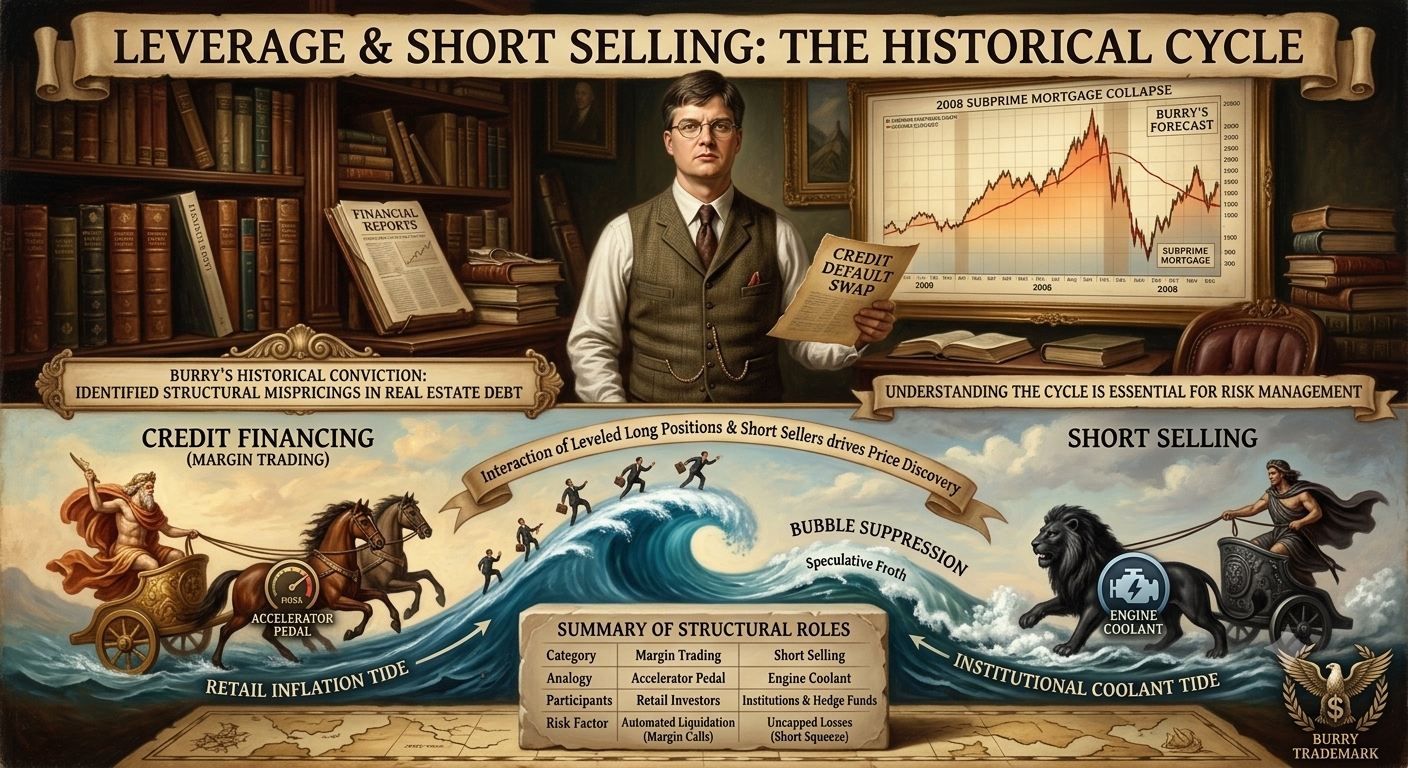
A classic historical precedent for this dynamic is modern short seller Michael Burry, famous for forecasting the 2008 subprime mortgage collapse depicted in The Big Short. Burry identified severe structural mispricings that the broader market ignored, utilizing credit default swaps to position against overleveraged real estate debt. Just as Burry’s historical short position counterbalanced irrational exuberance in housing markets, short sellers in equity markets systematically target overvalued equities inflated by retail leverage.
2. Core Financial Concepts and Market Analogies1) Credit Financing (Margin Trading)
Margin trading involves borrowing funds from a brokerage firm to purchase equities beyond one’s immediate cash capacity, relying on account equity as collateral.
- Functional Analogy: It acts as an accelerator pedal. While it amplifies gains during sustained upward momentum, it significantly increases downside vulnerability during unexpected market corrections. It is predominantly utilized by retail investors aiming to maximize capital efficiency.
2) Margin Purchase (Short-Term Settlement Credit) A margin purchase is an ultra-short-term extension of credit provided by brokerages to clear equity transactions within a standard settlement window (e.g., T+2 or T+3, depending on the market).
- Functional Analogy: It functions like a short-term store credit agreement requiring full settlement within a very few business days. Due to the tight liquidation timeframe, it introduces significant forced-sale risk if the asset price declines immediately after purchase.
3) Short Selling Short selling is an investment strategy where an investor borrows shares they do not own, sells them on the open market, and later repurchases them at a lower price to return to the lender, profiting from the net difference.
- Functional Analogy: It serves as an engine coolant. By penalizing overvalued equities, short selling helps prevent asset bubbles and realigns stock prices with fundamental corporate earnings. This strategy is primarily executed by institutional investors and foreign hedge funds.
4) Securities Lending (Margin Loans for Shorting) Securities lending represents the formal legal contract through which institutional investors borrow large blocks of shares specifically to execute short-sale orders.
- Functional Analogy: It is comparable to reserving water at a dam before opening the floodgates. An uptick in outstanding securities lending balances indicates that institutional short sellers are accumulating inventory to execute bearish positions.
3. Market Dynamics: Contributions and Risks of Leverage vs. Shorting
Margin trading and short selling represent opposing market forces, yet both serve essential structural roles in maintaining deep and efficient capital markets.
1) Market Contributions (Benefits)
- Enhanced Market Liquidity: Margin trading supplies capital that increases trading volume, facilitating smoother order execution and reducing bid-ask spreads.
- Price Discovery and Bubble Suppression: Short selling exerts downward pressure on stocks trading above their intrinsic value, bringing equity prices back into alignment with underlying financial metrics.
- Corporate Transparency and Risk Warning: Short sellers, including prominent figures like Michael Burry, actively scrutinize corporate balance sheets, uncover accounting irregularities, and expose fundamental vulnerabilities before broader market collapses occur.
2) Market Drawbacks (Risks)
- Amplified Volatility and Margin Calls: Excessive retail leverage creates cascading liquidation risks. If asset values fall below minimum margin requirements, brokerages execute automated forced sales (forced liquidation), triggering sharp market declines.
- Accelerated Downside Momentum: Aggressive short positioning during market downturns can exacerbate investor anxiety, pulling down fundamentally sound equities alongside weaker assets.
- Information Asymmetry: Short selling is dominated by institutional entities with superior access to research, data analytics, and capital, leaving retail investors exposed to asymmetric market conditions.
4. Operational Guide: Executing Margin and Short Transactions
Participating in margin expansion or short hedging requires formal administrative onboarding and adherence to regulatory requirements (which vary by jurisdiction and asset class).
1) Setting Up a Margin Trading Account
- Account Activation: Apply for margin trading capabilities through your brokerage platform or open a designated margin account.
- Credit Limit Assessment: Brokerages typically perform risk profile evaluations to establish credit thresholds aligned with total asset holdings.
- Initial Margin Requirement: Verify the collateral ratio assigned to target securities to determine maximum purchasing power relative to cash reserves.
- Collateral Maintenance: Maintain total account equity above the required maintenance margin. Falling below this threshold triggers margin calls and automated liquidation.
2) Executing Individual Short Sales (Stock Lending Transactions)
- Prerequisite Education/Aptitude: Depending on the jurisdiction and platform, mandatory educational courses or aptitude tests regarding short-selling risks may be required.
- Borrowing shares: Before initiating a short sale, the investor must first borrow the shares from a lender (often facilitated by the broker) to satisfy settlement requirements (the “locate” requirement).
- Collateral and Interest: The borrower must post collateral and pay interest on the borrowed securities to the lender.
- Repurchase and Return: Investors are liable for dividend distributions made during the loan term and must repurchase the shares and return them to the lender within the agreed timeframe.
5. Strategic Portfolio Management in Volatile Environments
When benchmark indices reach historical highs while macroeconomic uncertainty remains elevated, strategic capital preservation becomes critical.
- Eliminate Unhedged Short-Term Credit: Macroeconomic uncertainty and market shifts can rapidly alter sentiment. Overleveraged positions face immediate forced liquidation if volatility spikes unexpectedly.
- Monitor Short Interest Balances: Consistently track elevated short interest in individual holdings. High short concentration signals that institutional investors anticipate structural price declines or earnings contractions.
- Prioritize Cash Reserves: Maintaining adequate cash balances provides essential downside protection. Preserving capital ensures liquidity to acquire quality assets at discounted valuations during market corrections.
6. Structural Comparison Table
| Category | Margin Trading (Credit Financing) | Short Selling (Securities Lending) |
| Core Analogy | Incoming Tide pushing asset prices higher. | Outgoing Tide draining speculative froth. |
| Mechanical Analogy | Accelerator Pedal (amplifying momentum). | Engine Coolant (preventing structural overheating). |
| Primary Participants | Retail Investors seeking capital amplification. | Foreign Institutions and Hedge Funds. |
| Primary Risk Factor | Automated forced sales triggered by collateral maintenance breaches. | Theoretically uncapped losses if equity prices rally indefinitely. |
Conclusion: Key Takeaways
Risk Management Imperative: Navigating turbulent markets requires strict leverage control, regular tracking of institutional short balances, and maintaining cash reserves to absorb macroeconomic shocks.1. The History and Evolution of Market Leverage and Shorting
Dual Forces in Market Cycles: High-valuation environments trigger simultaneous spikes in retail debt expansion and institutional short hedging, resulting in heightened price volatility.
Insights from Historical Short Sellers: As demonstrated by Michael Burry’s position against subprime debt, institutional shorting focuses on identifying overleveraged asset bubbles and structural financial weaknesses.