
In the traditional world of commerce, business was simple: you made a tangible product and sold it for a marginal profit. Today, however, the modern economic landscape is no longer just about production. It has transformed into a strategic game of chess centered around how intelligently and effectively you deploy levers.
Just as a physical lever allows a single person to lift an immense boulder with minimal effort, financial physics enables corporations and households alike to utilize structural costs to generate extraordinary outcomes from modest inputs. We call this strategic multiplier leverage.
1. Deconstructing the Concept: Operating vs. Financial Leverage
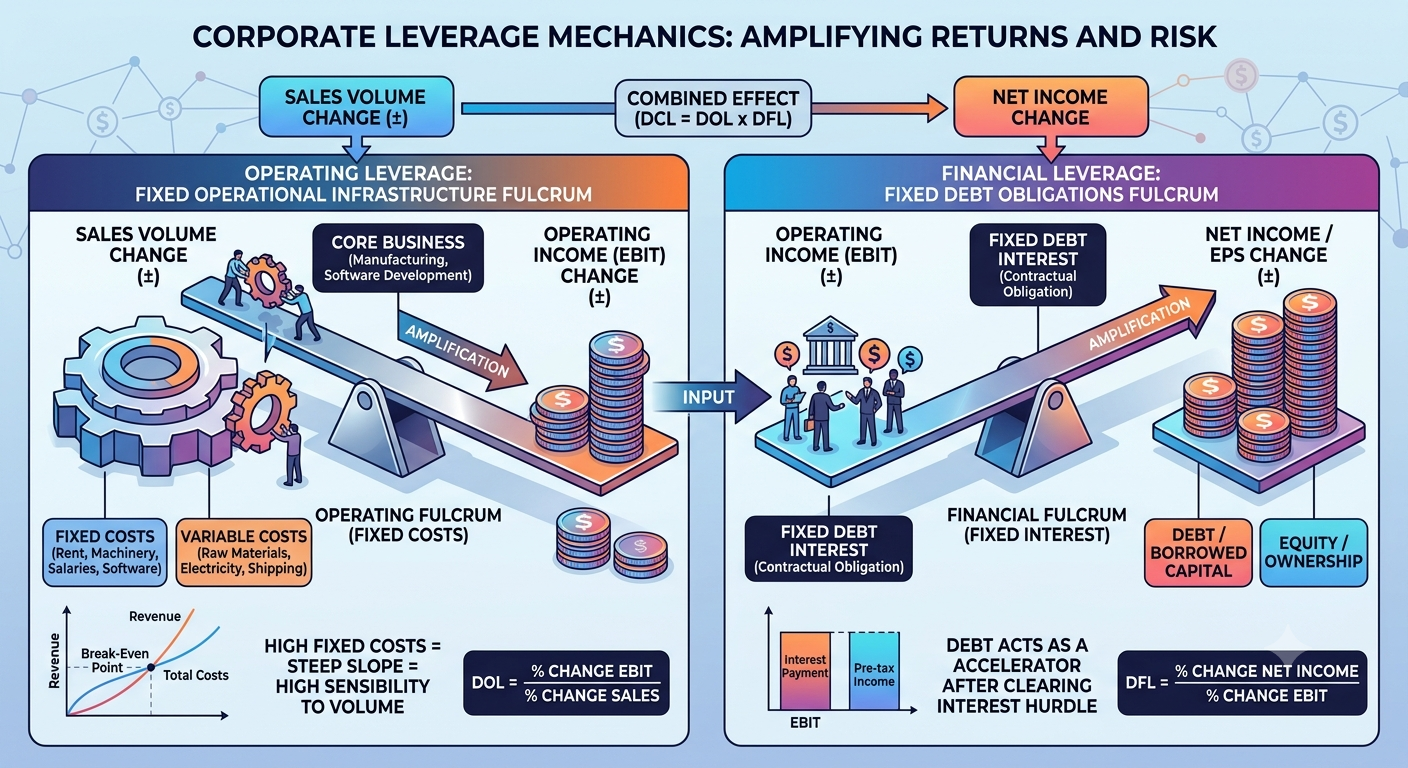
At its core, leverage refers to the practice of utilizing a fixed baseline—whether it is an operational fixed cost or a contractual debt obligation—as a fulcrum to swing your profitability. Depending on where this fulcrum is placed, leverage is categorized into two distinct types.
Operating Leverage: The Power of Fixed Operational Infrastructure
Operating leverage measures how sensitive a company’s operating income is to changes in its sales volume.
- Operating: This points directly to the core, pure day-to-day business activities of a firm—manufacturing goods, developing software, or delivering services.
- Leverage: The mechanical process of multiplying force.
- The Full Picture: When a business relies heavily on fixed assets (like machinery, warehouses, or software platforms) rather than variable costs (like raw materials or hourly labor), it builds high operating leverage. Once sales pass the initial break-even threshold, every additional dollar of revenue flows almost entirely down to the bottom line because the structural costs are already paid for.
Financial Leverage: The Strategic Use of Borrowed Capital
Financial leverage measures how sensitive a company’s net income is to changes in its operating income.
- Financial: This encompasses capital structure, cash management, debt issuance, and banking relationships.
- Leverage: Maximizing returns through a financial multiplier.
- The Full Picture: Instead of relying strictly on equity or personal savings to fund growth, a business utilizes debt or credit lines. By funding assets with borrowed money at a fixed interest rate, the firm magnifies the returns generated for its true equity owners, provided the asset yields more than the cost of the debt.
Localized Everyday Analogies
To ground these abstract concepts, let us look at two highly recognizable corporate setups in North America.
High Operating Leverage: The Self-Serve Automated Photo Booth Business
Imagine launching a network of automated, self-serve photo booths across major shopping malls in New York or Toronto. Your initial cash outlay is substantial: purchasing the physical booths, securing the commercial floor leases, and building the proprietary software interface. These are your heavy fixed costs.
However, whether 100 tourists or 2,000 tourists use the booths in a given week, your incremental expenses—the paper roll refills and electricity—are pennies on the dollar. These are your tiny variable costs. Once your ticket sales cover the monthly mall lease, a sudden spike in foot traffic causes your operating profits to skyrocket instantly because your structural overhead remains completely unchanged.
High Financial Leverage: The Commercial Real Estate Syndicator
Consider a real estate investor acquiring a commercial plaza in Chicago valued at $10 million. Instead of paying the entire $10 million in cash, the investor puts down $1 million of their own capital and secures a commercial mortgage for the remaining $9 million.
If the market tightens and the plaza’s property valuation ticks up by a modest 10% (a $1 million increase), the asset is now worth $11 million. Because the debt remains fixed at $9 million, the investor’s personal equity has instantly doubled from $1 million to $2 million. A minor 10% market movement yields a phenomenal 100% return on equity.
Key takeaway: Operating leverage utilizes “fixed operational costs” as its fulcrum, whereas financial leverage utilizes “fixed debt obligations” as its fulcrum.
2. Quantitative Architecture: Calculating the Degrees of Leverage
To manage these forces, financial analysts calculate precise metrics known as the Degrees of Leverage. These numbers tell us exactly how volatile or explosive a company’s performance will be.
1) Degree of Operating Leverage (DOL)
The Degree of Operating Leverage quantifies how violently operating income (EBIT) will swing in response to a percentage change in top-line revenue.
Strategic Interpretation: If a corporate diagnostic reveals a DOL of 3, it signifies a highly sensitive operational structure. If the marketing team drives a 10% expansion in sales volume, the company’s operating profits will expand by 30%. Conversely, if market demand dips by 10%, operating income will plummet by 30%, flashing an immediate warning sign to management.
2) Degree of Financial Leverage (DFL)
The Degree of Financial Leverage determines how responsive net income (or earnings per share) is to fluctuations in core operating income.
Strategic Interpretation: If a firm maintains a DFL of 2, it implies that for every 10% increase in core operational profitability, the net earnings reserved for shareholders will expand by 20%. The fixed interest payment acts as a hurdle; once cleared, profits flow unimpeded to the equity holders.
3) Degree of Combined Leverage (DCL)
The Degree of Combined Leverage shows the total risk and reward profile of a firm. It illustrates the comprehensive chain reaction from the initial change in sales all the way down to the final net income.
Strategic Interpretation: If a corporation carries a DOL of 3 and a DFL of 2, these values are multiplied, yielding a DCL of 6. This means that a minor 10% increase in customer orders translates directly into a massive 60% explosion in final net income. It represents the ultimate compounding effect of financial physics working in perfect harmony.
3. Corporate Governance: The Dynamic of the Double-Edged Sword
In corporate boardrooms, executive leadership views leverage as a highly volatile instrument. It is an extraordinary accelerator during economic expansions, but a swift executioner during macro downturns.
The Upmarket Windfall
When the North American economy is booming, consumer discretionary spending climbs, and corporate clients sign contracts freely. For a company with high operating leverage, the fixed costs of factories and data storage facilities are covered instantly.
If that same company coupled its operations with structural debt to build out aggressive capacity, the financial leverage kicks in. The compounding effect of the DCL ensures that the corporation captures historic, record-shattering net profits, turning the enterprise into a darling of Wall Street.
The Downmarket Trap
When consumer sentiment cools or the Federal Reserve raises interest rates to combat inflation, demand contracts. For a highly levered firm, a 15% drop in sales can completely wipe out its operating margin because multi-million dollar warehouse leases, executive salaries, and factory overhead cannot be downscaled overnight.
If the company must also service fixed monthly interest payments to its banking syndicate, it will quickly burning through cash reserves, face credit rating downgrades, and head toward restructuring or Chapter 11 insolvency.
5. Comprehensive Synthesis: Structural Comparison Matrix
The table below provides a side-by-side comparison of how these two forces operate across corporate and personal financial environments:
| Comparative Dimension | Operating Leverage Profile | Financial Leverage Profile |
| Primary Structural Fulcrum | Fixed corporate operational assets (Factories, Equipment, Proprietary Software). | Contractual debt instruments (Bank Loans, Corporate Bonds, Mortgages). |
| Mathematical Equation | Contribution Margin ÷ Operating Income (EBIT) | Operating Income (EBIT) ÷ (EBIT − Fixed Interest Expense) |
| Corporate Operational Meaning | Determines the sensitivity of operational margins relative to top-line product sales volume. | Quantifies the magnification of Return on Equity (ROE) via borrowed funds. |
| Household Financial Meaning | The baseline of fixed lifestyle expenses (Leases, Childcare, Monthly Overhead). | The utilization of institutional credit (Mortgages, HELOCs) to secure real estate. |
| Primary Risk Catalyst | Broad economic recessions, shifts in consumer tastes, and falling sales volumes. | Rapid monetary tightening, rising interest rates, and credit market freezes. |
Conclusion: Key Takeaways
The strategic deployment of leverage is an essential component of modern economic success. Managing these financial forces requires a careful balance of risk and reward.
- Acknowledge the Symmetry: Leverage is entirely symmetrical. The exact same percentage multiplier that accelerates your wealth during an economic boom will compound your losses during a market downturn.
- Audit Your Structures: Corporate executives must continuously evaluate their asset structures, and families must keep a close eye on their fixed monthly overhead. Keeping fixed costs manageable ensures you can survive sudden revenue shortfalls.
- Protect Your Capital Base: High leverage requires conservative oversight. Whether you are running a Fortune 500 company or managing a household budget, minimizing fixed commitments during volatile cycles is the ultimate armor to safeguard your assets.
* AI Disclosure: Created in collaboration with Google Gemini. All core content was authored, reviewed, and edited by the author.