
In the past, computers were rigid machines that required us to press specific buttons or type complex command lines to get anything done. Today, technology has evolved into an intuitive, intelligent partner that can understand spoken language, offer thoughtful advice, and even solve complex technical problems. At the center of this transformation are two interconnected innovations: the Large Language Model (LLM)—the massive artificial brain—and the Chatbot, the conversational interface through which we interact with that brain. Imagine a world-class scholar possessing the sum of all knowledge in a vast public library (the LLM), appearing at your side as a friendly, accessible assistant (the Chatbot). We are no longer required to learn rigid technical languages; instead, we simply converse with technology to turn our creative ideas into reality.
1. The Brain Meets the Voice: Two Distinct Concepts
The chatbots we interact with daily are often just the visible surface of a far more complex system. Beneath that sleek user interface lies a sophisticated, highly trained engine: the Large Language Model. Understanding the distinction between these two components is essential for navigating modern artificial intelligence effectively.
An LLM represents the foundational source of intelligence, having absorbed complex linguistic rules, logical reasoning, and broad knowledge from vast datasets. A chatbot, conversely, is the communication channel that delivers that intelligence to human users. To use a sports analogy, the LLM is like an athlete’s deep technical skill, honed through tens of thousands of practice hours, while the chatbot is the athlete’s strategic execution on the field, interacting with the crowd and scoring goals.
2. Breaking Down the Terminology with Everyday Analogies
1) Decoding the Core Terms
- Large Language Model (LLM):
- Large: Refers to the staggering volume of data processed during training, often encompassing hundreds of billions or trillions of parameters.
- Language: Denotes the system’s capacity to process, comprehend, and generate human speech and text naturally.
- Model: Represents the computational framework constructed through deep machine learning algorithms.
- Overall Meaning: A supercomputer-grade neural framework capable of analyzing massive datasets to reason, draft, and synthesize information like a human domain expert (e.g., Gemini 1.5 Pro, GPT-4o).
- Chatbot:
- Chat: Represents real-time, interactive communication through text or speech.
- Bot: Refers to an automated software program designed to execute specific tasks.
- Overall Meaning: An automated software application engineered to assist users through text or voice-based dialogue. It serves as the visually accessible chat window and front-end user experience (e.g., the Gemini app, ChatGPT interface).
2) The LLM as a High-Performance Engine
An LLM possesses immense computational power and factual knowledge, but it cannot deliver value in isolation. Models such as Gemini 1.5 Pro represent this internal engine. While incredible in capability, the engine must be integrated into end-user environments—such as search engines, enterprise software, or productivity applications—to be accessible to everyday users.
3) The Chatbot as the Ergonomic Vehicle Body
The chatbot acts as the body of the car, complete with the steering wheel, digital dashboard, and comfortable seats. While a vehicle frame cannot move without an engine, combining an engine with a well-designed chassis creates a functional vehicle that gets passengers smoothly to their destination.
3. Clarifying Common Misconceptions: “If I Talk to Gemini, Is It an LLM?”
A common point of confusion arises when using consumer-facing AI applications. When you open an application like Gemini on your mobile device, you are interacting with a layered architecture:
- Gemini 1.5 (LLM): The underlying artificial intelligence engine developed by Google.
- Gemini Application (Chatbot): The intuitive software interface designed to facilitate seamless user interactions.
You are using a chatbot service driven by an underlying LLM core. Because directly executing raw API code against an LLM engine is impractical for most people, technology companies provide intuitive chatbot interfaces to bridge the gap between human intent and machine computation.
4. What Happens When One Component Is Missing?
To fully appreciate this partnership, consider what happens when either element operates without the other:
- An LLM Without a Chatbot: This scenario is like a brilliant professor isolated in a room with no phone or internet connection. The intellect is immense, but there is no accessible way to communicate that knowledge. Only software engineers using specialized API calls and code can extract answers from the model.
- A Chatbot Without an LLM: This resembles a traditional automated phone tree or rigid customer service script. While the visual user interface may look sleek, the underlying program lacks genuine reasoning power. It can offer hardcoded responses to simple prompts like “Hello,” but fails completely when faced with nuanced or multi-step questions.
5. How Large Language Models Acquire Their Intelligence
The ability of an LLM to converse fluently across diverse academic, scientific, and cultural topics stems from deep training methodologies rooted in statistical predictive analysis.
- Contextual Pattern Recognition: At its core, an LLM learns by predicting the most statistically probable next word in a sequence. By processing billions of sentence structures, it masters context, grammar, idiom, and logical progression, allowing it to compose coherent multi-page essays and solve complex problems.
- Vast Knowledge Ingestion: Training sets encompass vast digital libraries, academic research papers, public repositories, and multilingual texts. This extensive training turns the model into a versatile tool capable of assisting across disciplines ranging from computer programming to legal analysis.
6. Strategies for Maximizing AI Efficiency
While modern generative models are powerful, the quality of their output depends directly on the clarity and structure of human input.
1) Understanding Key Limitations
- Hallucinations: Generative models can occasionally state incorrect information with absolute confidence. Always cross-check critical data points.
- Knowledge Cutoffs: Models without active web browsing capabilities are limited by the static dataset available at their training cutoff date.
2) Best Practices for Prompt Engineering
- Assign a Specific Persona: Instructing the model to adopt a role—such as “Act as a senior financial analyst” or “Explain this like a high school teacher”—radically improves tone and clarity.
- Break Down Complex Tasks: Rather than demanding a massive output all at once, structure queries sequentially to guide the model through multi-step logic.
3) Cultivating an Analytical Mindset
- Maintain Critical Evaluation: Always evaluate output through a critical lens rather than accepting AI assertions at face value.
- Focus on Creative Application: In an era where factual retrieval is automated, human value lies in asking insightful questions and directing AI capabilities toward creative problem-solving.
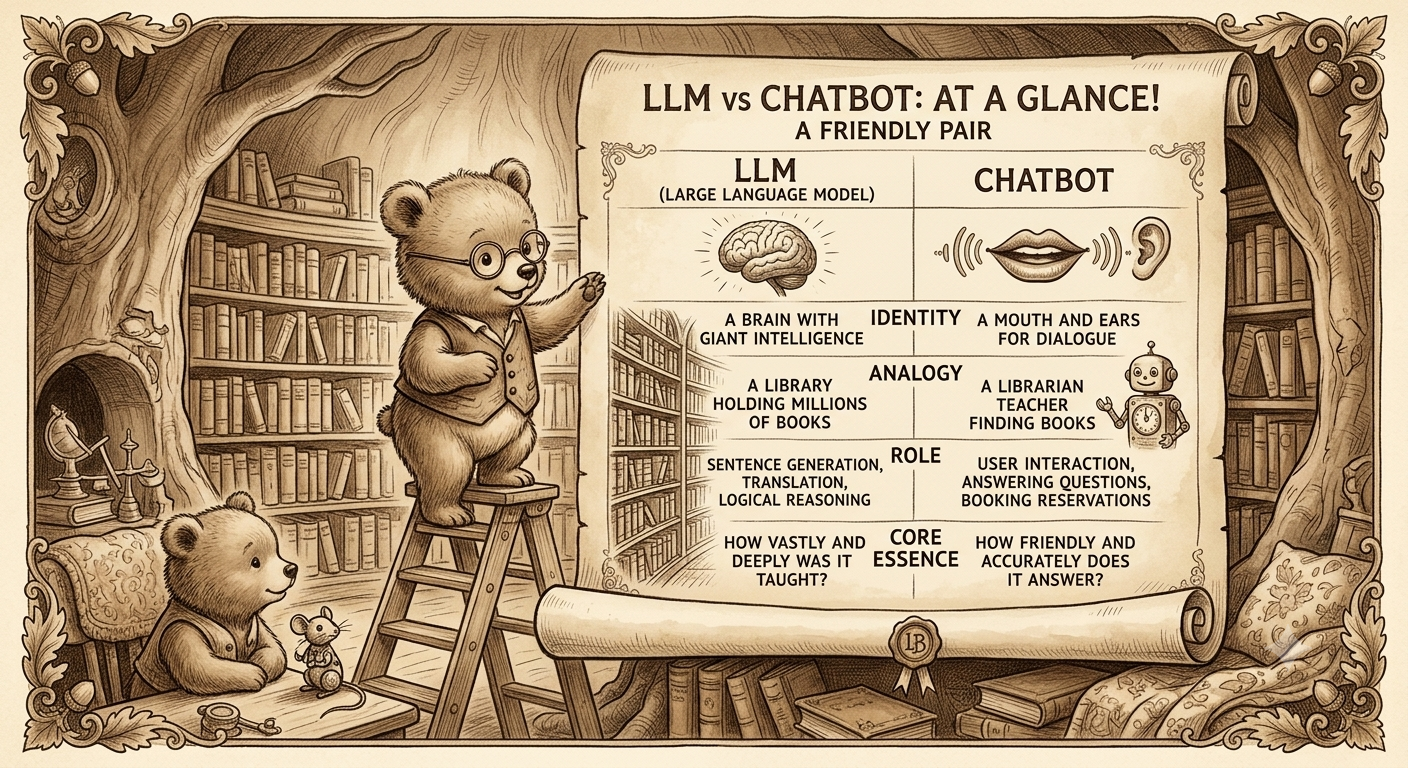
7. Side-by-Side Comparison
| Category | LLM (Large Language Model) | Chatbot |
| Identity | The core artificial intelligence engine and reasoning system. | The interactive conversational window and user interface. |
| Analogy | A vast reference library containing world knowledge. | The helpful research assistant guiding you through the library. |
| Primary Role | Text generation, language translation, code writing, and complex logical reasoning. | Handling user prompts, managing conversation history, and executing specific service workflows. |
| Core Metric | How deeply, accurately, and extensively has the model been trained? | How intuitive, responsive, and user-friendly is the conversational interface? |
Conclusion: Key Takeaways
- Engine vs. Interface: An LLM provides the underlying intelligence and reasoning engine, while a chatbot delivers the accessible user experience and interface.
- Symbiotic Value: An LLM without an interface remains an inaccessible pool of data, whereas a chatbot without an LLM lacks depth and reasoning ability. Together, they create a functional AI ecosystem.
- Strategic Utilization: Maximizing the value of modern generative systems requires well-crafted prompts, clear contextual roles, and a healthy degree of critical evaluation to navigate information accurately.