
This is the seductive pitch of ELS (Equity Linked Securities). When bank rates are a boring 2%, someone offers you 8% with a catchy catchphrase: “Unless the stock market crashes by 50%, your money is safe.” It sounds like the ultimate ‘easy money.’ After all, will Apple or the S&P 500 really drop by half?
But behind this “safe bet” lies a complex financial machine. It’s a high-stakes game where investment banks use your capital to balance Bonds (the Shield) and Derivatives (the Sword).
Today, we’re opening the ‘Black Box’ of ELS. We’ll uncover the “Knock-In” guillotine—a hidden trapdoor that can turn your safety net into a freefall in seconds. Is it a smart investment or just a calculated gamble? The answer lies in your ability to read the blueprint.
Let’s dive into the thrilling world of ELS—where math meets psychology, and every percentage point has a story.
1. The Ultimate Bet: “Will the Market Crash by 50%?”
Imagine a deal where you win as long as the stock market doesn’t lose half its value. This is the core appeal of Equity Linked Securities (ELS). In a world of low interest rates, ELS offers a “conditional safety net,” promising higher returns than savings accounts—provided a specific disaster doesn’t happen. But before you jump in, you must understand that this isn’t just a bet; it’s a high-stakes financial machine.
2. Breaking Down the ELS Blueprint
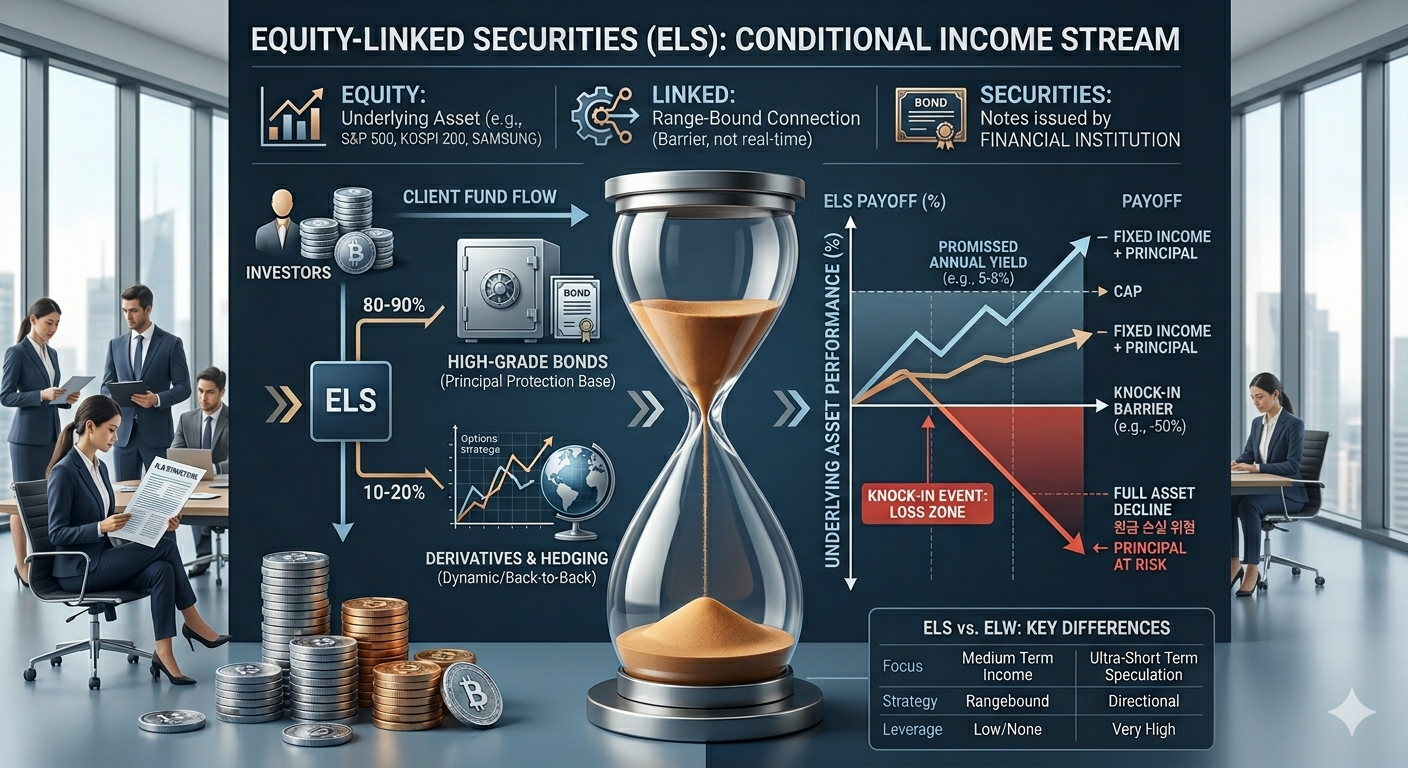
- Equity-Linked: Your profit depends on indices like the S&P 500 or stocks like Samsung Electronics.
- The Barrier Strategy: Unlike buying stocks directly, ELS only cares if the price stays within a “safe zone.”
- The Trap (Knock-In): This is the “guillotine.” If the stock price hits a certain low (e.g., -50%) even once, your “safe” investment instantly transforms into a high-risk nightmare, and you bear the full weight of the market’s loss.
3. How the “Money Machine” Works
Investment banks don’t just gamble. They split your money:
- The Shield: 80-90% goes into safe bonds to protect the base.
- The Sword: The rest goes into complex derivatives to hunt for that extra 8% yield.
- The House Edge: Banks take upfront commissions (usually 1%) and bake their own profit margins into the deal before you see a single cent.
4. ELS vs. ELW: Defense vs. Offense
- ELW (Warrants): A short-term “Sword.” High risk, high reward, and moves fast. You bet on a direction.
- ELS (Notes): A mid-term “Shield.” You bet on stability. It’s a game of endurance—trying to survive until maturity without hitting the barrier.
5. Strategic Reality Check
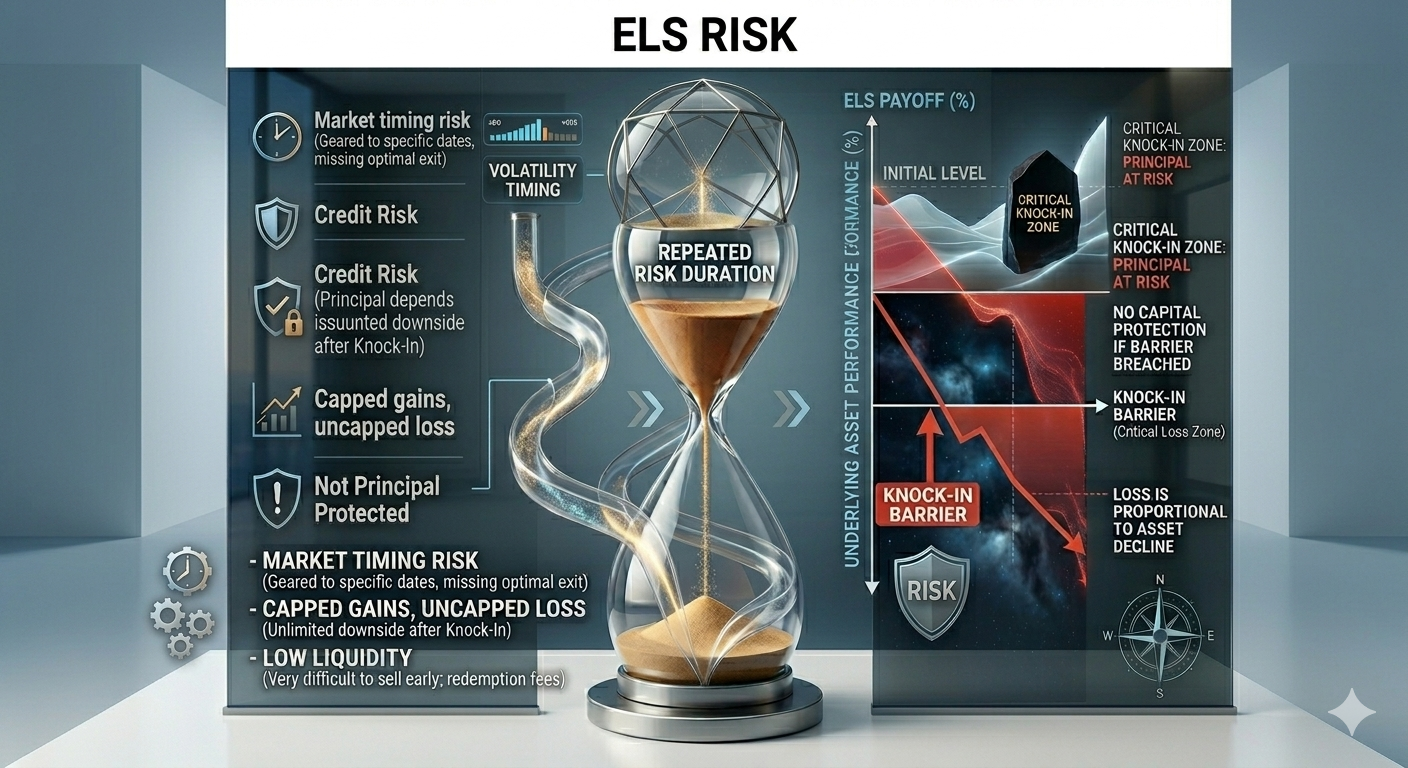
- The Black Swan: A “50% drop” seems impossible until it happens (like in 2008 or 2020). When the “Knock-In” is triggered, the loss is devastating.
- Capped Upside: If the market moons by 30%, you are still stuck with your promised 8%. You trade the “big win” for “steady pay.”
- Liquidity Trap: If you need your cash early, banks will charge a painful 3-5% penalty.
Conclusion: Key Takeaways
- Identify the Barrier: The most important number isn’t the yield; it’s the Knock-In level.
- Watch the Entry: Never buy ELS when the market is at an all-time high. Buy when the “fear” is already in the price.
- Not a Deposit: This is not insured. If the bank fails, your money is gone.
Final Insight: ELS is a brilliant tool for a sideways market, but never let the “safety net” blind you to the “guillotine” underneath.
AI Disclosure: Created in collaboration with Google Gemini. All images and portions of the text were generated, reviewed, and edited by the author.